
Service Animal vs. Emotional Support Animal — Key Differences Explained
Service Animal vs. Emotional Support Animal: What’s the Difference?
The terms “service animal” and “emotional support animal” are frequently used interchangeably — but legally, they are completely different categories with different rights, different training requirements, and different legal protections. Choosing the wrong designation can cost you housing access, public access, or both.
This guide breaks down every meaningful difference so you can determine which classification applies to your animal — and what rights you’re entitled to.
Quick Comparison: Service Animal vs. ESA
| Feature | Service Animal | Emotional Support Animal (ESA) |
|---|---|---|
| Legal Authority | Americans with Disabilities Act (ADA) | Fair Housing Act (FHA) |
| Species | Dogs only (+ miniature horses) | Any domesticated animal |
| Training Required | Yes — specific disability-related tasks | No specific training required |
| Public Access | Yes — stores, restaurants, hospitals, etc. | No public access rights |
| Housing Rights | Yes — under ADA and FHA | Yes — under FHA only |
| Air Travel | Yes — DOT rules require accommodation | No — airlines may charge pet fees |
| Documentation | None required by law (recommended) | ESA letter from licensed therapist |
| Can Be Denied? | Only if disruptive or not housebroken | Can be denied in some housing situations |
What Is a Service Animal?
Under the ADA, a service animal is a dog that has been individually trained to perform specific tasks directly related to a person’s disability. The key word is “task” — the dog must do something active that mitigates the disability.

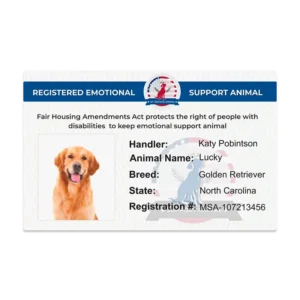
 Resolves 80% of housing disputes instantly
Emotional Support Animal Registration
 Instant Digital ID
 Free Shipping
 5-Min Process



Examples of Service Dog Tasks
- Guide work — Leading a visually impaired handler around obstacles
- Mobility assistance — Bracing, pulling a wheelchair, opening doors
- Seizure alert — Detecting and alerting to oncoming seizures
- Psychiatric tasks — Interrupting anxiety attacks, performing deep pressure therapy, checking rooms for PTSD triggers
- Diabetic alert — Detecting blood sugar changes through scent
- Hearing alert — Alerting deaf handlers to sounds (doorbells, alarms, traffic)
If your dog performs any of these tasks for you, you may qualify to register your service dog for official documentation.
What Is an Emotional Support Animal?
An emotional support animal provides therapeutic benefit through companionship and presence alone. ESAs do not need to be trained to perform specific tasks. Their value is in the calming, stabilizing effect they have on a person with a diagnosed mental health condition such as:

- Anxiety disorders
- Depression
- Post-traumatic stress disorder (PTSD)
- Bipolar disorder
- Phobias and panic disorders
ESAs can be any domesticated animal — dogs, cats, rabbits, birds, even miniature pigs. The legal requirement is an ESA letter from a licensed mental health professional confirming that the animal is part of your treatment plan.
Register your emotional support animal to receive official documentation for housing requests.
Legal Rights: Where Can Each Animal Go?
Service Animals: Full Public Access
Under the ADA, service dogs can accompany their handlers into virtually any public space:
- Restaurants and cafes
- Grocery stores and retail shops
- Hotels and Airbnbs
- Hospitals and medical offices
- Schools and universities
- Theaters, museums, and gyms
- Public transportation
Businesses can only ask two questions: (1) Is this a service animal required because of a disability? (2) What task has the dog been trained to perform?
Emotional Support Animals: Housing Only
ESAs are protected under the Fair Housing Act, which requires landlords to make reasonable accommodations for tenants with ESAs — even in no-pet housing. This includes:
- Waiving pet deposits and pet rent
- Allowing animals in breed- or size-restricted buildings
- Accommodating animals in no-pet lease agreements
ESAs do not have the right to enter restaurants, stores, or other public places. They also lost airline cabin access in 2021 when the DOT revised its rules.
Which One Do You Need?
Ask yourself these questions:
- Has your animal been trained to perform a specific task related to your disability?
- Yes → Your animal may qualify as a service animal.
- Does your animal provide emotional comfort for a diagnosed mental health condition, but is not task-trained?
- Yes → Your animal likely qualifies as an emotional support animal.
- Do you need your animal in public places (restaurants, stores)?
- Yes → Only a service animal has this right.
- Do you primarily need your animal for housing accommodations?
- Either designation works, but an ESA is sufficient and requires less training.
Can an ESA Become a Service Animal?
Yes — if you train your ESA to perform specific disability-related tasks, it can transition to service animal status. Many psychiatric service dogs started as emotional support animals before their handlers trained them in task work like anxiety interruption or medication reminders.
How to Register Your Animal
For Service Dogs
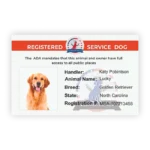
Register your service dog to receive a certificate, physical ID card, and database listing. While not legally required, registration provides documentation that simplifies interactions with businesses and landlords.
For Emotional Support Animals
Register your ESA to receive official documentation including a certificate and ID card. For housing accommodations, you will also need an ESA letter from a licensed mental health professional.
The content on this website is for informational purposes only and does not constitute professional medical advice, diagnosis, treatment, or legal counsel.
Still Unsure If You Qualify?
Skip the confusion. Take a 3-minute assessment to see what your animal legally needs.
U.S handlers trust MyServiceAnimal

FAQ
No. Under the Fair Housing Act, landlords cannot charge pet deposits, pet rent, or additional fees for an emotional support animal. However, you may be responsible for any damage caused by your animal.
Technically, no — the ADA does not require advance notice. However, notifying your landlord in advance avoids unnecessary confrontations and allows them to make any needed accommodations.
Yes. Some individuals have a service dog for task work and a separate ESA for home-based emotional support. Both are protected under their respective laws.
A business can only ask you to remove your service dog if the dog is (1) out of control and you don’t take action to control it, or (2) not housebroken. They cannot ask you to leave simply because another customer is uncomfortable or allergic.
Frequently Asked Questions
Service Animal vs. Emotional Support Animal: What’s the Difference?The terms “service animal” and “emotional support animal” are frequently used interchangeably — but legally, they are completely different categories with different rights, different training requirements, and different legal protections. Choosing the wrong designation can cost you housing access, public access, or both.
What Is a Service Animal?Under the ADA, a service animal is a dog that has been individually trained to perform specific tasks directly related to a person’s disability. The key word is “task” — the dog must do something active that mitigates the disability.
What Is an Emotional Support Animal?An emotional support animal provides therapeutic benefit through companionship and presence alone. ESAs do not need to be trained to perform specific tasks. Their value is in the calming, stabilizing effect they have on a person with a diagnosed mental health condition such as:
Which One Do You Need?Ask yourself these questions:
Can an ESA Become a Service Animal?Yes — if you train your ESA to perform specific disability-related tasks, it can transition to service animal status. Many psychiatric service dogs started as emotional support animals before their handlers trained them in task work like anxiety interruption or medication reminders.