Acquiring an ESA in the state of Arizona
Arizona is one of the more ESA-friendly states in the country — but recent federal changes have created new questions for tenants, students, and pet owners across the Grand Canyon State. Whether you’re renting in Phoenix, moving into a dorm at ASU, or just trying to understand your rights with an emotional support animal, this guide breaks down every law, statute, and policy that applies to you in 2026.
We’ll cover everything from your federal housing protections under the Fair Housing Act to Arizona-specific statutes like A.R.S. § 11-1024 and the critical May 2026 HUD enforcement memo that has shaken up ESA protections nationwide. If you live in Arizona and have (or want) an emotional support animal, this is the article you need to read. For a broader look at how different states handle these rules, check out our ESA laws by state hub page.
What Is an Emotional Support Animal Under Arizona Law?
An emotional support animal (ESA) is a companion animal that provides therapeutic benefit to a person with a mental health or emotional disability. Unlike service animals, ESAs are not trained to perform specific tasks. Instead, their presence alone helps reduce symptoms of conditions like anxiety, depression, PTSD, and other qualifying disorders.
Under federal law — specifically the Fair Housing Act (42 U.S.C. §§ 3601–3619) — ESAs are classified as “assistance animals.” This distinction matters because it separates them from both pets and trained service animals, giving them a unique legal standing when it comes to housing.
Arizona does not have a standalone state ESA statute. Instead, ESA protections in Arizona come from the federal FHA and the state’s own fair housing law found in A.R.S. Title 41, Chapter 9, Article 7 (§§ 41-1491 through 41-1491.37). The state law mirrors the federal FHA and is enforced by the Arizona Attorney General’s Civil Rights Division.
ESA vs. Service Animal vs. Therapy Animal
One of the biggest sources of confusion — and the root of many denied accommodation requests — is mixing up these three categories. They are not interchangeable, and each carries very different legal rights in Arizona.
| Category | Emotional Support Animal (ESA) | Service Animal | Therapy Animal |
|---|---|---|---|
| Legal Protection | Fair Housing Act (housing only) | ADA + AzDA (public access) + FHA (housing) | No federal or state legal protections |
| Training Required | No specific training required | Individually trained to perform specific tasks | Basic obedience and socialization training |
| Species | Any species (dog, cat, bird, rabbit, etc.) | Dog or miniature horse only (ADA/AzDA) | Typically dogs, sometimes cats or rabbits |
| Housing Rights | Protected — no pet fees, breed/size waivers | Protected — no pet fees, breed/size waivers | No housing protections |
| Public Access | None — treated as pets in public | Full access to all public accommodations | Only where specifically invited |
| Air Travel | No protections since Jan 2021 — treated as pet | Protected under ACAA — must be in cabin | No protections — treated as pet |
| Workplace | No legal right — employer may voluntarily allow | Protected under ADA Title I | No legal right |
| Documentation | ESA letter from licensed mental health professional | No documentation required for public access | Handler certification through organization |
| AZ Fraud Penalty | N/A | Up to $250 per violation (A.R.S. § 11-1024) | N/A |
If you’re dealing with anxiety or another emotional condition, an ESA may be the right fit — but understanding which category your animal falls into determines exactly what rights you have.
Which Conditions Qualify for an ESA in Arizona?
There is no fixed list of qualifying conditions. Under the FHA, any disability that “substantially limits one or more major life activities” may qualify. In practice, licensed mental health professionals in Arizona commonly write ESA letters for conditions including:
- Generalized anxiety disorder
- Major depressive disorder
- Post-traumatic stress disorder (PTSD)
- Panic disorder
- Social anxiety disorder
- Obsessive-compulsive disorder (OCD)
- Bipolar disorder
- Phobias and specific anxiety conditions
- Chronic stress-related disorders
The determination is made by a licensed professional who evaluates whether your condition rises to the level of a disability and whether an ESA would alleviate its symptoms. Learn more about the process in our guide on how to get an ESA letter from a doctor.
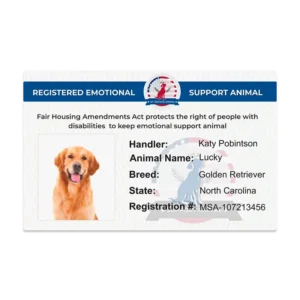
If you already have an ESA letter and want to make your animal’s status visible and official, registering your emotional support animal is a practical next step. Registration provides you with a certificate, ID card, and optional gear like a vest — all of which can make day-to-day interactions with landlords and property managers much smoother.

 Resolves 80% of housing disputes instantly
Emotional Support Animal Registration
 Instant Digital ID
 Free Shipping
 5-Min Process


Arizona ESA Housing Rights Under the Fair Housing Act

Housing is where ESA owners in Arizona hold the strongest legal ground. The federal Fair Housing Act (42 U.S.C. §§ 3601–3619), combined with Arizona’s own fair housing statutes (A.R.S. §§ 41-1491 through 41-1491.37), creates a two-layer shield of protection for qualified ESA owners.
These laws apply to nearly all rental housing in Arizona — apartments, condos, townhomes, single-family rentals managed by brokers, and even HOA-governed communities. If you’re renting an apartment with an ESA, here’s exactly what your landlord is legally required to do — and what they cannot do.
What Landlords Must Do for ESA Owners
| Landlord Obligation | Legal Basis |
|---|---|
| Waive no-pet policies for verified ESAs | FHA reasonable accommodation + A.R.S. § 41-1491.19 |
| Waive breed, size, and weight restrictions for ESAs | FHA reasonable accommodation |
| Waive pet deposits, pet rent, and pet fees for ESAs | FHA — ESAs are not pets |
| Engage in an interactive process to evaluate accommodation requests | FHA + HUD guidance |
| Provide a timely response to ESA accommodation requests | FHA reasonable accommodation procedures |
Want to learn more about avoiding those extra charges? Read our breakdown of how to avoid pet fees at apartments with an ESA.
What Landlords Cannot Do
- Demand your full medical records or detailed diagnosis
- Require proof of specific task training for your ESA
- Ask for a registration certificate, ESA ID, or “official” registry documents as a condition of approval
- Charge any pet-related fees, deposits, or additional rent for the ESA
- Apply blanket breed bans or weight limits to your ESA
- Retaliate against you for requesting an ESA accommodation
- Refuse to accept a valid ESA letter from a telehealth provider licensed in Arizona (or authorized to practice there via telehealth)
If a landlord crosses any of these lines, that may constitute housing discrimination. Our article on when a landlord can deny an ESA covers the exact situations where denial is (and isn’t) lawful.
When a Landlord Can Legally Deny Your ESA
ESA protections are strong, but they are not unlimited. A landlord in Arizona may legally deny your ESA accommodation request in a narrow set of circumstances:
- Direct threat: The specific animal (not its breed or species) has a documented history of dangerous behavior that poses a direct threat to the health or safety of others, and that threat cannot be reduced through reasonable conditions.
- Substantial property damage: The specific animal would cause substantial physical damage to the property beyond normal wear and tear.
- Invalid or missing documentation: You cannot provide a valid ESA letter from a licensed mental health professional when reasonably requested (and your disability is not readily apparent).
- FHA-exempt property: The housing falls under one of the Fair Housing Act’s narrow exemptions.
FHA Exemptions: Which Properties Are Not Covered?
Most Arizona rental properties are covered by the FHA, but a few narrow exemptions exist:
- Owner-occupied buildings with four or fewer rental units
- Single-family homes rented without a real estate broker, where the owner has three or fewer such properties
- Housing run by religious organizations restricted to members of that religion (non-commercial)
- Private clubs with lodging limited to their own members
Even if a property qualifies for an FHA exemption, Arizona’s state fair housing law (A.R.S. § 41-1491.19) may still apply. When in doubt, consult the Arizona Attorney General’s Civil Rights Division.
May 2026 HUD Enforcement Memo: What Changed for Arizona ESA Owners
On May 22, 2026, the U.S. Department of Housing and Urban Development (HUD) issued an enforcement memo that has sent ripples through the ESA community. This is the single most significant policy shift affecting ESA owners in over a decade, and every Arizona resident with an emotional support animal needs to understand it.
What the Memo Says
The May 2026 HUD memo announced that HUD’s Office of Fair Housing and Equal Opportunity (FHEO) will now prioritize reasonable cause determinations only for animals that are individually trained to perform specific work or tasks — essentially aligning HUD’s enforcement priorities with the ADA’s definition of a service animal.
The memo also permanently rescinds HUD’s 2013 and 2020 guidance documents, which had broadly supported housing accommodations for untrained emotional support animals. Going forward, HUD has indicated it will no longer expect housing providers to automatically grant accommodation requests for untrained ESAs. The agency has also stated its intention to pursue formal rulemaking to further update its regulations.
What Has NOT Changed
The Fair Housing Act itself has not been amended. Congress has not changed the statute. No federal court has ruled that ESAs are excluded from the FHA’s protections. The May 2026 memo is a change in HUD’s internal enforcement strategy — it is not a repeal of your legal rights.
Here’s what remains true as of June 2026:
- The FHA text (42 U.S.C. §§ 3601–3619) still defines “handicap” broadly and still requires reasonable accommodations
- State and local laws are not preempted by the HUD memo — Arizona’s own fair housing law (A.R.S. Title 41, Chapter 9, Article 7) remains fully in effect
- Existing tenants with already-approved ESA accommodations should not be immediately affected
- Courts may interpret the FHA differently than HUD’s enforcement memo suggests
- Legal experts widely advise housing providers to proceed with caution before denying ESA requests
What Arizona Residents Should Do Now
If you have an ESA or are considering one, the May 2026 HUD memo makes a few things more urgent:
- Get a proper ESA letter from a licensed mental health professional with a genuine patient-provider relationship — not a five-minute online form
- Keep your documentation current — make sure your letter is dated within the last 12 months and is on professional letterhead
- Know your state-level rights — if HUD declines to investigate your complaint, Arizona’s AG Civil Rights Division is an alternative enforcement avenue
- Document everything — save all communications with landlords regarding your ESA accommodation request
- Consult an attorney or Disability Rights Arizona if your accommodation is denied
The bottom line: this memo shifts enforcement at the federal level, but it does not erase your rights under the FHA statute or under Arizona law. Reviewed by Daniel Butler, who tracks federal ESA policy developments closely.
Arizona-Specific ESA Laws and Protections
Beyond the federal FHA, Arizona has several state-level laws that directly affect emotional support animal owners. These statutes create additional protections — and penalties — that are unique to the Grand Canyon State.
Arizona Fair Housing Law (A.R.S. Title 41, Chapter 9, Article 7)
Arizona’s state fair housing law is codified in A.R.S. §§ 41-1491 through 41-1491.37. A common mistake (even among legal blogs) is citing Article 4 — that section actually covers the Legislative Governmental Mall. The ESA-relevant provisions are in Article 7.
Key sections include:
- § 41-1491.19: Prohibits disability-based discrimination in housing — the most directly relevant section for ESA owners
- § 41-1491.22: Outlines the complaint filing process
- § 41-1491.26: Covers conciliation procedures when a complaint is filed
- § 41-1491.29: Governs reasonable cause determinations by the Attorney General
- § 41-1491.31: Establishes civil action provisions for enforcement
Because the Arizona AG’s office is a Fair Housing Assistance Program (FHAP) partner with HUD, complaints filed at the state level are automatically dual-filed with HUD. This gives you two enforcement paths from a single complaint.
Arizona Service Animal Fraud Law (A.R.S. § 11-1024)
Arizona takes service animal misrepresentation seriously. Under A.R.S. § 11-1024, it is unlawful to knowingly and fraudulently misrepresent an animal as a service animal or service animal in training in a public place. The civil penalty is up to $250 per violation.
A few things to note about this statute:
- It defines a service animal as a dog or miniature horse individually trained to perform specific work or tasks for a person with a disability
- It explicitly excludes emotional support, well-being, comfort, or companionship from qualifying as “work or tasks”
- The fraud provision applies to public places — it is not specifically aimed at ESAs in housing situations
- Businesses are limited to two questions: (1) Is the animal required because of a disability? (2) What task has the animal been trained to perform?
Important correction: Some websites incorrectly cite A.R.S. § 33-1319 as Arizona’s ESA fraud statute. That section actually governs bedbug control in residential properties. The correct service animal fraud law is A.R.S. § 11-1024.
Arizona Breed-Specific Legislation Preemption (A.R.S. § 9-499.04)
Arizona is one of a growing number of states that prohibit breed-specific legislation (BSL). Under A.R.S. § 9-499.04, no city or town in Arizona can enact ordinances that ban or restrict dogs based solely on their breed.
This is a significant protection for ESA owners with breeds commonly targeted by bans — pit bulls, Rottweilers, German Shepherds, Dobermans, and similar breeds. In Arizona, a landlord cannot point to a municipal breed ban as a reason to deny your ESA because no such bans exist.
Additionally, A.R.S. § 20-1510 (effective 2023) prohibits insurance companies from using a dog’s breed as the sole factor to deny, cancel, or increase the cost of homeowners’ or renters’ insurance. This removes yet another excuse that some landlords have historically used to reject ESAs of certain breeds.
How to Get a Legitimate ESA Letter in Arizona
Your ESA letter is the single most important document you’ll need. Without a valid letter, a landlord has no legal obligation to accommodate your emotional support animal. Here’s what Arizona law and federal guidance require.
What a Valid ESA Letter Must Contain
- Written and signed by a licensed mental health professional (LMHP) — this includes psychiatrists, psychologists, licensed clinical social workers (LCSWs), licensed professional counselors (LPCs), or other qualified healthcare providers
- The professional must be licensed to practice in Arizona, or in a state with telehealth authorization covering Arizona residents
- Based on a genuine, established patient-provider relationship — not a quick online questionnaire
- Confirms that you have a disability as defined by the FHA
- Explains the disability-related need for the emotional support animal
- Dated within the last 12 months
- Printed on professional letterhead with the provider’s contact information and license number
- Does not need to disclose your specific diagnosis or detailed treatment history
Red Flags: How to Spot ESA Letter Scams
The internet is flooded with websites offering “instant ESA letters” for a flat fee. Many of these letters are worthless — and some can actually hurt your case. Watch out for these warning signs:
- Guaranteed approval without any clinical evaluation
- No video or phone consultation with a licensed professional
- The provider is not licensed in Arizona (or in a state with valid telehealth reciprocity)
- The letter arrives in minutes and contains generic, copy-paste language
- The website pressures you to buy a “registration” or “certification” as a substitute for a professional letter
- No professional letterhead, license number, or provider contact information on the letter
A legitimate ESA letter requires a real clinical relationship. There are no shortcuts.
ESA Policies at Arizona Universities

Arizona’s three major public universities all allow emotional support animals in campus housing through formal disability accommodation processes. If you’re a student, here’s what you need to know at each school.
Arizona State University (ASU)
ASU handles ESA accommodation requests through Student Accessibility and Inclusive Learning Services (SAILS), formerly known as the Disability Resource Center (DRC). The process requires:
- Written approval from SAILS before bringing any animal to campus housing
- Medical documentation from a qualified healthcare or mental health professional
- A case-by-case review of each accommodation request
- Written approval from all roommates and suitemates
- If a roommate disagrees, the ESA owner may be administratively relocated
ESAs at ASU are restricted to the student’s assigned housing unit. They are not permitted in classrooms, dining halls, libraries, or other campus buildings. ASU requires legitimate medical documentation — an online ESA registry certificate alone will not be accepted.
Contact: SAILS at ASU
University of Arizona (UArizona)
At UArizona, students register with the Disability Resource Center (DRC), complete an accommodation request form, and meet with an Access Consultant. Requirements include:
- Documentation from a healthcare provider verifying a disability-related need
- The DRC coordinates directly with Housing and Residential Life
- Assistance animals (ESAs) are distinguished from service animals — each has different access rights on campus
ESAs at UArizona are restricted to the student’s assigned housing unit. Service animals, by contrast, have broader campus access under the ADA.
Contact: UArizona DRC — Animals on Campus
Northern Arizona University (NAU)
NAU’s Disability Resources office handles ESA accommodation requests. The process involves:
- Formal documentation verifying your disability and the necessity of the animal
- A reasonableness evaluation for the residential setting
- Written approval before bringing the animal to campus housing
As with ASU and UArizona, ESAs at NAU are limited to university housing. They are not permitted in dining halls, libraries, classrooms, or other campus facilities.
Contact: NAU Disability Resources
Can You Take Your ESA on Flights or to Public Places in Arizona?
This is where many ESA owners run into trouble — because the answer to both questions is generally no.
Air Travel: ACAA Changes Since January 2021
On January 11, 2021, the U.S. Department of Transportation (DOT) finalized a rule under the Air Carrier Access Act (14 CFR Part 382) that ended the requirement for airlines to accommodate ESAs as service animals. Under the current rule:
- A service animal is defined exclusively as a dog individually trained to perform tasks for a person with a disability
- ESAs are no longer recognized as service animals for air travel purposes
- Airlines may treat ESAs as pets — subject to pet fees, carrier size requirements, and breed or size restrictions
- Psychiatric service dogs (individually trained) remain fully protected
- Airlines may require the DOT Service Animal Air Transportation Form
If you’re flying out of Phoenix Sky Harbor, Tucson International, or any other Arizona airport, your ESA will be treated as a pet by virtually every major U.S. airline.
Public Access: Restaurants, Stores, and Workplaces
ESAs have no public access rights under the ADA, Arizona’s AzDA, or any other federal or state law. Only trained service animals (dogs or miniature horses) can enter restaurants, retail stores, grocery stores, and other public accommodations as a matter of right.
Some businesses voluntarily allow well-behaved pets on their premises, but they are under no legal obligation to admit your ESA. Misrepresenting your emotional support animal as a service animal in a public place can result in a civil penalty of up to $250 under A.R.S. § 11-1024.
As for workplaces: there is no legal right to bring an ESA to work in Arizona. The ADA’s reasonable accommodation provisions for workplaces apply only to trained service animals. An employer may choose to allow pets or ESAs voluntarily, but you cannot demand it as a legal accommodation.
Having proper identification for your emotional support animal can help prevent awkward confrontations and make it easier to communicate your ESA’s status to landlords, property managers, and housing offices. A registration kit with a certificate, ID card, and vest signals legitimacy at a glance — even if it’s not legally required.

How to File an ESA Housing Discrimination Complaint in Arizona

If a landlord, property manager, or HOA in Arizona has denied your legitimate ESA accommodation request, you have multiple paths to file a complaint. You do not need an attorney, and there is no cost to file.
Arizona Attorney General’s Civil Rights Division
The AG’s Civil Rights Division is Arizona’s primary enforcement body for fair housing violations. As a Fair Housing Assistance Program (FHAP) partner with HUD, complaints filed here are automatically dual-filed at the federal level.
Phoenix Office:
- Phone: 602-542-5002
- Toll-free: 877-491-5742
- TDD: 602-542-5002 / Toll-free TDD: 877-624-8090
- Email: [email protected]
- Address: 2005 N. Central Ave., Phoenix, AZ 85004
Tucson Office:
- Phone: 520-628-6500
- Toll-free: 877-491-5740
- TDD: 520-628-6872 / Toll-free TDD: 877-881-7552
- Address: 400 West Congress, South Building, Suite 315, Tucson, AZ 85701
Filing details: You must file within 12 months of the alleged discrimination. No attorney is required, and there is no fee. The Division investigates, attempts conciliation, and may take legal action if a violation is found.
HUD Region IX
You can also file directly with HUD, which enforces the federal Fair Housing Act. HUD Region IX covers Arizona.
- National Hotline: 1-800-669-9777
- TTY: 1-800-927-9275
- Online Filing: HUD Online Complaint Portal
- Regional Office Phone: 1-415-489-6524
- Address: U.S. Department of Housing and Urban Development, Region IX, 1 Sansome Street, Suite 1200, San Francisco, CA 94104
Complaints must generally be filed within one year of the alleged discrimination.
Disability Rights Arizona
Formerly known as the Arizona Center for Disability Law, Disability Rights Arizona provides free legal advocacy and advice for individuals with disabilities facing housing discrimination — including ESA-related disputes.
- Phoenix Office: (602) 274-6287 — 5025 E. Washington Street, Ste. 202, Phoenix, AZ 85034
- Tucson Office: (520) 327-9547 — 177 N. Church Ave, Ste. 800, Tucson, AZ 85701
- Toll-free: (800) 927-2260
- Email: [email protected]
If HUD’s new enforcement posture under the May 2026 memo means your federal complaint doesn’t move forward, Disability Rights Arizona and the state AG’s office become even more valuable resources.
| Complaint Route | Contact | Time Limit | Cost | Attorney Needed? |
|---|---|---|---|---|
| Arizona AG Civil Rights Division | 602-542-5002 / [email protected] | 12 months | Free | No |
| HUD Region IX | 1-800-669-9777 / Online Portal | 1 year | Free | No |
| Disability Rights Arizona | (602) 274-6287 / [email protected] | N/A (advisory) | Free | They provide free legal help |
For a neighboring state’s approach to the same issues, see our guide to emotional support animal laws in Utah.
References and Sources
- U.S. Department of Justice — Fair Housing Act (42 U.S.C. §§ 3601–3619)
- A.R.S. § 11-1024 — Arizona Service Animal Fraud Statute (Official Text)
- Arizona Attorney General’s Civil Rights Division — Fair Housing
- HUD Online Fair Housing Complaint Portal
- Disability Rights Arizona (formerly Arizona Center for Disability Law)
- U.S. DOT — Service Animal Air Travel Rules (14 CFR Part 382)
- ASU Student Accessibility and Inclusive Learning Services (SAILS)
- University of Arizona DRC — Animals on Campus
- NAU Disability Resources
The content on this website is for informational purposes only and does not constitute professional medical advice, diagnosis, treatment, or legal counsel.
Still Unsure If You Qualify?
Skip the confusion. Take a 3-minute assessment to see what your animal legally needs.
U.S handlers trust MyServiceAnimal

FAQ
Generally no. Under the Fair Housing Act, landlords must make reasonable accommodations for ESAs. However, they can deny if the specific animal poses a direct safety threat, would cause substantial property damage, or if the landlord qualifies for the Mrs. Murphy exemption (owner-occupied, four or fewer units, no broker).
No. Under the FHA, emotional support animals are not pets. Landlords cannot charge pet rent, pet deposits, or pet fees for ESAs. However, you are still liable for any actual property damage your animal causes.
Yes. Under A.R.S. § 11-1024, knowingly misrepresenting an animal as a service or support animal is a civil offense with a penalty of up to $250. This applies to falsely claiming your pet is an ESA or lying to obtain ESA documentation.
Not exactly. HUD changed its enforcement policy, not the Fair Housing Act itself. The law still protects reasonable accommodations. Arizona’s Attorney General Civil Rights Division can still investigate ESA housing complaints under state law. But HUD now focuses enforcement on trained animals only.
ESAs are not limited to dogs or cats. Rabbits, birds, miniature horses, and other animals can qualify, as long as they are manageable and can be safely housed in the residence. Arizona law under A.R.S. § 9-499.04 also preempts local breed-specific bans.
No. ESAs are protected only in housing under the FHA. They do not have ADA public access rights. Stores, restaurants, and businesses can legally deny entry to ESAs. Only trained service animals have full public access under both the ADA and Arizona’s AzDA.
Not as an ESA. Since January 2021, airlines are no longer required to accommodate emotional support animals under the ACAA. Only trained psychiatric service dogs qualify. Most airlines now treat ESAs as regular pets with fees of $50–$150 each way.
Yes. ASU, University of Arizona, and NAU all require students to register ESA accommodations through their disability services offices before bringing an animal to campus housing. Apply well before move-in — most require documentation review that takes 1–3 weeks.
Document everything in writing. Educate your landlord about the Fair Housing Act. File a complaint with the Arizona Attorney General’s Civil Rights Division at (602) 542-5263, HUD at 1-800-669-9777, or contact Disability Rights Arizona at (800) 927-2260 for free legal advocacy.