Service Dog for Anxiety: How They Help, Who Qualifies & How to Get One
A service dog for anxiety is a psychiatric service dog individually trained to perform specific tasks that help a person manage a disabling anxiety condition. Under the Americans with Disabilities Act, it carries the same legal protections as any other service animal. If anxiety substantially limits your ability to work, learn, socialize, or carry out other major life activities, you may qualify.
Key Takeaways
A service dog for anxiety is not just a comforting companion. It is a trained dog that performs tasks directly tied to a handler’s psychiatric disability. Under the ADA, psychiatric service dogs trained to do specific work are treated the same as service dogs for physical disabilities, and federal housing and air travel rules also recognize them as service animals.
To qualify, your anxiety must rise to the level of a mental health disability that substantially limits major life activities. Emotional support alone, without trained tasks, does not make a dog a service animal under federal law. Emotional support animals provide comfort without specific training but do not have public access rights under the ADA.
“Dogs whose sole function is to provide comfort or emotional support do not qualify as service animals under the ADA.”
U.S. Department of Justice, ADA Requirements: Service Animals
Concrete tasks a psychiatric service dog can perform include alerting to the onset of panic attacks, providing deep pressure therapy during anxiety attacks, guiding a handler out of crowds, interrupting self-harm behaviors, reminding a handler to take medication, and waking a handler from nightmares or night terrors.
There is no official U.S. government registry for service dogs. Vests, ID cards, and online registrations are optional identification tools that confer no legal rights. Businesses can only ask two questions: whether the dog is a service animal required because of a disability and what task the dog is trained to perform.
MyServiceAnimal.org covers U.S. laws (ADA, Fair Housing Act, DOT rules) and offers education and practical tools. Nothing on this site guarantees approval or constitutes legal advice.
What Is a Service Dog for Anxiety?
A “service dog for anxiety” is a psychiatric service dog individually trained to do work or perform tasks that directly relate to an anxiety-related disability. Under the ADA, this dog is a service animal with full public access rights, no different from a guide dog for a blind person or a medical alert dog for someone with diabetes. The Department of Justice’s own service animal FAQ gives the example of a dog trained to sense that an anxiety attack is about to happen and take a specific action to help avoid it or lessen its impact.
Anxiety can be an “invisible disability.” Many people do not realize that mental health conditions like panic disorder, generalized anxiety disorder, and post traumatic stress disorder can qualify under federal disability law when they substantially limit how someone functions day to day. The National Institute of Mental Health estimates that 59.3 million U.S. adults (23.1%) lived with a mental illness in 2022, and for many, the impact goes far beyond occasional worry.
Here is a quick breakdown of the core definition:
-
A psychiatric service dog is a dog specifically trained to perform specific tasks related to a handler’s psychiatric disability, including anxiety disorders and depressive disorders.
-
Anxiety qualifies as a disability under the ADA when it substantially limits major life activities such as working, learning, sleeping, or interacting with others.
-
Pets and emotional support dogs are not the same. ESAs provide emotional support through their presence but lack task training and are not ADA service animals.
-
Only dogs are recognized as service animals under ADA public access rules. Miniature horses have limited separate provisions, but they are not typical for anxiety service work.
-
Psychiatric service dogs can assist with PTSD and anxiety disorders, among other mental health disorders.

When Does Anxiety Qualify You for a Service Dog?
Not all anxiety qualifies someone for a service dog. Your condition must reach the level of a psychiatric disability that substantially limits one or more major life activities. Occasional stress or situational nervousness, while real, does not meet the legal threshold.
Conditions that commonly qualify include:
-
Panic disorder
-
Generalized anxiety disorder
-
Social anxiety disorder
-
Post traumatic stress disorder (PTSD)
-
Anxiety occurring alongside bipolar disorder, severe depression, or major depressive disorders
-
Certain mental health conditions that produce persistent functional impairment
What does “substantially limits” look like in practice?
-
Being unable to ride public transit because of recurring panic attacks
-
Avoiding work or school for weeks due to severe anxiety
-
Inability to sleep safely because of night terrors or anxiety-driven insomnia
-
Being effectively homebound due to agoraphobia or overwhelming fear of crowds
A licensed mental health professional, such as a psychiatrist, psychologist, licensed clinical social worker, or a medical doctor managing your mental health care, typically documents the diagnosis and explains how it affects daily life. Clinicians generally look for an ongoing condition rather than a temporary reaction to a single event. A service dog is usually considered after standard treatments like therapy and medication have been tried as part of a broader treatment plan.
Service Dog for Anxiety vs Emotional Support Animal
The distinction between a psychiatric service dog and an emotional support animal is not just academic. It directly shapes your legal protections in housing, public places, and air travel. If an ESA sounds closer to what you need, see our guide to an emotional support animal for anxiety.
A psychiatric service dog is legally different from an emotional support animal. Here is how they compare:
-
Task training: A service dog for anxiety is trained to perform tasks such as interrupting panic attacks, providing grounding, or guiding a handler to safety. An ESA offers emotional support through its presence without specialized training.
-
Public access: Service dogs have public access rights under the ADA. Emotional support animals lack public access rights under the ADA and are generally treated as pets outside of housing.
-
Housing: Both service dogs and ESAs may qualify for reasonable accommodations under the Fair Housing Act. Landlords must consider requests for assistance animals in no-pet housing.
-
Air travel: Trained psychiatric service dogs are recognized as service animals on flights. Since January 11, 2021, airlines may treat ESAs as pets and are not required to accommodate them in the cabin as service animals.
-
Documentation: ESA requests in housing usually rely on a letter from a licensed health care professional. Service dogs do not need letters for public access, though providers often document the disability for housing or travel purposes. Some states add rules for ESA letters. California, for example, requires a client-provider relationship of at least 30 days before a practitioner provides ESA documentation.
-
Practical example: A person with panic disorder might use a PSD for deep pressure therapy and crowd-exit tasks in public. A person with milder anxiety at home might benefit from an ESA’s calming presence in their apartment. Unlike service dogs, emotional support animals do not carry the same legal protections for public access.
What Tasks Can a Service Dog Perform for Anxiety?
Tasks must be specific, trained behaviors that the dog reliably performs in response to cues or observable changes in the handler. General comfort or the dog’s presence alone does not count as a task under the ADA. Psychiatric service dogs perform specific tasks for disabilities that go well beyond companionship.
Here are concrete tasks a service dog can perform for anxiety:
-
Alerting to panic attacks: The dog is trained to notice the handler’s early signs of distress, such as changes in breathing, posture, or behavior, and to prompt the handler to use coping strategies before a full anxiety attack develops.
-
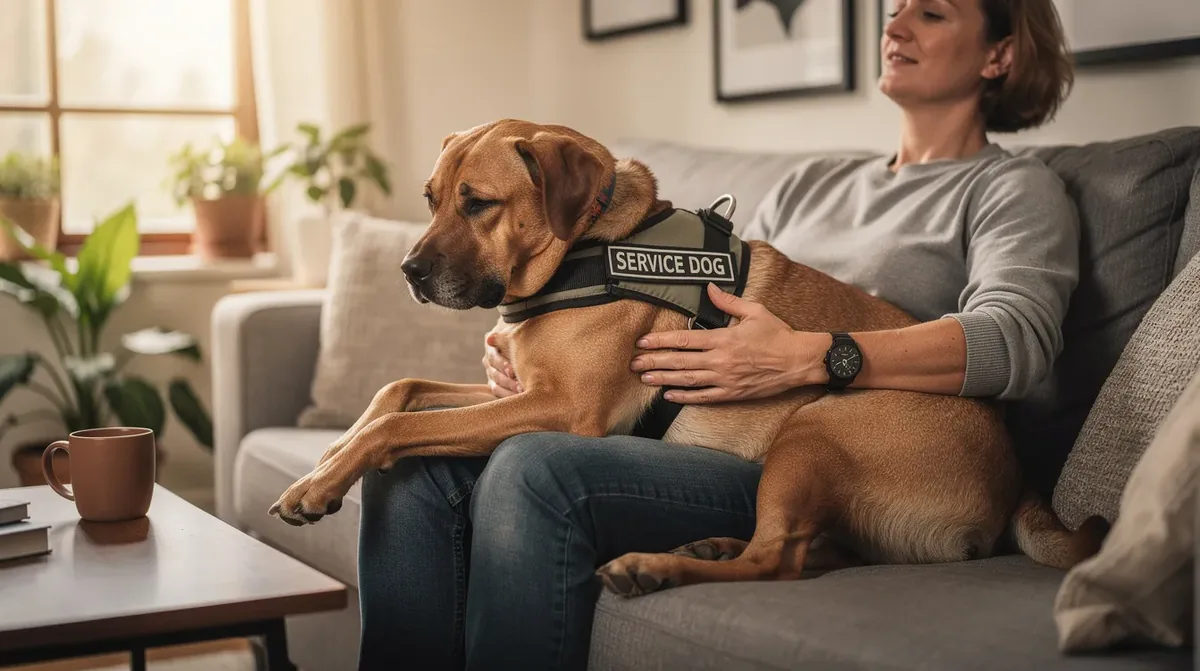
Deep pressure therapy (DPT): The dog lies across the handler’s lap, chest, or leans firmly against them. Many handlers use this trained pressure to ground themselves during acute anxiety episodes.
-
Guiding to exits or quiet spaces: Psychiatric service dogs can assist in overwhelming environments by guiding the handler away from sensory overload or a panic episode to a calmer location.
-
Interrupting anxious behaviors: The dog nudges, paws, or redirects the handler when it detects pacing, skin picking, rumination, or other compulsive patterns. This includes interrupting self-harm behaviors with a trained physical interruption.
-
Waking from nightmares: Service dogs can wake handlers from nightmares or night terrors by nudging, licking, or performing a trained alert.
-
Crowd buffering: Crowd buffering is a technique where dogs help manage personal space in crowded areas by positioning themselves between the handler and other people, easing claustrophobia and social anxiety.
-
Medication reminders: Service dogs can remind handlers to take their medication through trained alert behaviors at set times or in response to cues.
-
Retrieving items: When the handler is frozen or dissociating, the dog can retrieve medication, a water bottle, or a phone.
-
Room searches: Psychiatric service dogs can conduct room searches for PTSD, checking spaces before the handler enters. It is worth noting that true “threat assessment” and security work are controversial and not typical service dog tasks. This behavior is better framed as trained reassurance checking.
Medical alert dogs may also assist if anxiety co-occurs with other conditions like diabetes or POTS by alerting to physiological changes.
Task lists are always individualized. A dog for a college student with panic attacks will be trained differently than one for a veteran with agoraphobia.
What the research says: The strongest evidence so far comes from veterans with PTSD. In an NIH-funded nonrandomized controlled trial of 156 veterans and military members (Leighton et al., JAMA Network Open, 2024), those who received a psychiatric service dog reported lower PTSD symptom severity, depression, and anxiety after three months than those still on the waiting list. Because the study was not randomized and focused on PTSD, it shows an association rather than proof that a service dog will help every person with an anxiety disorder.
“Psychiatric service dogs may be an effective complementary intervention for military service-related PTSD.”
Leighton SC et al., JAMA Network Open, Service Dogs for Veterans and Military Members With Posttraumatic Stress Disorder
Best Service Dog Breeds & Temperaments for Anxiety
Temperament and health matter more than breed label. Mixed-breed dogs can be excellent psychiatric service dogs if they have the right disposition.
Selecting a service dog requires considering the dog’s temperament and behavior. Traits that work well include:
-
Steady nerves and low reactivity to noise, strangers, and busy environments
-
Strong human focus and willingness to stay close to the handler
-
Moderate energy level with the ability to settle calmly for long periods
-
Trainability and eagerness to work
-
Quick recovery from startling or stressful situations
Common breeds used as assistance dogs in the U.S. include Labrador Retrievers, Golden Retrievers, Standard Poodles, and their crosses. Smaller breeds like Cavalier King Charles Spaniels or Miniature Poodles can also serve well for tasks like tactile alerts or light DPT. Our overview of the best service dog breeds for PTSD and anxiety compares the most common choices.
Very high-drive, highly protective, or extremely sensitive dogs may be poor fits for psychiatric service work. A dog that reacts protectively to strangers or escalates under stress can worsen anxiety rather than ease it. A dog must remain calm in unpredictable environments to be effective as a service dog.
Prospective handlers should consider size: large breeds suit deep pressure therapy, while smaller breeds work well for apartment living and lighter tasks. Any candidate should pass a basic temperament evaluation and veterinary screening before beginning specialized training.

 Resolves 80% of housing & airline access issues instantly
PSD Registration
 Instant Digital ID
 Free Shipping
 5-Min Process


How to Get a Service Dog for Anxiety
There are three main routes to get a service dog: working with an organization that provides program-trained dogs, hiring a professional trainer, or choosing to owner-train your own dog. Here is a practical sequence.
-
Step 1: Consult a licensed mental health professional. Discuss your anxiety diagnosis, how it limits your daily functioning, and whether a psychiatric service dog fits your treatment plan. You may also work with a medical doctor who manages your mental health.
-
Step 2: Document your functional limitations clearly: difficulty leaving home, using transit, attending work, or sleeping safely. The ADA does not require a letter for public access, but many training programs ask for provider documentation, and it clarifies which disability-related tasks the dog would need to perform.
-
Step 3: Research assistance dog organizations and reputable private trainers in your state. Waitlists for program-trained dogs are common and can be long, and fees vary widely, so ask each program about wait times, costs, and follow-up support before applying.
-
Step 4: If you plan to owner-train, select an appropriate dog (your own dog or a new adoption), commit to a long period of consistent work, and consider hiring a certified professional dog trainer or enrolling in structured courses to build reliable task performance and public access skills.
Insurance rarely covers service dog acquisition. Some nonprofits, veteran programs, and local grants may help offset costs. No product or service can guarantee housing or travel approval.
Training a Service Dog for Anxiety: Owner-Training vs Programs
Both routes are valid. The ADA does not require that a professional trainer or program be involved. What matters legally is that the dog performs trained tasks for your disability and behaves appropriately in public.
“People with disabilities have the right to train the dog themselves and are not required to use a professional service dog training program.”
U.S. Department of Justice, Frequently Asked Questions about Service Animals and the ADA
Program-trained dogs: Organizations that train psychiatric service dogs typically invest many months of training in each dog before placement. The matching process considers your disability profile, living situation, and lifestyle. Common eligibility requirements include stable housing, age minimums, and the ability to care for the dog independently. Many programs offer ongoing support after placement. This is a strong path for handlers who need a fully trained service dog without the time or capacity to train one themselves.
Owner-training: You can train your own dog to be a service dog. Start with basic obedience, socialization, and public manners, then layer in specific anxiety tasks like alerts, deep pressure therapy, and interrupting panic attacks. How long this takes depends on the dog, the tasks, and your consistency, and it is usually a matter of many months rather than weeks.
Many handlers combine approaches, working with local force-free trainers, online courses, or service-dog group classes. Public behavior training is essential for psychiatric service dogs to access places covered under the ADA. Daily practice, field trips to stores and transit, and regular evaluation of the dog’s stress and suitability are all part of the process.
There is no official U.S. certification or registry required. No test result, card, or service dog vest creates legal status. What matters is that the dog is specially trained and behaves well in public.
Your Legal Rights: ADA, Fair Housing Act & Travel
U.S. law treats a service dog for anxiety like any other service animal, as long as the dog is trained to perform tasks related to the handler’s disability. Psychiatric service dogs have legal protections under the ADA identical to those for dogs assisting people with physical disabilities.
ADA public access: The ADA allows service dogs in places open to the public, including restaurants, hotels, stores, hospitals, and public transit. A business that charges pet deposits or fees must waive them for service animals. Staff may only ask two questions: (1) Is this a service animal required because of a disability? (2) What work or task has the dog been trained to perform? They cannot ask for documentation, demand a demonstration, or require registration. The ADA requires no certification, registration, ID, or vest (see ADA.gov).
Fair Housing Act: The Fair Housing Act protects service dogs in no-pet housing. Under 42 U.S.C. 3604(f)(3)(B), housing providers must make reasonable accommodations in rules and policies, such as a no-pet rule, for assistance animals including psychiatric service dogs and ESAs, subject to the direct-threat and substantial-damage limits in 3604(f)(9). Because HUD withdrew its assistance animal guidance (FHEO-2020-01 and FHEO-2013-01) effective September 17, 2025, questions about breed, weight, and pet fees now depend on the statute, courts, and state law.
Air travel: Under the Air Carrier Access Act rules (14 CFR part 382), trained service dogs, including psychiatric service dogs, may fly in the cabin. Airlines may require the DOT Service Animal Air Transportation Form. Since January 11, 2021, airlines may treat ESAs as pets. Therapy dogs and therapy animals do not have these travel rights.
State laws may add protections, such as rights for service dogs in training. Check your state statutes in addition to federal law.
Documentation, IDs, and Common Myths
There is widespread confusion about “certification,” online registries, and ID cards for service dogs.
-
There is no official U.S. government registry for service dogs. No website can make a dog a service animal or guarantee legal approval through a certificate or card.
-
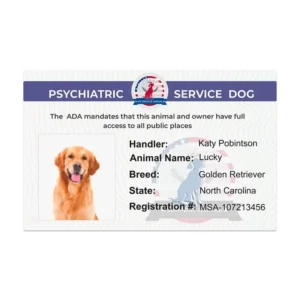
IDs, vests, and registration services are optional tools some handlers use to reduce questions in public. A psychiatric service dog ID, for example, can make everyday interactions quicker, but it does not create legal status or confer the rights that task training does.
-
For public access under the ADA, handlers do not need to show paperwork. For housing under the Fair Housing Act, landlords may request reliable documentation from a licensed health care professional when the disability or need is not obvious.
-
ESA letters must come from a licensed health care professional. Some states add requirements. California, for example, requires a client-provider relationship of at least 30 days.
-
Service dogs do not have to be purchased from special programs or pass an “official” government test. Many professional training organizations use public access tests as best-practice benchmarks, but these are voluntary.
Daily Life With a Service Dog for Anxiety
Living with a psychiatric service dog brings real benefits and real responsibilities. The dog’s presence in your daily routine provides structure, but it is not a passive arrangement.
-
Daily routines: Scheduled walks, task practice (such as running through alerts or deep pressure therapy during planned relaxation), grooming, feeding, and downtime where the dog is off duty.
-
Handler responsibilities: Keeping the dog under control at all times, monitoring the dog’s stress, respecting areas where the dog may be excluded (such as certain sterile hospital areas), and planning outings in advance.
-
Common scenarios: The dog might perform crowd buffering at a grocery store, alert to rising panic on a commute, or guide the handler to a quiet area in a crowded school hallway. At the airport, the handler may need to present the DOT form if the airline requires it.
-
Questions from strangers: Having a visible service dog often attracts attention. A simple one-sentence answer like “This is my service dog; he helps me with a medical condition” protects your privacy without oversharing.
Keep up with ongoing training, veterinary care, and mental health care so the dog supports, rather than replaces, therapy or medication. A psychiatric service dog is one part of a broader mental health treatment plan, not a standalone solution. Your mental health professional can provide ongoing support to adjust your care as needed.

Costs, Funding & Long-Term Planning
Cost is one of the biggest barriers. It includes both the initial acquisition or training and lifelong care. Budget realistically before committing.
-
Program-trained dogs: Usually the most expensive route, because the program covers months of professional training, and fees vary widely by provider. Some nonprofits place dogs at low or no cost, especially for veterans. K9s For Warriors, the organization behind the NIH-funded PTSD study above, says it provides its dogs at no financial cost to the veteran.
-
Trainer-assisted owner training: Costs depend on how many professional sessions, consultations, and classes you need, plus gear.
-
Self-training: Usually the least expensive route in cash, covering classes, gear, and occasional trainer consultations, but it requires a significant personal time investment.
-
Ongoing annual costs: Food, routine veterinary care, emergency vet funds, grooming, flea/tick and heartworm prevention, and gear like harnesses or a service dog vest.
Potential funding sources include personal savings, disability benefits, local civic clubs, community fundraisers, and limited grant programs. Our guide to service dog grants and financial help lists where to start.
Think in terms of a long-term commitment. Plan for backup caregivers if you are hospitalized, and consider the eventual need to retire and replace a working dog as it ages.
References
-
U.S. Department of Justice, Civil Rights Division. ADA Requirements: Service Animals. ADA.gov, 2020. ada.gov
-
U.S. Department of Justice, Civil Rights Division. Frequently Asked Questions about Service Animals and the ADA. ADA.gov, 2020. ada.gov
-
Leighton SC, Rodriguez KE, Jensen CL, MacLean EL, Davis LW, Ashbeck EL, Bedrick EJ, O’Haire ME. Service Dogs for Veterans and Military Members With Posttraumatic Stress Disorder: A Nonrandomized Controlled Trial. JAMA Network Open, 2024;7(6):e2414686. doi.org
-
National Institute of Mental Health. Mental Illness statistics. NIMH, 2022 data. nimh.nih.gov
-
Fair Housing Act, 42 U.S.C. 3604. Legal Information Institute, Cornell Law School. law.cornell.edu
-
U.S. Department of Housing and Urban Development. Notification of Withdrawal of Fair Housing and Equal Opportunity Guidance Documents. Federal Register, 2026. federalregister.gov
-
U.S. Department of Transportation. 14 CFR 382.3, Definitions (service animal). Legal Information Institute, Cornell Law School. law.cornell.edu
-
California Board of Behavioral Sciences. AB 468 Emotional Support Dogs: Frequently Asked Questions. BBS, 2022. bbs.ca.gov
Readers should consult current federal and state statutes or an attorney for specific legal questions, especially as housing guidance and airline policies can change.
The content on this website is for informational purposes only and does not constitute professional medical advice, diagnosis, treatment, or legal counsel.
Still Unsure If You Qualify?
Skip the confusion. Take a 3-minute assessment to see what your animal legally needs.
U.S handlers trust MyServiceAnimal

FAQ
Minors can sometimes work with psychiatric service dogs when anxiety is severely disabling and meets the threshold of a mental health disability. A parent or guardian typically takes responsibility for the dog’s care and training, and the dog must stay under the handler’s control in public. Schools covered by federal disability law must generally allow the service animal.
It is possible to have both if your clinical team agrees each animal plays a distinct role. A service dog would perform specific tasks in public, while an ESA might provide emotional support at home. Housing providers may evaluate requests for multiple assistance animals for reasonableness under the Fair Housing Act.
Colleges covered by the ADA must allow service dogs in classrooms, libraries, and other public areas. Campus housing covered by the Fair Housing Act generally must accommodate service dogs and must consider ESA requests as reasonable accommodations. Schools may set behavior rules and request disability accommodation paperwork for housing through their accessibility office.
Many people continue to benefit from their service dog even as symptoms improve, particularly for preventing setbacks. Some handlers eventually transition the dog to pet status or lighter work in consultation with their clinicians and trainers. There is no legal requirement to give up a service dog if your condition improves but the dog still performs useful tasks.
While many handlers report significant benefits, some may feel increased public attention, social pressure, or added responsibility from managing a working dog. Destructive behavior from an undertrained dog can add stress. Discuss these concerns honestly with a therapist before deciding. A service dog works best when it fits naturally into your life alongside ongoing mental health care.
This article is for informational purposes only and does not constitute legal advice. Consult an attorney or your state’s laws for guidance on your specific situation.