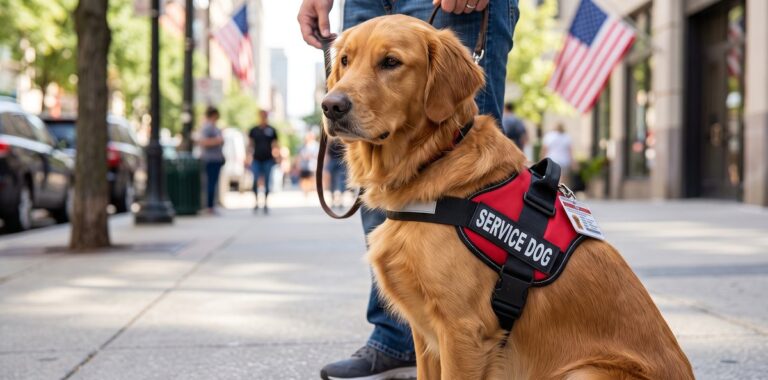
How to Fly with a Service Dog: The Ultimate Guide
You are standing at the gate with your service dog at your feet, boarding pass in hand, when the agent asks for “the paperwork.” Your stomach drops — which paperwork? You filled out a form online weeks ago, but is it the right one? The dog behind you in line flew last week with no issue, but that handler used a different airline. The difference between walking onto the plane and being turned away almost always comes down to two federal forms and one airline’s submission window — and almost nobody explains both clearly in one place.
This guide does. Below is exactly what U.S. law requires in 2026, the two Department of Transportation forms you must complete, and a side-by-side breakdown of all nine major U.S. airlines — including the quirks that get handlers stuck at the gate.

What U.S. Law Says About Flying With a Service Dog in 2026
Air travel with a service animal is governed by the Air Carrier Access Act (ACAA) and its regulation, 14 CFR Part 382. This is federal law, not airline preference — every U.S. carrier, and every foreign carrier flying to or from the United States, must follow it.
Under the current rule, a service animal for air travel is a dog of any breed that is individually trained to do work or perform tasks for a person with a disability. That definition matters because it draws a hard line that surprises many travelers.
The 2021 DOT Rule Changed Everything: Emotional Support Animals Are Out
Before January 11, 2021, emotional support animals could fly in the cabin for free. That is no longer true. The DOT’s 2020 final rule, “Traveling by Air With Service Animals,” removed ESAs from the definition of service animal for air travel. Airlines are now free to treat an emotional support animal as an ordinary pet — meaning standard pet fees, carrier requirements, and no guaranteed cabin access.
If your animal provides comfort but is not trained to perform a specific disability-related task, it is an ESA in the eyes of the airlines, not a service dog. That distinction decides whether you fly free in the cabin or pay a pet fee. There is no airline you can fly that still treats ESAs as service animals — the change is federal and universal.
 Resolves 80% of housing & airline access issues instantly
Service Animal Registration
 Instant Digital ID
 Free Shipping
 5-Min Process


Service Dog vs. Emotional Support Animal — and the “Certification” Myth
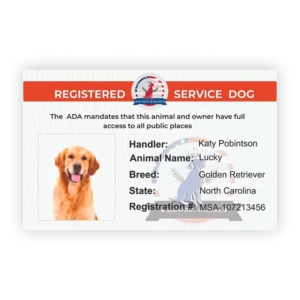
A common question is some version of “how do I make my dog a service dog just for flying?” Here is the honest answer: there is no government registry, ID card, or certificate that makes a dog a service dog. A dog becomes a service dog by being trained to perform tasks tied to a disability — guiding, alerting to a medical event, interrupting a panic attack, retrieving items, and so on. No website can grant that status, and airlines are legally barred from requiring a vest, an ID card, or any “certification” as proof.
What airlines can require — and all of them do — are the official DOT attestation forms below. Those forms are the real documentation. Anyone selling a mandatory “flight certificate” is selling something the airline never asked for.
The Two DOT Forms You Must Complete Before Every Flight
There are two separate U.S. DOT forms. The current versions were updated in September 2024. Submitting a false attestation on either is a federal offense, so fill them out honestly.
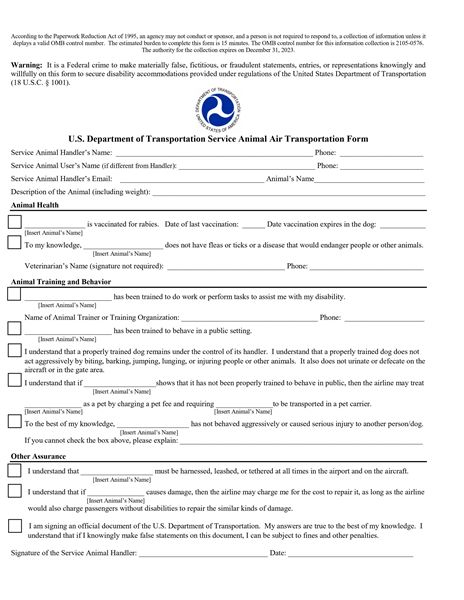
Form 1 — Service Animal Air Transportation Form (every flight)
Required for every service dog flight, regardless of length. You attest to:
- Health: the dog is currently vaccinated against rabies and is free of disease and parasites.
- Task training: the dog is trained to perform tasks for your disability (you list the trainer, which can be you if self-trained).
- Behavior training: the dog is trained to behave in public and has no history of unprovoked aggression.
- Assurances: the dog will be leashed or harnessed, and you accept liability for any damage it causes.
The easiest way to arrive at the airport prepared is to have a correctly completed DOT form ready in advance. Our DOT Service Dog Air Travel Form walks you through each section and gives you a clean, airline-ready document.
Form 2 — Service Animal Relief Attestation Form (flights 8 hours or longer)
Required only for flights of eight hours or more. You attest that your dog either will not need to relieve itself during the flight, or can do so in a way that does not create a health or sanitation problem. Short domestic hops do not need this form; long-haul and most international flights do.
Airline Service Dog Requirements Compared — All 9 U.S. Carriers
Every carrier below requires Form 1, none accepts ESAs as service animals, and all require Form 2 for flights of eight or more hours. Where they differ is the advance-notice window and how you submit — and that is where handlers get caught.
| Airline | Advance notice | How to submit the DOT form | What trips handlers up |
|---|---|---|---|
| Delta | 48 hours | Accessibility request on delta.com | Dog must be at least 4 months old; kennel and food check-in are free |
| United | From 24 hours (domestic) | Electronically via Trip Details | Notably lets certified trainers fly free with a service dog in training |
| American | 48 hours | Email the Special Assistance Desk | Dogs in training and ESAs fly only as pets; extra review for international |
| Southwest | No mandatory window | Special Assistance at booking, or present at the counter on travel day | Open seating — board early to claim floor space; the dog cannot block the aisle |
| JetBlue | 48 hours (5 days advised) | Upload link, or at the gate if you booked late | London flights need Heathrow Animal Reception Centre approval — contact them at least 7 days out |
| Alaska | 48 hours | Open Doors service-animal forms portal via My Trips | You get a reusable handler/dog ID — no need to re-complete the form for each trip |
| Frontier | 48 hours | Special Services request | Service dogs in training are not accepted; dog must fit in your foot space |
| Breeze | 48 hours (or at check-in if booked later) | Breeze Contact Center | Dog rides on your lap or in foot space without crowding the next seat; ESAs are charged as pets |
| Allegiant | 48 hours (72h for dogs in training) | Email [email protected] or phone — no online portal | One of the few carriers with no web portal; email or call only |
Note: Hawaiian Airlines merged into Alaska and no longer operates as a separate carrier — former Hawaiian routes now use Alaska’s service-dog process above.
The pattern is simple: submit Form 1 at least 48 hours before departure through the airline’s accessibility portal, and you clear the biggest hurdle. Southwest is the exception with no required window, but its open-seating model creates a different problem — get to the gate early so you can claim adequate floor space.
At the Airport: Check-In, TSA, and Relief Areas
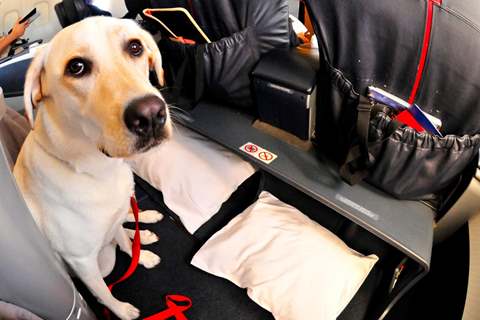
At check-in, present your completed DOT form if you did not submit it online. At the TSA checkpoint, your dog goes through screening with you; you are never required to be separated from your service dog, and you can request a pat-down instead of having the dog removed from its harness. After security, look for a Service Animal Relief Area (SARA) — every U.S. airport with 10,000+ annual passengers is required to provide one in each terminal, usually past security so you do not have to re-screen.
On the Plane: Seating, Space, and Behavior
Your service dog flies free in the cabin and must fit within your foot space without intruding on the aisle or the next passenger. The dog cannot occupy a seat or eat from a tray table, and exit-row seating is not allowed — you may be reassigned to a bulkhead row for more floor space. You may travel with up to two service dogs if both fit in your space.
Behavior is the one thing that can get a fully documented dog removed. A service dog that growls at passengers, barks repeatedly, jumps on people, or relieves itself in the cabin can be denied boarding or removed, because the DOT rule requires the dog to behave in public. Documentation gets you on the plane; behavior keeps you there.
Can an Airline Deny Your Service Dog?
Yes, but only on narrow grounds. An airline may refuse a service dog that poses a direct threat to health or safety, is too large or heavy to be safely accommodated, behaves disruptively, or whose entry is barred by the destination country. An airline cannot deny your dog because of its breed, because it lacks a vest or ID card, or because the gate agent personally doubts it — the DOT forms are the only documentation they may require.
Flying With a Service Dog in Training
Under federal law, a service dog in training is not yet a service dog, so airlines are not required to accommodate one. Policies vary: United notably allows certified trainers to fly free with a dog in training, American treats them as pets, and Frontier does not accept dogs in training at all. If you are a trainer or owner-training, check the specific carrier before you book — this is the single biggest difference between airlines.
Flying Internationally — and Into Canada
Two things change the moment you leave U.S. domestic airspace. First, foreign airlines don’t use the DOT form. Canadian carriers — Air Canada, WestJet, and Porter — fall under the Canadian Transportation Agency, not the ACAA, so each uses its own service-dog clearance form, asks for about 48 hours’ notice, and wants proof of the specific tasks your dog performs, not just “service dog” status. Confirm the exact form with your carrier before you book.
Second, the destination country controls entry, no matter which airline you fly. Briefly, for a U.S. service dog:
- Canada: no quarantine for dogs arriving from the U.S. Dogs accredited by ADI or IGDF skip the rabies paperwork; others simply carry a vet’s rabies-vaccination certificate.
- United Kingdom: pre-clear with the Heathrow Animal Reception Centre a few days before arrival; bring a microchip and rabies certificate.
- European Union: an ISO microchip plus a USDA-endorsed EU Animal Health Certificate; no quarantine when done correctly.
- Australia: the strictest — quarantine applies even to service dogs (around 10 days), after months of vaccination and blood-test prep.
- Japan: as little as a 12-hour clearance if the microchip and rabies blood test were completed 180+ days ahead; otherwise quarantine can run months.
Connecting Flights and Multi-Leg Trips
If your trip involves more than one airline, you must satisfy each carrier’s requirements — submit the DOT form to both, and meet the stricter advance-notice window of the two. On a single airline with a connection, one submission covers the whole trip, but confirm relief-area access at your layover airport if the connection is long.
Frequently Asked Questions
Can service dogs fly for free?
Yes. On every U.S. airline, a trained service dog flies free in the cabin. Pet fees apply only to pets and emotional support animals.
What dog breeds can fly as service dogs?
Any breed. Under the ACAA, airlines cannot deny a service dog based on breed. (Some destination countries have breed bans on arrival, which is separate from the flight itself.)
Does my service dog need a vest or an ID card to fly?
No. Airlines may not require a vest, ID card, or certificate. The only documentation they can require is the DOT form.
Can I make my dog a service dog just for flying?
No shortcut exists. A service dog must be trained to perform disability-related tasks. If your dog is not task-trained, it is a pet or an ESA for air-travel purposes and will be charged accordingly.
How do I fly Breeze Airways with a service dog?
Complete the DOT Service Animal Air Transportation Form and submit it through the Breeze Contact Center at least 48 hours before departure, or at check-in if you booked within 48 hours. Your dog rides on your lap or in your foot space.
Flying with a service dog is mostly about arriving prepared: the right DOT form, submitted to the right portal, before the airline’s deadline. Get your airline-ready DOT form handled in advance, confirm your carrier’s submission window from the table above, and the gate becomes a formality instead of a gamble.
The content on this website is for informational purposes only and does not constitute professional medical advice, diagnosis, treatment, or legal counsel.
Still Unsure If You Qualify?
Skip the confusion. Take a 3-minute assessment to see what your animal legally needs.
U.S handlers trust MyServiceAnimal

FAQ
Yes. Under the Air Carrier Access Act (ACAA), all trained service dogs (including psychiatric service dogs) fly for free in the passenger cabin. You do not have to pay any pet fees.
The ACAA only protects fully trained service dogs. Airlines are not legally required to transport service dogs in training for free. They may treat them as pets subject to standard pet fees and carrier rules. However, some airlines choose to allow them, and certain state laws provide protections. Check with your specific carrier beforehand.
No. Under DOT regulations, airlines cannot deny boarding to a service dog based solely on its breed. Even if a country or city has breed-specific legislation, U.S. airlines cannot apply breed bans to service animals on flights to, from, or within the United States.
For domestic flights within the United States, no passport is required. For international travel, many countries require a Pet Passport or an endorsed International Health Certificate to bypass quarantine.