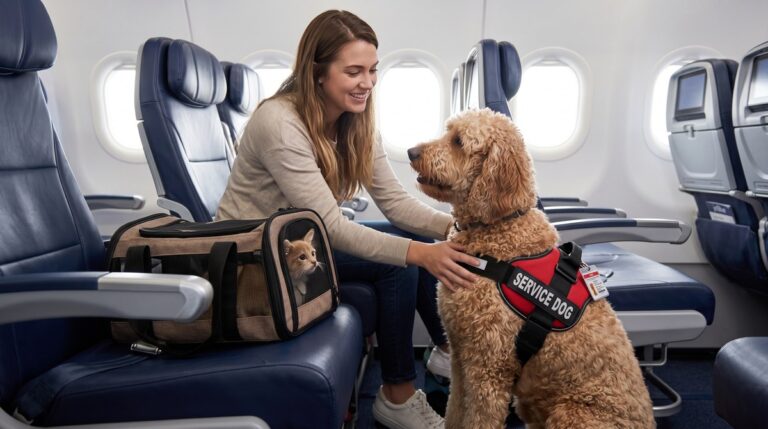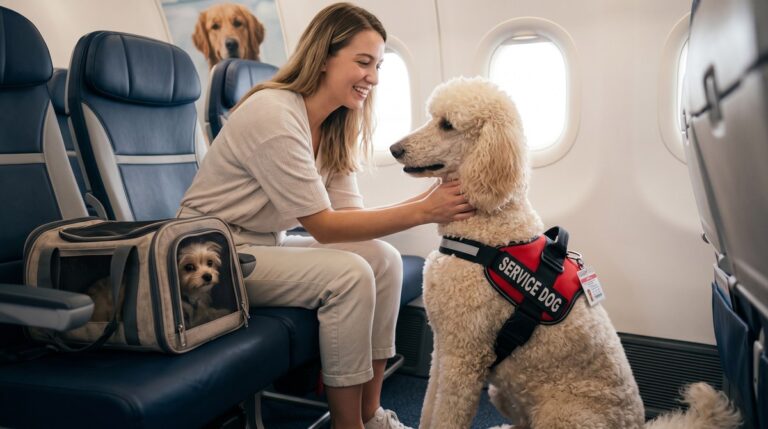
Hilton Pet Policy: Service Dogs, ESAs & Pets Explained For U.S. Travelers
Under the ADA, every U.S. Hilton hotel must admit service dogs and cannot charge them the pet fees or deposits it charges pets. For emotional support animals and regular pets, the rules vary by brand and property. Hilton says it welcomes pets at over 5,000 hotels across the U.S. and Canada, but fees, weight limits, and restrictions are set hotel by hotel, so always confirm the pet policy with the specific Hilton property before booking.
Policies checked October 2026 on Hilton, Marriott, La Quinta (Wyndham), Airbnb and Vrbo official pages. Hotel rules and fees change often, so confirm with the property or host before you book.
This guide is written by MyServiceAnimal.org and covers U.S. law and U.S. Hilton properties only.
Finally, a Clear Guide to Hilton’s Pet Policy for Service Dogs, ESAs and Pets
Hilton’s animal policies can be genuinely confusing. Federal law, brand-level marketing, and the decisions of individual hotel managers all layer on top of each other. A Home2 Suites in Texas may welcome your large dog, while another Hilton-family hotel across the state line may not allow pets at all.
This guide separates three categories that matter: ADA service dogs, emotional support animals, and regular pets at Hilton. We also compare Hilton to Marriott, La Quinta, Airbnb, and Vrbo so you can make the best choice for your next trip. One important thing to keep in mind from the start: there is no official U.S. government registry for service dogs. Registrations, ID cards, and vests are optional identification tools and confer no legal rights.
Why Understanding Hilton’s Pet, ESA and Service Dog Rules Matters
Knowing the rules before you book saves money, stress, and awkward conversations at the front desk. Here is why it is worth your time:
-
Avoid surprise pet fees. ESA and pet owners who assume their animal stays free may be charged a pet fee at check-in. Hilton notes that fees apply and vary by hotel, so knowing the fee in advance lets you budget or choose a different property.
-
Assert ADA rights correctly. Service dog handlers who understand the Americans with Disabilities Act can respond calmly and accurately when staff ask questions, without over-claiming or under-claiming.
-
Choose the right Hilton brand. Some brands, like Home2 Suites and Homewood Suites, accept pets at every property, while other brands leave the decision to each hotel.
-
Reduce conflict with hotel staff. Clear knowledge of what a hotel can and cannot legally ask makes the check-in experience smoother for everyone.
-
Plan documentation correctly. ESA letters from a licensed health care professional are relevant to housing requests under the Fair Housing Act, but hotels are public accommodations under the ADA, not housing. That distinction changes everything.
Hotels are considered businesses and public accommodations under the ADA. They are not “dwellings” under the Fair Housing Act (42 U.S.C. 3604(f)(3)(B)), which is the statute that requires housing providers to consider reasonable accommodations for assistance animals. This means the ESA protections you may have in a rental apartment do not apply at a Hilton hotel.
How Does the ADA Apply to Hilton Hotels?
Every Hilton hotel in the United States is a public accommodation under Title III of the Americans with Disabilities Act. That means the federal service animal rules in 28 CFR 36.302(c) apply at every property, regardless of that hotel’s pet policy.
Under the ADA, a service animal is defined as a dog that is individually trained to do work or perform tasks directly related to a person’s disability. Psychiatric service dogs qualify as service animals when they are trained to perform specific tasks for psychiatric disabilities, such as interrupting self-harm, providing tactile grounding during a panic attack, or reminding a handler to take medication. Dogs whose sole function is comfort or emotional support are not considered service animals under the ADA.
“Dogs whose sole function is to provide comfort or emotional support do not qualify as service animals under the ADA.”
U.S. Department of Justice, ADA Requirements: Service Animals
Miniature horses are covered by a separate, limited ADA provision: businesses must make reasonable modifications to permit a trained miniature horse where appropriate, so hotels evaluate them case by case.
What Hilton Staff Can and Cannot Ask About Your Service Dog
Hotel staff are limited to two questions when it is not obvious that a dog is a service animal:
-
Is the dog required because of a disability?
-
What work or task has the dog been trained to perform?
That is it. Hilton cannot require:
-
Medical records or disclosure of your specific diagnosis.
-
Training papers, federal “certification,” or any ID card.
-
That the dog demonstrate its tasks as proof on the spot.
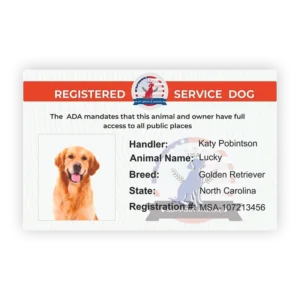
Handlers may choose to use IDs, vests, or voluntary registrations as convenience tools, but these items do not create legal rights and no hotel can demand them. There is no official U.S. government registry for service dogs.
Where Service Dogs Are Allowed at Hilton
Under the ADA, service dogs must be allowed in all areas of the hotel where guests and members of the public may go: guest rooms, the lobby, elevators, hallways, dining areas, and outdoor spaces guests can access. Hotels often keep pets out of areas such as breakfast rooms, fitness centers and pools, but those pet restrictions do not apply to service dogs.
A hotel can ask a service dog to leave only if:
-
The dog is out of control and the handler does not take effective action to regain control.
-
The dog is not housebroken.
-
The dog poses a direct threat to health or safety that cannot be reduced by reasonable adjustments.
“Allergies and fear of dogs are not valid reasons for denying access or refusing service to people using service animals.”
U.S. Department of Justice, ADA Requirements: Service Animals
Hilton Pet Policy vs Emotional Support Animals vs Service Dogs
Any animal that is not an ADA service dog falls under a hotel’s pet rules. That includes emotional support animals. Policies regarding pets can vary widely between different Hilton brands and locations, so what applies at one property may not apply at another.
Here is how the categories break down:
-
Service dog (ADA): A dog individually trained to perform tasks for a person with a disability. Must be admitted to guest areas, no pet fees.
-
Psychiatric service dog: A service dog trained to perform tasks for psychiatric disabilities. Same ADA protections as any other service dog.
-
Emotional support animal (ESA): An animal that provides comfort through companionship. Not task-trained. Not a service animal under the ADA. Treated as a pet at hotels.
-
Regular pet: A companion animal with no disability-related role. Subject to all pet rules and fees.
The practical result: service dogs must be admitted without pet fees at every property, while ESAs and pets are accepted only where the property allows pets, and usually under the same pet fees, weight limits, and restrictions.
Typical Hilton Brand Pet Policies in the U.S. (as of 2026)
Exact rules vary by property, but here are the general tendencies across major Hilton brands. Always confirm with the specific hotel before you travel.
-
Home2 Suites by Hilton is one of Hilton’s 100% pet-friendly brands (with Homewood Suites and Canopy by Hilton). When Hilton and Mars Petcare announced their partnership in 2021, Hilton said Home2 Suites and Homewood Suites would introduce consistent pet fees starting at $50 per stay; check the current fee and any weight limit with the hotel.
-
Homewood Suites by Hilton became 100% pet-friendly across the U.S. and Canada in January 2022, as part of Hilton’s partnership with Mars Petcare.
-
Hampton by Hilton is on Hilton’s list of pet-friendly brands, but pet acceptance, fees and weight limits are set by each hotel. ESAs are treated as pets.
-
Hilton Garden Inn is also listed as a pet-friendly brand, but individual hotels decide whether and how they accept pets. ESAs follow the same rules as pets.
-
Embassy Suites, DoubleTree, Tru, Curio Collection, Tapestry Collection, and Conrad also appear on Hilton’s pet-friendly brand list, with policies that vary by hotel. Brands not on that list may not accept pets at all.
Even within a single brand, individual hotels can set different fees, weight caps, and limits on the number of animals per room. See Hilton’s pet-friendly hotels page and the “Pets” section of each hotel’s page.
Fees, Deposits and Weight Limits at Hilton
Service dogs cannot be charged pet fees, cleaning surcharges, or deposits simply for being service dogs. Hotels can, however, charge for actual damage caused by any guest or animal, if they normally charge guests for damage they cause.
For ESAs and pets, here is what to expect:
-
Fees: Most pet-friendly Hilton hotels charge a pet fee, often per stay. Hilton does not publish one brand-wide amount; the fee is listed on each hotel’s page.
-
Weight limits: Many properties set a maximum weight for pets, and the limit differs from hotel to hotel. If you travel with a large-breed dog, check before booking.
-
Number of pets: Hotels commonly cap the number of pets per room. More pets or other species are generally not accommodated unless the hotel says so.
Expect common house rules: clean up after your pet, prevent damage, and keep your pet leashed or in a carrier in public areas. Many properties restrict leaving pets unattended in rooms. Always call or email the specific property shortly before your stay, because a single brand-wide summary will never capture every detail.
How to Stay at Hilton with a Service Dog: Step by Step
This process applies to ADA service dogs only, not ESAs or regular pets.
Step 1: Choose a Hilton Property and Book Your Room
Pick your hotel based on your own needs first: price, location, accessibility features. Do not limit yourself to “pet-friendly” properties, because every Hilton hotel is legally required to admit your service dog regardless of its pet policy.
When booking, note any accessibility needs (roll-in shower, ground-floor room, proximity to outdoor relief areas) in the reservation. You are not required to mention your service dog, but noting it in the “special requests” field or calling ahead can help the front desk prepare and make check-in smoother.
Step 2: Arrive Prepared to Answer ADA Questions
Be ready with a calm, short explanation:
-
That the dog is required because of a disability.
-
The specific task the dog performs (for example, seizure response, mobility support, psychiatric task interruption).
You do not need to bring or show documentation, an ID card, or a vest. If staff ask for papers or try to charge a pet fee for your service dog, politely explain that the ADA does not require certification or registration and that service dogs are exempt from pet fees. Some handlers still choose an optional service dog vest to signal that the dog is working; it can make check-in smoother but adds no legal rights. Our guide to real vs. fake service dog vests explains the difference. Stay firm but respectful.
Step 3: Manage Your Dog and Your Room Responsibly
Hotel staff and other guests will have a better experience when service dogs are well-managed. Here is what is expected:
-
Keep your dog under control by leash, harness, or voice command at nearly all times.
-
Prevent excessive barking that could disturb other guests. A dog that does bark briefly is not automatically “out of control,” but ongoing disruption is a problem.
-
Clean up promptly after bathroom breaks and protect room furnishings as reasonable.
-
Know that Hilton can ask a service dog to leave if its behavior becomes a genuine safety issue and the handler does not correct it. The guest must still be offered the chance to stay without the dog.
-
The hotel may charge for actual damage a service dog causes, just as with any guest.
 Resolves 80% of housing & airline access issues instantly
Service Animal Registration
 Instant Digital ID
 Free Shipping
 5-Min Process


Staying at Hilton with an Emotional Support Animal
If you have an ESA letter from a licensed health care professional, it is important to understand what it does and does not do at a hotel. The Fair Housing Act requires housing providers to consider reasonable accommodations for assistance animals in housing. Hotels, however, are ADA public accommodations, not housing. This means Hilton can treat ESAs as pets, charge pet fees, and apply pet size and number limits.
Emotional support animals may incur pet fees at hotels. An ESA letter does not force a hotel to waive those fees or override its pet policy. For a broader look at where an ESA can and cannot go, see where you have the right to take your emotional support animal.
Do Hilton Hotels Ask for ESA Documentation?
Hilton is not required by federal law to recognize ESAs differently from pets, so ESA letters usually do not change fees or rules at check-in. An individual hotel manager might choose to be flexible, but guests should assume standard pet rules will apply.
No online ESA letter service can guarantee hotel approval or fee waivers. Be cautious of any company that claims otherwise.
Tips for ESA Handlers Booking Hilton
-
Call the specific property ahead of time to confirm pets are allowed and that your ESA will be accepted under the pet policy.
-
Ask about pet fees, deposits, and weight limits.
-
Clarify rules about leaving the animal unattended in the room.
-
Time your walks to avoid busy lobbies and high-traffic areas.
-
Pack a blanket, crate, or pet bed to protect hotel furniture and help your animal feel settled.
-
Have a backup plan. If that property does not allow pets or your ESA exceeds a weight limit, you need another option ready.
How Hilton Compares: Marriott, La Quinta, Airbnb and Vrbo
Choosing where to stay depends on your animal’s category, your budget, and how much policy variability you can tolerate. Here is how Hilton stacks up against other popular options.
Marriott Pet and Assistance Animal Policies (U.S., 2026)
Marriott hotels accommodate service animals without pet fees, consistent with ADA requirements, and the brand states this standard applies across its portfolio.
“Service animals are accommodated in accordance with applicable laws and are not considered pets.”
Marriott Bonvoy, Pet-Friendly Hotels for You & Your Pet
For ESAs and pets, Marriott says pet policies vary by hotel, even within the same brand, with fees, size or weight limits, number of pets, and length-of-stay rules set at the property level. Marriott’s brand page does not set a separate ESA rule, so whether an ESA is accepted, and what it costs, is decided by each hotel across brands like Courtyard, Residence Inn, Fairfield, and Ritz-Carlton. Always check the specific hotel’s page and call ahead.
La Quinta (by Wyndham) Pet and Service Dog Policy
La Quinta is a broadly pet-friendly brand. Its brand page says an optional pet fee may be charged at check-in ($25 per night, up to $75 per room per stay), no more than two domestic pets are allowed per room, and select locations may have a weight limit. Pets are kept out of shared areas such as the breakfast area, fitness center and pool, with the exception of service animals.
“Authorized service animals are not subject to a pet fee.”
La Quinta by Wyndham, Pet-Friendly Hotels
La Quinta’s page does not address ESAs separately, so expect them to be handled under the pet policy and its fees. Some locations do not accept pets at all, so call the hotel when booking.
Airbnb and Vrbo Stays with Service Dogs, ESAs and Pets
Both platforms have their own service animal policies on top of the law. Airbnb’s Accessibility Policy says hosts may not refuse a reservation because of a service animal (unless Airbnb grants an exemption, for example where the host lives in the listing and the animal poses a direct threat to the host’s health) and may not charge pet or cleaning fees for it. Guests are not required to provide documentation. For emotional support animals, Airbnb lets hosts charge normal pet fees, except where its policy requires accommodation (for home reservations in California and New York).
Vrbo publishes a separate service animal policy for hosts and guests. Read it together with the listing’s house rules, because ESAs are generally handled under the host’s pet rules and fees, and contact the host directly before booking.
What Makes Hilton a Good or Bad Choice for Handlers?
Whether Hilton works for you depends on your animal’s category and your specific needs.
For service dog handlers:
-
Every Hilton property must admit your ADA service dog without pet fees or deposits. This is a clear advantage over vacation rentals where enforcement can be inconsistent.
-
Staff training on ADA rules varies by property. Some people report smooth check-ins, while others experience questions about documentation that go beyond what the law allows.
For ESA handlers:
-
You will likely be charged the same pet fees as any other pet owner. If keeping costs manageable matters, compare fees across brands and properties.
-
Extended-stay brands like Home2 Suites and Homewood Suites offer kitchenettes, extra space, and layouts that are easier for animals, but fees still apply.
For family pet owners:
-
Weight limits for pets vary by Hilton hotel. If you travel with a large-breed dog, confirm the weight limit before booking.
-
Many hotels cap the number of pets per room. Families with several dogs may struggle to find accommodating properties.
Who Benefits Most from Hilton’s Current Pet Rules?
Hilton’s pet-related policies work well for some travelers and create friction for others.
-
Handlers with fully trained ADA service dogs who want mainstream hotels with predictable ADA compliance. Every Hilton property is legally required to admit your service dog, and the chain’s size means wide geographic coverage.
-
Travelers with ESAs willing to pay pet fees who want mid-scale brands and extended-stay layouts. Home2 Suites and Homewood Suites offer more space, which can make a stay with an animal more comfortable.
-
Road-tripping families with dogs who can work within typical weight limits and fees. Hilton lists over 5,000 pet-friendly hotels in the U.S. and Canada, giving you plenty of options along most routes.
-
Guests who prefer hotel consistency over the variability of individual vacation rental hosts. A Hilton property, even with variable pet fees, is generally more predictable than a private Airbnb listing.
Large-breed dog owners, multi-pet households, and travelers on tight budgets may find Hilton’s property-level restrictions and fees a poor fit.
Planning Your Next Trip with a Dog: Practical Checklist
Use this checklist before your next Hilton stay or any hotel booking.
-
Confirm whether your dog is an ADA service dog, psychiatric service dog, ESA, or pet under the law. The category determines your rights.
-
Call the specific Hilton property to confirm:
-
Pet fees and deposits (for ESAs and pets).
-
Weight limits and breed restrictions, if any.
-
Rules about unattended animals and housekeeping entry.
-
-
Ask where the nearest dog relief area is and whether bags or bins are provided.
-
Pack essentials: copies of vaccination records, medication, food, collapsible bowls, leash, muzzle if needed, crate or mat.
-
Plan quiet routes in and out of the building to reduce stress for reactive or anxious dogs.
-
If you have an ESA, have a backup hotel or rental option ready in case the property does not accept pets.
-
If you have a service dog, be prepared to answer the two ADA-permitted questions calmly and clearly.
-
Bring cleanup supplies (bags, wipes, a small towel) for accidents or muddy paws.


References
-
U.S. Department of Justice, Civil Rights Division. ADA Requirements: Service Animals. ADA.gov, updated 2020. ada.gov
-
28 CFR 36.302: Modifications in policies, practices, or procedures. Legal Information Institute, Cornell Law School. law.cornell.edu
-
Hilton. Pet-Friendly Hotels. Hilton, 2026. hilton.com
-
Hilton. Hilton, Mars Petcare Pair For Pet-Friendly Travel. Hilton Stories, 2021. stories.hilton.com
-
Hilton. Homewood Suites by Hilton is Now 100% Pet-Friendly across the U.S. and Canada. Hilton Stories, 2022. stories.hilton.com
-
Marriott Bonvoy. Pet-Friendly Hotels for You & Your Pet. Marriott International, 2026. marriott.com
-
La Quinta by Wyndham. Pet-Friendly Hotels. Wyndham Hotels & Resorts, 2026. wyndhamhotels.com
-
Airbnb. Accessibility Policy. Airbnb Help Center, 2026. airbnb.com
This guide is informational and not legal advice. If you have specific legal questions about your rights as a service dog handler or ESA owner, consult an attorney.
The content on this website is for informational purposes only and does not constitute professional medical advice, diagnosis, treatment, or legal counsel.
Still Unsure If You Qualify?
Skip the confusion. Take a 3-minute assessment to see what your animal legally needs.
U.S handlers trust MyServiceAnimal

FAQ
No. Under the ADA, Hilton cannot charge pet fees, deposits, or cleaning surcharges for service dogs. However, the hotel can bill you for actual damage caused by your service dog if it normally charges guests for damage they cause.
No. Emotional support animals are treated as pets at hotels. Standard pet fees, weight limits, and other restrictions typically apply, and an ESA letter does not require the hotel to waive them.
Under the ADA, Hilton may not require medical proof, training papers, certification, or registration. Staff are limited to two questions: whether the dog is required because of a disability and what work or task it has been trained to perform.
No. A hotel’s pet rules, including “no large dogs” policies or breed bans, apply only to pets and ESAs. A service dog can be excluded only for the specific reasons the ADA allows, such as being out of control or not housebroken.
Only under narrow circumstances. A hotel may request removal if the dog is out of control and the handler does not correct the behavior, if the dog is not housebroken, or if the dog poses a direct threat to safety. Even then, the guest must be offered the chance to stay without the dog.
Service dog handlers are not legally required to give advance notice. However, calling ahead can prevent confusion at check-in and help the hotel prepare. ESA and pet owners should call to confirm fees, weight limits, and rules for that specific property. For the legal differences between the two, read our guide to service animals versus emotional support animals.