DOT Service Animal Form: Complete Guide to the Service Animal Air Transportation Form
The DOT Service Animal Air Transportation Form is a federal document that airlines may require before allowing a trained service dog to fly in the cabin. It covers your identity, your dog’s health and rabies vaccination, and attestations about task training and behavior. If you are flying with a service dog, this form is your starting point.
This guide walks you through every section of the form, when airlines can require it, how to submit it, and what happens if you get something wrong.
Rules checked October 2026 against the current DOT form and 14 CFR Part 382. Airline procedures change, so confirm the current process with your airline before you book.
Key Takeaways
-
The DOT Service Animal Air Transportation Form is a federal form that airlines, including Delta Air Lines and American Airlines, ask for when you fly with a trained service dog. Emotional support animals do not use this form; airlines may classify them as pets.
-
There is no central DOT portal for the form. The form’s own instructions say not to send it to DOT; if an airline requires it, you submit it directly to that airline through its web upload, app, or at the airport.
-
For flight segments of 8 hours or more, airlines may also require a second form: the DOT Service Animal Relief Attestation Form. It confirms your dog will not need to relieve itself on the aircraft, or can do so without creating a health or sanitation issue.
-
The form warns that knowingly and willfully making materially false statements on it is a federal crime under 18 U.S.C. § 1001. False answers can also lead to denial of transportation.
-
Always verify your airline’s current submission process and deadlines before traveling, since each airline has its own workflow.
What is the DOT Service Animal Air Transportation Form?
The U.S. DOT Service Animal Air Transportation Form is a standardized federal document that airlines may require before accepting a service dog in the aircraft cabin. It was created by the DOT’s final rule “Traveling by Air With Service Animals,” published December 10, 2020, at 85 FR 79742. That rule redefined “service animal” under the Air Carrier Access Act to mean only a dog individually trained to do work or perform tasks for a person with a disability.
“This rule is effective January 11, 2021.”
U.S. Department of Transportation, Traveling by Air With Service Animals (85 FR 79742)
The terms “DOT Service Animal Air Transportation Form” and “DOT service animal form” refer to the same government template. The current version, published by DOT in September 2024, carries OMB control number 2105-0576 and an expiration date of September 30, 2027.
Completing the DOT form is not something every passenger must do: it becomes mandatory when your airline requires it, which 14 CFR 382.75 allows. The form covers handler identity, animal details, health and vaccination, task training, behavior training, and other assurances. Psychiatric service dogs that perform specific tasks are included. Emotional support animals are not service animals for the purpose of this form.
There is no official U.S. government registry for service dogs, and airlines may not require documentation beyond the DOT forms, except to comply with animal transport rules of a federal agency, a U.S. territory, or a foreign country. The form itself is what DOT regulations allow airlines to request.
Why isn’t there one official DOT service animal form online portal?
Although the Department of Transportation wrote and publishes the official PDF, it does not run a central website where passengers upload the completed form. DOT’s role is regulatory: it provides the blank form and publishes 14 C.F.R. Part 382. The airline is where your completed form actually goes.
Each airline runs its own submission process for the DOT form. You complete the federal form and then submit it through your airline’s website, app, email, or in person at the airport. If an airline requires advance submission, it must let you submit either an electronic or a paper copy.
This decentralized approach can confuse first-time users, because the form content is standardized but the submission process is not. Some airlines embed a web form that mirrors the federal template. Others accept a completed PDF uploaded through a service animal request workflow.
Start from your airline’s “traveling with service animals” or accessibility page rather than searching for a generic third-party form online. That way you will find the correct link, deadline, and contact information for your specific carrier. If you would like help assembling the paperwork, our DOT form service can prepare the documents for you; it is an optional convenience, and the airline still decides whether to accept your dog.
How to download the official DOT service animal form PDF
The current official PDF is available on the DOT’s Service Animals page in the Aviation Consumer Protection section. The current file is labeled “FINAL 9.20.24” and shows OMB control number 2105-0576 with an expiration date of 09/30/2027. If your copy shows an earlier expiration date, it is outdated.
Airlines often link from their own sites to the DOT PDF, then bring you back to their upload portal. This back-and-forth can be confusing, but it ensures you are working from the correct federal template.
To get started, save the PDF to your device. You can fill it out electronically using a tool like Adobe Acrobat Reader or complete it by hand. Keep a printed copy in case a gate agent or partner carrier requests a paper version on the day of travel. If your airline offers its own web form, compare it to the DOT PDF to confirm all sections are included: handler info, animal health, task training, behavior training, other assurances, and the signature block.
Always verify you are using the most recent form version directly from DOT or your airline, since older copies may be rejected.
When do airlines actually require the DOT service animal form?
Many airlines require the DOT form for service animals on flights to, within, and from the United States. Whether you need it depends on the airline: the regulation allows it but does not force every carrier to ask.
Under 14 C.F.R. § 382.75, if your reservation is made more than 48 hours before departure, the airline may require the form up to 48 hours before the flight. The related advance notice rule in 14 CFR 382.27 lets the carrier instead ask for the forms at the departure gate on the date of travel.
If a ticket is booked less than 48 hours before departure, DOT rules prevent airlines from requiring advance submission. You may present the form at the departure gate, though processing could take extra time at the airport. Even if you miss an airline’s advance deadline, 14 CFR 382.75 requires the carrier to accommodate you if it can do so with reasonable efforts without delaying the flight.
A form counts as “current” only if it was completed on or after the date you bought your ticket. In the final rule, DOT explained that airlines may request up-to-date health and behavior information on each trip, so changing airlines or buying a new ticket usually means completing new paperwork.
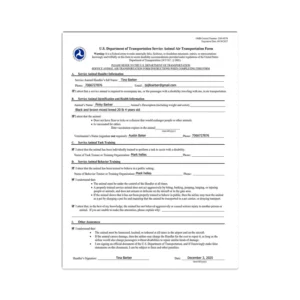
Section-by-section walkthrough of the DOT Service Animal Air Transportation Form
The current DOT form has five lettered sections (A through E) plus a signature block. Here is what to expect.
Section A: Service Animal Handler Information. You provide your full name, phone number, and email address, and check a box attesting that a service animal is required to accompany you (or the passenger with a disability you are traveling with) in air transportation.
Section B: Service Animal Identification and Health Information. This section asks for the dog’s name and a description, including weight and color. You attest that the animal does not have fleas, ticks, or a disease that would endanger people or other animals, and that it is vaccinated for rabies, and you enter the date the rabies vaccination expires. You also provide the veterinarian’s name and phone number; the veterinarian does not have to sign.
Section C: Service Animal Task Training. You attest that the dog has been individually trained to perform a task to assist with a disability and provide the name and phone number of the trainer or training organization. If you trained the dog yourself, you may list your own details. The handler is not required to provide a training certificate, although the airline may contact the trainer to verify.
Section D: Service Animal Behavior Training. You attest the dog has been trained to behave in a public setting and name the behavior trainer. You acknowledge that the animal must be under your control at all times, that a properly trained service animal does not bite, bark, jump, lunge, or relieve itself on the aircraft or in the gate area, and that an animal that has not been properly trained may be treated as a pet (pet fee and carrier) or denied transport. You also attest that, to the best of your knowledge, the dog has not behaved aggressively or caused serious injury, or explain why you cannot.
Section E: Other Assurances and signature. You confirm the animal must be harnessed, leashed, or tethered at all times in the airport and on the aircraft; that the airline may charge you for damage the animal causes if it would charge other passengers for similar damage; and that you are signing an official DOT document and can face fines and other penalties for knowingly false statements. The form’s warning cites 18 U.S.C. § 1001.
 Prevents airport boarding delays and access issues
Service Dog Air Travel Form
 Accepted by Airlines
 Meets Federal DOT Rules


What is the DOT Relief Attestation form for flights of eight hours or more?
For flight segments of 8 hours or more, 14 CFR 382.75 allows airlines to require a second form: the DOT Service Animal Relief Attestation Form. It shares the same OMB control number (2105-0576).
The relief attestation asks for the estimated flight length, flight date, and airports, and you check one or both boxes confirming that your dog will not need to relieve itself on the aircraft, or that it can do so without creating a health or sanitation issue. You then describe how (for example, the use of a dog diaper).
Delta Air Lines lists the relief attestation as a separate PDF on its service animal page, required only for flights of 8 hours or more. Other carriers may build it into an online request form, so check how your airline handles it.
Handlers should consider their dog’s normal routine and talk with their veterinarian before attesting. This is especially important for young dogs, seniors, or dogs with medical conditions that affect bladder control. Check each airline’s relief attestation instructions and any foreign-government quarantine rules for long-haul routes.
How to submit the DOT form: American, Delta, and other major carriers
While the form content is the same, each airline’s submission workflow is different.
American Airlines asks passengers to submit the form online at aa.com/svan, ideally at least 48 hours before the flight, and adds the relief attestation for flights over 8 hours. Once the form is approved, American emails a Service Animal ID (SVAN ID) that you can add to future bookings for that animal. You can also present the completed form at the airport. Check American’s service animal page for the current expiration rules for the SVAN ID.
Delta Air Lines allows only trained dogs as service animals and offers a “Submit Completed Forms” button on its Trained Service Animals page. You can also bring printed forms to the airport, where an agent will assist you.
Other carriers use a mix of online uploads and airport submission. Frontier, for example, asks travelers who book more than 48 hours out to upload the form at least 48 hours before departure, and those who book later to submit it in person at the airport. Review each airline’s “traveling with service animals” page and, if unclear, call the airline’s accessibility desk.
“You may not require a passenger with a disability to check-in physically at the airport, rather than using the online check-in available to the general public, on the basis that the passenger is traveling with a service animal.”
Legal Information Institute, 14 CFR 382.76
Keep digital proof of submission. Save your email receipt, confirmation page, or screenshots with timestamps. This can help resolve disputes about whether the form was provided on time.
Codeshares and international trips: when the operating carrier’s rules matter
On itineraries sold by one airline but flown by another, check the service animal process of the airline actually operating each flight segment. Even if you book through a U.S. airline’s website, a partner carrier may have its own paperwork and deadlines.
Foreign airlines flying to and from the United States may ask for the DOT forms too, but the destination country’s own entry rules still apply on top of them. Confirm the operating carrier for each leg and then review that carrier’s service animal pages for form deadlines and relief attestation requirements.
Allow more lead time on international trips. Additional veterinary certificates, parasite treatments, or microchip documentation may be required by foreign authorities apart from the federal DOT form, and dogs entering the U.S. must meet CDC dog import rules.
Legal implications of signing the DOT service animal form
Signing the DOT form is not a casual checkbox. It is a legal attestation that your statements about your need for the animal, your dog’s training, and your dog’s health and behavior are true. The form’s warning cites 18 U.S.C. § 1001, which covers knowingly and willfully making materially false, fictitious, or fraudulent statements to secure disability accommodations. False statements can carry criminal penalties in addition to airline-level consequences like denial of transport.
Passing off a pet or emotional support animal as a service dog to avoid pet fees violates airline policies and undermines protections for legitimate service animal handlers. Be wary of online “registrations” that promise airline approval; our guide to spotting service dog registration scams explains why.
Under the ADA, a service animal is a dog individually trained to do work or perform tasks for a person with a disability. Airline staff may ask only two questions: whether the dog is required because of a disability and what work or task it is trained to perform. Comfort-only or untrained animals do not qualify.
“Dogs whose sole function is to provide comfort or emotional support do not qualify as service animals under the ADA.”
ADA.gov, ADA Requirements: Service Animals
If you face a dispute with an airline, consider consulting an attorney or disability rights organization familiar with DOT and ADA rules.
Practical tips for completing and using the DOT service animal form
Fill the form out carefully in advance. Save a clean digital copy to reuse as a template, updating vaccination dates and other details before each new trip, since airlines can ask for a form completed on or after your ticket purchase date.
Carry both digital and printed copies of the completed DOT form and relief attestation. This is especially important when changing planes, flying codeshares, or connecting to smaller regional jets where staff may not have access to your airline’s digital records. Our guide on how to fly with a service dog covers the airport side of the trip.
Double-check airline-specific rules on the number of service animals per passenger, seating, and large dogs.
“You are not required to accept more than two service animals for a single passenger with a disability.”
Legal Information Institute, 14 CFR 382.74
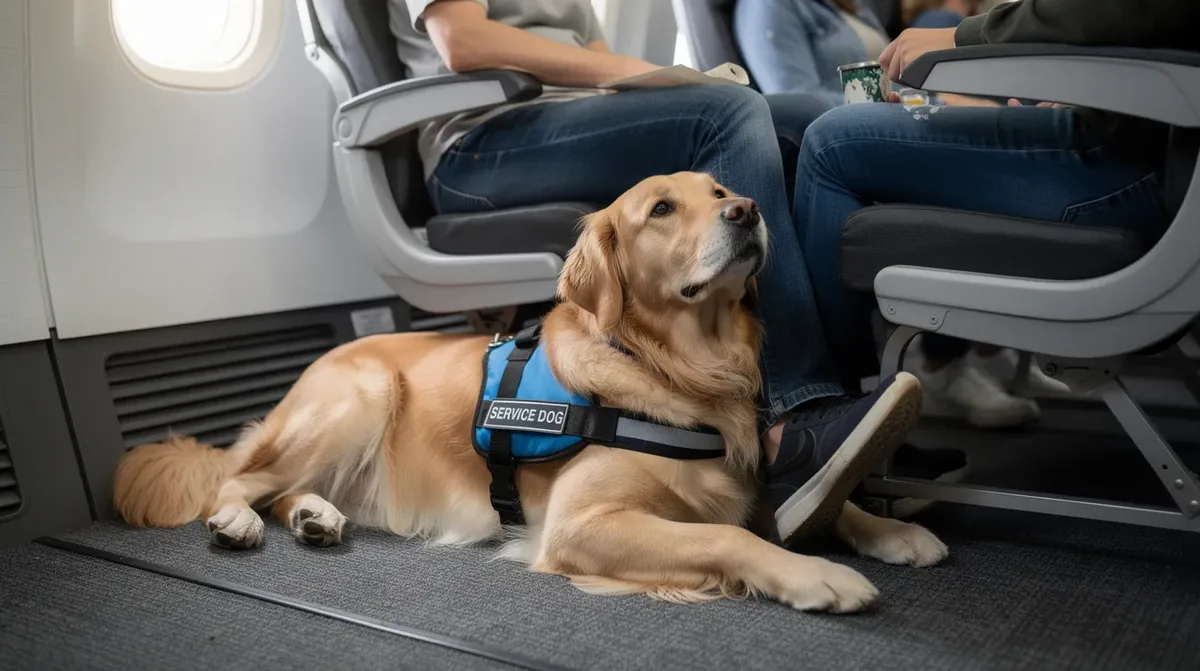
A service dog must fit on your lap or in your foot space without blocking aisles or emergency exits. Under 14 CFR 382.77, if a large dog does not fit, the airline must first offer another seat in the same class of service where the dog can be accommodated, if one is available. If no cabin option works, it must offer to carry the dog in the cargo hold free of charge or on a later flight with space.
When speaking with airline staff, be ready to answer the two permitted questions about whether your dog is required because of a disability and what tasks it is trained to perform. You do not need to share private medical information or show a registration document.
The DOT paperwork requirements stay the same regardless of how or where you bought your ticket.
References
-
U.S. Department of Transportation. Traveling by Air With Service Animals, final rule, 85 FR 79742. Federal Register, 2020. govinfo.gov
-
U.S. Department of Transportation. 14 CFR 382.75: Documentation for service animals. Legal Information Institute, Cornell Law School. law.cornell.edu
-
U.S. Department of Transportation. 14 CFR 382.27: Advance notice. Legal Information Institute, Cornell Law School. law.cornell.edu
-
U.S. Department of Transportation. 14 CFR 382.74, 382.76 and 382.77: Number, check-in and placement of service animals. Legal Information Institute, Cornell Law School. law.cornell.edu
-
U.S. Department of Transportation. Service Animal Air Transportation Form (OMB 2105-0576), September 2024. DOT, 2024. transportation.gov
-
Delta Air Lines. Trained Service Animals. Delta, 2026. delta.com
-
U.S. Department of Justice. ADA Requirements: Service Animals. ADA.gov. ada.gov
This article is informational only and not legal advice. Confirm current rules on your airline’s official website before you fly.
The content on this website is for informational purposes only and does not constitute professional medical advice, diagnosis, treatment, or legal counsel.
Still Unsure If You Qualify?
Skip the confusion. Take a 3-minute assessment to see what your animal legally needs.
U.S handlers trust MyServiceAnimal

FAQ
No. Emotional support animals do not use the DOT service animal form. Since January 11, 2021, airlines may treat ESAs as pets, apply pet fees, and require pet carriers. Only dogs individually trained to perform tasks for a person with a disability, including psychiatric service dogs, qualify as service animals for air travel purposes.
No. Under 14 CFR 382.76, an airline may not require you to check in physically at the airport, instead of using the online check-in available to everyone, just because you are traveling with a service animal.
If you book more than 48 hours before departure, an airline can require the form up to 48 hours in advance, so submit it as soon as you book. If you book less than 48 hours out, the airline must let you present the form at the departure gate on the day of travel, though processing could delay boarding.
Not for every flight segment. Airlines can ask for a current form for each trip, and DOT treats a round trip on one ticket as one trip. Changing carriers or booking new tickets usually means completing a new form. If your dog’s rabies vaccination expires or details change, you will also need an updated form.
Ask to speak with the airline’s Complaints Resolution Official. Under 14 CFR 382.151, airlines must make one available at no cost, in person at the airport or by telephone. Document the situation with photos, copies of forms, and correspondence. You can then file a disability complaint with DOT’s Office of Aviation Consumer Protection. A disability rights attorney can also help if needed.