
Can a Cat Be a Service Animal? (Service Cats, ESAs & Therapy Cats Explained)
Under the Americans with Disabilities Act (ADA), a cat cannot be a service animal. Federal law limits service animals to dogs (and miniature horses in limited cases), so even a highly trained cat has no ADA public access rights. However, cats can still play important legal and emotional roles as emotional support animals in housing and as therapy cats in community settings.
This article breaks down the real difference between service dogs, emotional support cats, and therapy cats, including a comparison table, qualification steps, and what changed with recent federal guidance.
Key Takeaways
-
Under the Americans with Disabilities Act (ADA), only dogs and miniature horses are recognized as service animals. Cats cannot be considered service animals, regardless of training.
-
Many people say “service cats,” but U.S. law places cats in different categories: emotional support animals (ESAs) for housing under the Fair Housing Act, or therapy cats for facility visits.
-
Emotional support cats have housing protections but lack public access rights. Since 2021, airlines may treat emotional support cats as regular pets.
-
There is no official U.S. government registry for ESAs or service animals. An ESA letter must come from a licensed mental health professional.
-
The rest of this article walks through how to qualify, what your legal rights actually are, and how to tell these categories apart in practice.
What Is a Service Animal under U.S. Law?
A service animal is legally defined as a dog individually trained to do work or perform tasks for a person with a disability (ADA.gov). The ADA also has a separate, limited provision for miniature horses under specific conditions, such as being housebroken, under the handler’s control, and of manageable size for the facility. But dogs remain the primary species covered.
Common types of service dogs include:
-
Guide dogs for people with visual impairments
-
Hearing alert dogs for deaf or hard-of-hearing individuals
-
Psychiatric service dogs trained to interrupt panic attacks, perform grounding tasks, or remind handlers to take medication
-
Mobility assistance dogs that retrieve items or provide balance support
-
Seizure alert dogs that respond to or predict seizures
The ADA is enforced by the U.S. Department of Justice and applies to most public places in the United States, including stores, restaurants, hotels, and government buildings. The ADA requires service animals to remain under control and focused on task execution without disruption.
Staff at covered businesses may only ask two questions if it is not obvious the dog is a service animal: (1) is the dog required because of a disability, and (2) what work or task has the dog been trained to perform. They cannot demand certification, registration, ID cards, or vests. There is no official U.S. government registry that grants legal rights.
Animals whose sole function is to provide comfort or emotional support are not considered service animals under the ADA, even if they are deeply important to the person’s well-being.
Can a Cat Be a Service Animal?
Under the ADA, a cat cannot be a service animal. The terms “service cats” or “service kitties” have no federal legal standing, and cats do not have public access rights as service animals in the United States.
This species rule is a legal limitation, not a statement about how helpful a feline companion can be. The ADA definition applies only to service dogs, with a separate limited provision for miniature horses. No other animals are included.
“Beginning on March 15, 2011, only dogs are recognized as service animals under titles II and III of the ADA.”
U.S. Department of Justice, ADA Requirements: Service Animals
A common misconception is that special training can turn a cat into a service animal. Even a cat trained to perform tasks does not gain ADA status or the right to enter non-pet-friendly public spaces. Training does not change the species classification under federal law.
Some states or individual businesses may voluntarily allow companion animals like a kitty companion on a case by case basis, but those are private policy choices. They are not federal rights and can vary widely from one city or store to the next.
So where do cats fit legally? The answer is in two roles: emotional support cats in housing and therapy cats in community facilities.

What Is an Emotional Support Cat?
An emotional support cat is a domesticated cat that provides emotional support to a person with a diagnosed mental or emotional disability. Unlike service animals, emotional support cats do not require special training. Their value comes from their calming presence, companionship, routine, and affection.
Emotional support cats help with mental health conditions such as anxiety, depression, PTSD, and panic disorder. Many owners find that a cat’s daily company eases stress, and a clinician may conclude that a cat helps alleviate specific symptoms of anxiety or depression.
Typical benefits owners report include:
-
Lower perceived stress during difficult moments
-
Reduced loneliness, especially for people living alone
-
Better sleep routines tied to the cat’s schedule
-
Grounding during panic episodes or intrusive thoughts
There is no official U.S. government “registration” for emotional support cats. The key document is an ESA letter from a licensed health care professional confirming that the animal alleviates symptoms of a disability. You do not need to register your ESA cat on any website or database. Some owners still choose an optional emotional support animal ID package for everyday convenience, but it is an identification tool only and does not create legal rights. Our guide to the emotional support cat covers the paperwork side in more detail.
For many handlers, an emotional support cat is as emotionally impactful as any dog. The legal framework is simply different.
How Do I Qualify for an Emotional Support Cat?
Qualifying for an emotional support animal centers on the person’s disability and need, not on the cat’s breed, age, or skills. The process is about mental health documentation, not “certifying” the feline companion.
Common qualifying mental health conditions include:
-
Generalized anxiety disorder
-
Major depressive disorder
-
Post-traumatic stress disorder (PTSD)
-
Chronic insomnia related to anxiety or depression
-
Panic disorder
A licensed health care professional, such as a psychiatrist, psychologist, licensed professional counselor, or in some states a primary-care doctor, must determine that an emotional support cat would help with the person’s symptoms.
The typical steps look like this:
-
Schedule an appointment with a licensed mental health professional.
-
Discuss your symptoms, daily limitations, and how a cat helps.
-
If clinically appropriate, receive an ESA letter stating your need.
An ESA letter should come from a licensed health care professional who has actually evaluated your condition. Federal law sets no expiration date, but many housing providers ask for a reasonably recent letter, so plan on updating it from time to time. Some states add their own rules: California, for example, requires a 30-day client-provider relationship before a professional can issue ESA documentation (Health and Safety Code 122318).
There is no need to “register” an emotional support cat on any national database. Websites selling ESA registrations or ID cards do not create legal rights by themselves.

Housing Rights for Emotional Support Cats (Fair Housing Act)
The Fair Housing Act (42 U.S.C. 3604(f)(3)(B)) requires housing providers in the U.S. to consider reasonable accommodations for assistance animals. This includes emotional support cats. The Fair Housing Act protects emotional support cats in housing, and it protects your right to live with an ESA even in buildings with no-pets policies.
In simple terms, “reasonable accommodation” can mean:
-
Allowing an emotional support cat in a no-pets building
-
Making an exception to breed restrictions or weight limits for the animal
-
Waiving pet deposits or pet rent for the ESA (now contested for untrained animals, see below)
HUD withdrew its older assistance animal guidance documents (FHEO-2020-01 and FHEO-2013-01) effective September 17, 2025 (Federal Register document 2026-06624). These documents are no longer current policy. Landlords and tenants now look directly to the statute, court decisions, and any applicable state or local laws for guidance.
Renters typically follow these steps (our guide to renting an apartment with an emotional support animal walks through each one):
-
Submit a written accommodation request to the landlord or property manager.
-
Attach the ESA letter from a licensed health care professional.
-
Cooperate reasonably with any follow-up questions that stay within fair housing rules.
Housing providers can deny a request only in limited situations, such as where the animal poses a direct threat, causes significant property damage, or fundamentally alters the provider’s operations. The denial must be evaluated on a case by case basis. The statute itself sets the safety and damage limit:
“Nothing in this subsection requires that a dwelling be made available to an individual whose tenancy would constitute a direct threat to the health or safety of other individuals or whose tenancy would result in substantial physical damage to the property of others.”
Legal Information Institute, 42 U.S. Code 3604(f)(9)
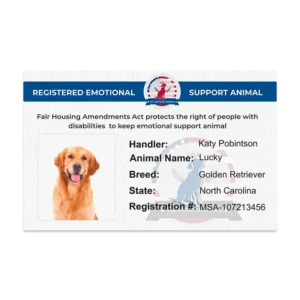
 Resolves 80% of housing disputes instantly
Emotional Support Animal Registration
 Instant Digital ID
 Free Shipping
 5-Min Process


Where Are Emotional Support Cats Allowed in Public?
Emotional support cats lack public access rights under the ADA. They do not have a legal right to enter non-pet-friendly public places like grocery stores, malls, restaurants, or other places that allow only service animals.
Some businesses may choose to allow ESAs voluntarily. A small counseling practice or a pet-friendly cafe might welcome a well-behaved cat, but they are not required to. Rules change from one location to another.
Air travel changed significantly on January 11, 2021, when the Department of Transportation’s final rule under the Air Carrier Access Act (14 CFR part 382) took effect. Airlines are no longer required to accept emotional support animals as service animals. Since 2021, airlines may treat emotional support cats as regular pets, meaning they can charge pet fees and enforce carrier, health, and behavior requirements. Airlines for America, the airline trade group, reported nearly 60 percent growth in emotional support animals on flights in 2017, which was part of the pressure behind the rule change (A4A).
“Animal species other than dogs, emotional support animals, comfort animals, companionship animals, and service animals in training are not service animals for the purposes of this part.”
Legal Information Institute, 14 CFR 382.3, Definitions
Trained psychiatric service dogs are still treated as service animals for flights and may need to complete the DOT Service Animal Air Transportation Form. Emotional support cats are subject to standard pet policies on all carriers.
Practical tips for traveling with your cat:
-
Always check airline, train, or bus policies before booking
-
Expect to pay a pet fee
-
Prepare a comfortable carrier and bring up-to-date vaccinations and health records
What Is a Therapy Cat?
Therapy cats are different from both service animals and emotional support cats. Therapy cats are trained to provide comfort in community settings like hospitals, nursing homes, schools, and counseling centers. They visit multiple patients or groups rather than living with and supporting one handler.
Therapy cats are typically evaluated and registered through private therapy-animal organizations that assess temperament, health, and safe handling. This is a private credential, not a legal category like a service dog.
Ideal traits for a therapy cat include being sociable, tolerant of handling and noise, comfortable with car rides and new places, and generally affectionate with strangers. Cats that are well suited to this work enjoy contact with humans and do not startle easily.
Concrete examples include weekly visits to a local VA hospital or reading programs in elementary schools where children read aloud to a calm cat. These programs can benefit patients, students, and seniors alike.
Therapy cats have no special housing rights or public access rights under federal law. They enter facilities only with that facility’s permission.
Service Cats vs Emotional Support Cats vs Therapy Cats
The table below helps you see the difference at a glance. Remember, the law does not recognize cats as service animals, so the “Service Dog” column is included as the legal baseline.
|
Criteria |
Service Dog |
Emotional Support Cat |
Therapy Cat |
|---|---|---|---|
|
Training required |
Individually trained for specific tasks |
No special training required |
Temperament evaluation by private organization |
|
Primary role |
Perform tasks directly related to a disability |
Provide comfort and companionship at home |
Visit multiple people in facilities |
|
Legal basis |
ADA (federal) |
Fair Housing Act (federal), state laws |
Private facility policies |
|
Housing rights |
Yes, under the FHA |
Yes, under FHA as reasonable accommodation |
No federal housing rights |
|
Public access (stores, restaurants) |
Yes, under ADA |
No |
No (facility permission only) |
|
Flights |
Flies as service animal (DOT form may be required) |
Treated as a pet; airlines may charge fees |
No special flight rights |
Real-world examples:
A psychiatric service dog might be trained to sense an oncoming panic attack and interrupt it by applying deep pressure or leading the handler to a safe space. That dog is generally allowed in stores and restaurants under the ADA and can fly as a service animal under DOT rules.
An emotional support cat might help its owner manage evening anxiety and depression at home by providing routine, companionship, and a calming presence during stressful moments. That cat is protected in housing but not in public spaces generally.
A therapy cat might visit a senior living community weekly, spending time with residents and helping reduce feelings of isolation. That cat enters only with the facility’s blessing.
Although the term “service cats” is common online, using accurate language helps avoid conflict with landlords, airlines, and businesses. The legal rights attached to each category are different, and clarity matters.

Choosing and Preparing a Good Emotional Support Cat
Nearly any breed can become an emotional support cat if its temperament and the handler’s lifestyle are a good match. Personality matters more than pedigree.
Desirable traits include:
-
Calm but affectionate behavior
-
Enjoys human contact and does not hide for long periods
-
Tolerates some change in routine
-
Reliable litter box habits
-
Comfortable spending time indoors in an apartment or rental home
A few breeds commonly described as people-oriented include Ragdoll, Maine Coon, and American Shorthair (see our list of the best emotional support cat breeds). That said, many mixed-breed shelter cats make excellent emotional support cats. If your mental health professional supports a different species, such as a rabbit, remember that housing requests under the FHA are still evaluated case by case.
Practical preparation tips:
-
Schedule a veterinary exam and vaccinations before moving in
-
Microchip your cat for safety
-
Set up a quiet space with a bed, litter box, food, and water
-
Gradually introduce the cat to new sounds, people, and new places
Be realistic about what a kitty companion can and cannot do. Build a daily routine (feeding, grooming, playtime) that supports both your mental health and the cat’s well-being. An emotional support cat is not a replacement for professional treatment, but it can be a meaningful part of your overall plan.
Common Myths About Service Cats, ESAs, and Registries
Myth: Cats can be “certified service animals” that must be allowed everywhere. Cats may provide emotional support or therapeutic assistance but do not meet the ADA service animal definition. The ADA does not recognize cats as service animals, no matter what any website claims.
Myth: There is a national ESA or service animal registry. There is no official U.S. government registry for service animals or emotional support cats. ID cards, vests, and certificates are optional identification tools. They do not create or guarantee legal rights.
Myth: A website can guarantee landlord or airline approval. No product or service can guarantee approval. Landlords evaluate requests based on the FHA statute and supporting documentation. Airlines set their own pet policies within DOT rules.
Myth: Emotional support cats still fly free. Since early 2021, airlines may treat ESAs as pets and charge standard pet fees. Older information claiming otherwise is outdated.
Myth: A video or social media post proves your cat is a service animal. Documentation of a cat’s behavior does not change its legal classification. If you have a complex housing or access situation, speak with an attorney or contact a local fair-housing agency. Rely on ADA.gov, the Fair Housing Act statute, current airline policies, and state statutes for accurate, up-to-date information.

References
-
U.S. Department of Justice, Civil Rights Division. ADA Requirements: Service Animals. ADA.gov, 2011 (updated February 28, 2020). ada.gov
-
Legal Information Institute. 42 U.S. Code 3604, Discrimination in the sale or rental of housing. Cornell Law School. law.cornell.edu
-
Legal Information Institute. 14 CFR 382.3, Definitions (Air Carrier Access Act regulations). Cornell Law School. law.cornell.edu
-
U.S. Department of Housing and Urban Development. Withdrawal of guidance documents, Federal Register document 2026-06624. Federal Register, 2026. federalregister.gov
-
Airlines for America. New Rules for Animals in the Sky. A4A, 2019. airlines.org
Disclaimer: This article from MyServiceAnimal.org is for informational purposes only and is not legal advice.
The content on this website is for informational purposes only and does not constitute professional medical advice, diagnosis, treatment, or legal counsel.
Still Unsure If You Qualify?
Skip the confusion. Take a 3-minute assessment to see what your animal legally needs.
U.S handlers trust MyServiceAnimal

FAQ
Psychiatric service dogs are recognized service animals when they are trained to perform specific tasks for psychiatric disabilities, such as interrupting self-harm or responding to a medical emergency like a severe panic episode. However, current U.S. federal law does not allow cats to be psychiatric service animals. Even if your cat seems to sense your anxiety and comes to comfort you, that behavior is considered emotional support and does not change the cat’s legal status. A dog trained for psychiatric tasks occupies a completely different legal category.
This is no longer settled. HUD’s older guidance said housing providers should not charge pet fees for an approved assistance animal, but that guidance was withdrawn, and under the HUD enforcement guidance of May 22, 2026 HUD now finds reasonable cause only for animals trained to provide disability-related assistance, which an emotional support cat is not. State law, your lease and court decisions now decide most fee questions, and private Fair Housing Act claims remain possible. Tenants are still responsible for any damage their cat causes, and some state or local rules may add specifics about security deposits or required documentation. If your landlord insists on charging pet rent for an approved ESA, that may be a fair housing violation worth reporting.
There is no fixed federal limit on the number of ESAs, but each animal must be part of a reasonable accommodation supported by your licensed health care professional. A doctor or therapist should document why more than one feline companion is needed. Practical limits like apartment size, local animal-keeping laws, and potential impact on neighbors all affect what a landlord or court considers “reasonable.”
Emotional support cats do not require special training. They are not required to attend formal behavior classes to qualify as ESAs. Their main role is emotional support and companionship, not task performance. That said, basic manners, litter box reliability, and safe behavior around humans are still important, especially in shared housing. A cat that causes constant disruption or poses a safety concern could weaken your accommodation request.
While veterinarians care for the animal’s health, ESA letters typically must come from a licensed professional who treats the handler’s mental or emotional health. This includes therapists, psychologists, psychiatrists, or licensed physicians. Your vet can support the process by keeping your cat healthy, ensuring vaccinations are current, and documenting that the animal is safe and well-behaved. Some landlords may request veterinary records separately from the ESA letter itself.