Allegiant Pet Policy: Complete 2026 Guide for Pets, Service Dogs & ESAs
Allegiant Air allows only domestic dogs and cats in the cabin, on flights within the 48 contiguous United States. The airline does not transport pets in cargo at all. Emotional support animals are treated as pets with standard fees, while trained service dogs fly free as working animals.
Policies checked October 2026 on Allegiant’s official Contract of Carriage (Article 47, Pets, and Article 48, Service Animals), Optional Services and Fees and Passengers with Special Needs pages. Airline rules and fees change, so confirm the details with Allegiant before you book.
Key Takeaways
Allegiant Airlines keeps its pet policy simple but strict. Only domestic dogs and cats may travel in the cabin, and there is no checked pet or cargo option. ESAs are treated as ordinary pets under federal air travel rules that took effect in January 2021. Task-trained service dogs, including psychiatric service dogs, fly at no charge.
Here is what you need to know before booking:
-
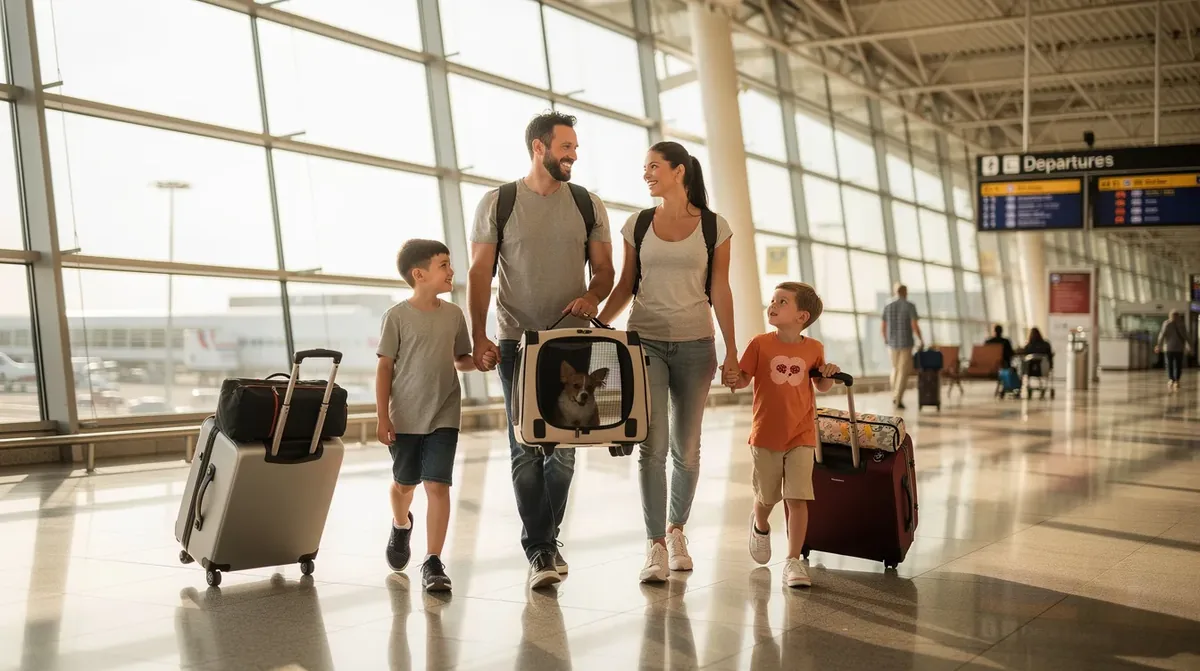
In-cabin pets must ride in a leak-proof carrier that fits under the seat in front of you. Allegiant charges a non-refundable fee of $50.00 for each one-way flight for a pet carrier.
-
Allegiant accepts trained service dogs consistent with DOT rules and requires the DOT Service Animal Air Transportation Form, completed at least 48 hours before departure when you book earlier than that. No airline can require a “service animal registration” because no official U.S. government registry exists.
-
Allegiant completed its acquisition of Sun Country Airlines on May 13, 2026. The two airlines still operate as separate carriers with their own brands, so each keeps its own pet and service animal policy. Check the rules of the airline that actually operates your flight.
Introduction: How Does Allegiant Air Handle Pets & Assistance Animals?
Allegiant Air (often called Allegiant Airlines) is a low-cost U.S. carrier focused on leisure routes connecting smaller cities to vacation destinations. Its pet policy is straightforward: small in-cabin pets only, no checked or cargo animals at all.
U.S. Department of Transportation rules changed in January 2021. Since then, only trained service dogs count as service animals for air travel. Emotional support animals now fly as pets on Allegiant and every other U.S. airline.
This guide covers three categories for Allegiant travelers:
-
Regular pets (dogs and cats in approved carriers)
-
Emotional support animals treated as pets
-
Task-trained service dogs that fly free and receive accommodations
Fees, carrier measurements and limits below come from Allegiant’s own published pages as checked in October 2026. Where Allegiant does not publish a rule, we say so instead of guessing.
What Is Allegiant Airlines Pet Policy in 2026?
As of October 2026, Allegiant’s in-cabin pet policy permits domestic dogs and cats on flights within the 48 contiguous states. Allegiant’s Contract of Carriage does not publish a fixed number of pet carriers per flight, so add the pet when you book and ask Allegiant if you are unsure.
Key rules at a glance:
-
Allegiant allows only domestic dogs and cats in the cabin. Some older online sources mention miniature horses, but Allegiant’s current Contract of Carriage lists dogs and cats as pets and accepts only dogs as service animals.
-
Allegiant does not accept any animals as checked baggage or freight. There is no cargo pet program, so larger dogs that cannot fit under the seat cannot fly with Allegiant as pets.
-
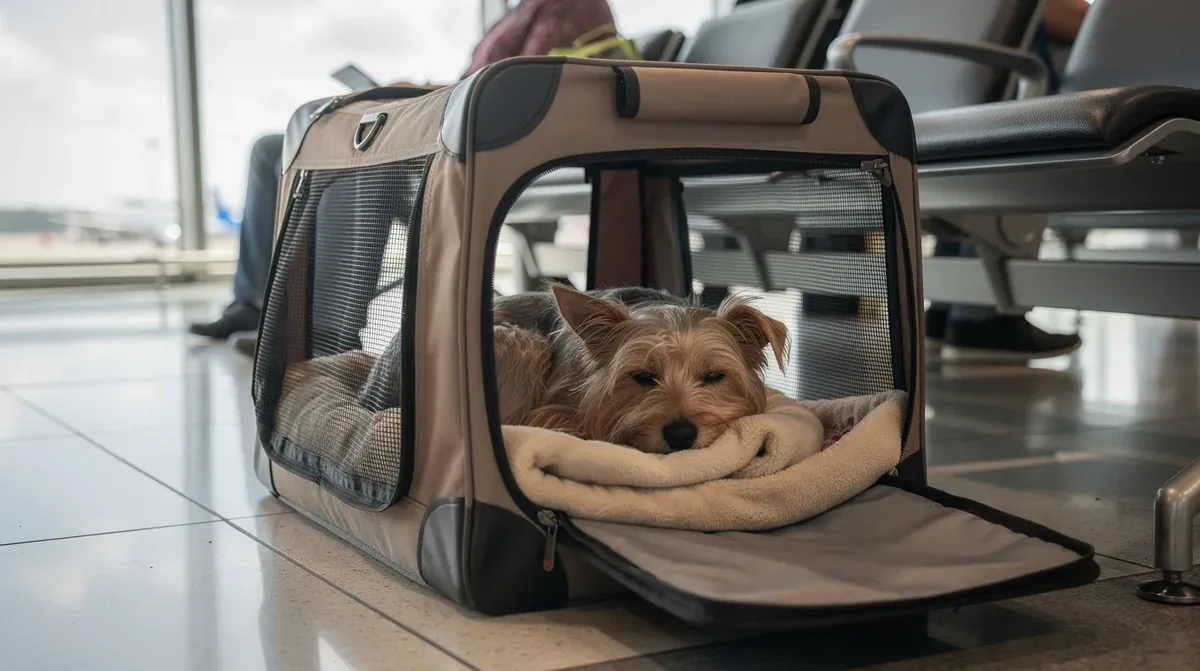
Pets must always be fully inside the carrier, including at the airport and during boarding and deplaning, and the carrier goes under the seat directly in front of you. No heads or paws may protrude from the carrier.
-
The pet carrier counts as one of your cabin items: a passenger may travel with a pet carrier and a personal item OR a carry-on, but not both.
-
Allegiant’s fee page accepts pets “for flights within the 48 contiguous states,” so do not plan pet travel to or from Hawaii, Alaska, U.S. territories or international destinations on Allegiant.
Which Pets Can Fly In-Cabin on Allegiant Air?
This section covers species, health, and behavior criteria for in-cabin pets.
-
Allegiant permits only domestic cats and dogs in the cabin. No birds, rabbits, reptiles, rodents, or exotic animals are accepted as pets.
-
A passenger may bring only one pet carrier. Two pets may share that carrier if both fit comfortably inside it.
-
Allegiant’s pet article sets no breed restrictions. However, an animal that is disruptive at the airport or onboard can be refused, and Allegiant may deny future boarding if a pet is not kept fully inside its carrier.
-
All animals must be at least eight weeks old.
-
Allegiant does not publish a separate weight limit for in-cabin pets; the practical limit is the carrier size below. Pets must be harmless, non-disruptive and odorless. Allegiant staff may refuse obviously ill or distressed animals to protect safety and comfort in the cabin.
Allegiant In-Cabin Pet Carrier Rules & Size Restrictions
The carrier is the single most important piece of equipment for flying with a pet on Allegiant. Your pet must remain contained under the seat, so getting the right carrier is essential.
Maximum carrier dimensions (Contract of Carriage, Article 47):
|
Carrier Type |
Length |
Width |
Height |
|---|---|---|---|
|
Soft-sided |
18 inches |
12 inches |
11 inches |
|
Hard-sided |
17 inches |
11 inches |
10.5 inches |
All dimensions are external measurements when the carrier is fully closed.
-
Pet carriers must be leak-proof. Allegiant prefers soft-sided carriers and accepts hard-sided ones within the smaller limits above. Soft-sided carriers compress slightly to fit under aircraft seats, while an oversized crate can be refused.
-
The pet carrier must fit entirely under the seat in front of the passenger without blocking the aisle, life vests, or other safety equipment. Pets or carriers may not be placed in or strapped into a seat.
-
Passengers traveling with pets cannot sit in the exit row or the bulkhead. Because of foot space limits, pet carriers are also prohibited in aisle seats on Boeing aircraft.
Preparation tips:
-
Start crate-training your pet at home weeks before the trip so the carrier feels familiar.
-
Attach an ID tag with your name and phone number to the carrier.
-
Line the bottom with an absorbent pad to keep things leak-proof and meet Allegiant’s guidelines.
How Much Does Allegiant Charge for In-Cabin Pets?
Allegiant Airlines charges $50.00 for each one-way flight for a pet carrier; its fee table lists Pet-in-Cabin at $50.00 per person, per segment. The fee is per carrier, not per animal inside it, so two cats sharing one carrier still cost $50 for that flight.
“There is a non-refundable fifty-dollar ($50.00) fee for each one-way flight for a pet carrier.”
Allegiant Air, Contract of Carriage, Article 47
-
The pet fee is non-refundable, even if you later decide to travel without the pet.
-
This fee is separate from Allegiant’s base ticket fare, seat selection charges, and baggage fees.
-
Allegiant lists the pet as an optional service on your booking. Add it when you book or by managing your existing booking, and call Allegiant if the option is not shown, rather than arriving at the airport with an undeclared pet.
-
This fee applies to ordinary pets and emotional support animals. Task-trained service dogs flying as service animals under DOT rules are not charged pet fees.
Quick example: If your round trip has one flight each way, expect to pay $50 going and $50 returning, for $100 total in pet fees on top of your fare.
Does Allegiant Air Require a Health Certificate or Other Vet Paperwork?
Allegiant’s pet article (Article 47) does not list a veterinary health certificate or other paperwork for in-cabin pets on its domestic flights. That is different for service dogs: Allegiant requires all service animals to have a current and verifiable rabies vaccination.
However, keep these points in mind:
-
The airline reserves the right to deny transport to animals that appear sick, injured, or unsafe to fly. A recent checkup with your veterinarian before travel is still a wise precaution.
-
Some states regulate the import of dogs and cats and may require proof of rabies vaccination. Carry paper or digital vaccine records even if Allegiant does not inspect them routinely.
-
This section refers only to ordinary in-cabin pets and ESAs treated as pets. Service dogs need the DOT Service Animal Air Transportation Form, covered below.
Any detailed medical decisions should be discussed with your own veterinarian. This article does not provide veterinary advice.
Why Doesn’t Allegiant Allow Pets on International Flights or in Cargo?
Allegiant is a point-to-point, leisure-focused carrier that keeps its pet policy narrow. Pets are limited to in-cabin travel on flights within the 48 contiguous states.
-
Allegiant does not operate a pet cargo or checked animal program. Its Contract of Carriage simply states that pets do not travel in the cargo area; it does not explain why.
-
Destinations outside the 48 contiguous states can have their own animal entry rules, and Allegiant’s service animal article warns that such destinations may restrict the type or species of animal permitted. Passengers are responsible for knowing those requirements.
-
Passengers who need to move larger dogs or who must fly to international destinations with animals may need to choose a different airline that offers checked pet or cargo options.
Always review the latest policy before booking, as Allegiant’s route map can change.

 Prevents airport boarding delays and access issues
Service Dog Air Travel Form
 Accepted by Airlines
 Meets Federal DOT Rules


How Does Allegiant Treat Emotional Support Animals (ESAs)?
Since the January 2021 DOT rule change, Allegiant treats emotional support animals as regular pets. Allegiant’s service animal rules cover only trained dogs, and federal regulations exclude ESAs from the definition of a service animal. Emotional support animals incur standard pet fees on Allegiant Airlines.
“Animal species other than dogs, emotional support animals, comfort animals, companionship animals, and service animals in training are not service animals for the purposes of this part.”
U.S. Department of Transportation, 14 CFR 382.3, Definitions
ESA letters from a licensed mental health professional can still be valuable for housing under the Fair Housing Act (42 U.S.C. 3604(f)(3)(B)), but they do not convert an animal into a service dog for Allegiant flights. They do not waive Allegiant’s in-cabin pet fees or size restrictions. Our guide to service animals versus emotional support animals explains the difference in more detail.
ESAs on Allegiant Air must fully comply with all in-cabin pet rules:
-
Species limits (dogs and cats only)
-
Carrier requirements and size restrictions
-
Route eligibility (48 contiguous states)
-
Per-flight fees ($50 each way)
-
Behavior expectations
Be cautious of any online claims about “certifying” or “registering” an ESA for free airline travel. There is no official U.S. government registry that grants extra rights for ESAs on flights. Registrations, ID cards, and vests are optional identification tools and confer no legal rights.
Understanding the difference: A psychiatric service dog trained to perform a specific task (such as interrupting a panic attack or providing deep pressure therapy during a crisis) travels as a service animal at no charge. An ESA that provides comfort through companionship alone travels as a pet with all standard fees and carrier requirements.
What Is Allegiant Airlines Policy for Service Dogs & Other Service Animals?
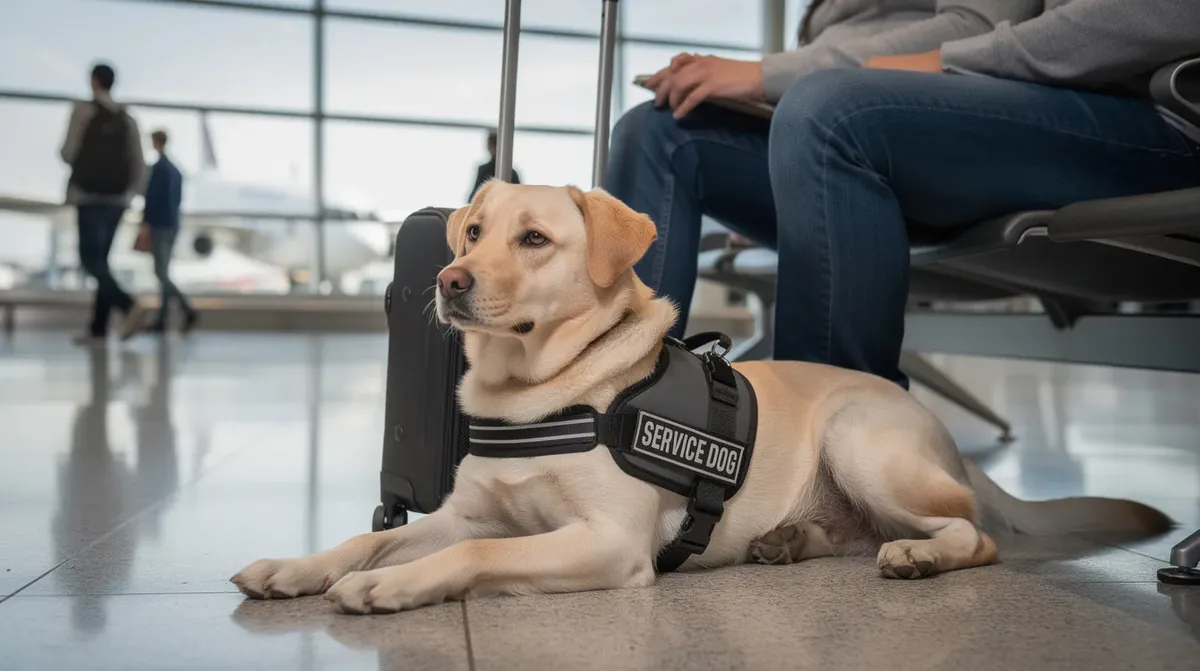
Allegiant Air follows U.S. DOT rules and recognizes only dogs that are individually trained to perform tasks for a person with a disability as service animals, including psychiatric service dogs. Allegiant accepts only domestic dogs as service animals, regardless of breed or type.
Under the ADA definition, a service animal is a dog individually trained to do work or perform tasks directly related to a person’s disability. Dogs whose sole function is comfort or emotional support are not ADA service animals. Staff may ask only two questions: whether the dog is required because of a disability and what task it is trained to perform. The ADA requires no certification, registration, ID, or vest.
“Dogs whose sole function is to provide comfort or emotional support do not qualify as service animals under the ADA.”
U.S. Department of Justice, ADA Requirements: Service Animals
Key Allegiant service dog rules as of October 2026:
-
Allegiant requires the U.S. DOT Service Animal Air Transportation Form. You can complete it online through the Open Doors Organization portal linked from Allegiant’s Passengers with Special Needs page, or email or mail it to Allegiant. Federal rules also allow airlines to ask for a relief attestation form on flight segments of 8 hours or more (14 CFR 382.75). If you want help preparing your DOT service animal form, that is a paperwork convenience only; Allegiant decides acceptance, and no form makes an untrained dog a service animal.
-
Service animals fly for free on Allegiant Airlines. No pet fee is charged for legitimate service dogs.
-
Passengers are limited to two fully trained service animals.
-
Allegiant defines a service animal as a dog “regardless of breed or type,” and DOT rules require any direct-threat decision to be an individualized assessment independent of breed (14 CFR 382.79). Claims that Allegiant bans certain breeds come from an outdated form and do not match its current contract.
-
Service dogs must be kept under control via a harness, leash, or tether at all times. The dog must fit within your foot space or on your lap without encroaching on another passenger’s space or blocking an emergency exit path. If a large dog cannot fit, Allegiant may require a second seat for the animal.
How To Fly Allegiant With a Service Dog: Practical Steps
Here is a step-by-step checklist for Allegiant travelers flying with a task-trained service dog or psychiatric service dog. Our longer guide on how to fly with a service dog covers the rules that apply on every U.S. airline.
-
Book early and indicate you are traveling with a service dog.
-
Review Allegiant’s latest service animal page for any updates to forms or requirements.
-
Complete the DOT form accurately and honestly, at least 48 hours prior to scheduled departure. If you book within 48 hours of departure, Allegiant asks you to begin the online process anyway; under federal rules the airline may then ask for the form at the departure gate instead of in advance.
-
Check in at least 45 minutes before departure and be in the gate area at least 30 minutes before departure, as Allegiant’s Contract of Carriage requires. Bring proof of your dog’s current rabies vaccination.
-
Confirm seating with gate staff. Allegiant asks for seating requests at least 24 hours before departure; avoid exit rows and make sure the dog fits safely at your feet.
Behavior standards on the aircraft:
-
The dog must remain under your control at all times, be house-broken, and stay quietly at your feet.
-
No growling, biting, repeated barking, jumping on people or roaming the cabin. Allegiant may deny transport to any animal displaying disruptive behavior.
Tips for psychiatric service dogs:
-
Practice long settle-stays in crowded, noisy places before travel day.
-
Desensitize your dog to engine noise using recordings at home.
-
Bring a familiar mat or blanket and any calming task items your dog is trained to use.
Remember: training, not paperwork, is what makes a dog a service animal.
Tips for Stress-Free Holiday & Leisure Travel on Allegiant With Animals
Allegiant’s typical leisure routes get busy during peak holiday periods. A little planning goes a long way.
-
Book early. During Thanksgiving, Christmas, spring break, and major holiday weekends, flights fill fast. Add your pet to the booking early and confirm with Allegiant if you have any doubt about space.
-
Pack a travel kit. Bring a collapsible water bowl, extra leash, waste bags, absorbent pads, a familiar blanket, and any medications in your carry-on. Never place animal supplies in checked luggage.
-
Feed lightly. Give your pet a small meal a few hours before departure to reduce motion sickness. Offer a bathroom break just before security and use pet relief areas at the airport.
-
Skip sedation unless your vet recommends it. Sedation is often discouraged for flying pets. Discuss any concerns with your veterinarian.
-
Plan ground transportation. Confirm that hotels or vacation rentals at your destination will accept pets or service dogs. Housing rights under the Fair Housing Act are separate from Allegiant’s pet policy for flights.
Allegiant Air, Sun Country Airlines & The 2026 Acquisition
In January 2026, Allegiant agreed to acquire Sun Country Airlines. Allegiant announced on May 13, 2026 that it had completed the acquisition, but as of October 2026 the two airlines still fly as separate carriers.
“Both airlines will continue to operate as separate carriers in the near term, maintaining their respective brands.”
Allegiant Travel Company, Allegiant Completes Acquisition of Sun Country Airlines (May 13, 2026)
-
Until the FAA issues a single operating certificate, Allegiant Air and Sun Country Airlines continue to operate as separate carriers. Each has its own pet, ESA, and service dog rules, published in its own contract of carriage, and they are not identical.
-
Passengers must check which airline is actually operating their flight and follow that carrier’s policy. On a Sun Country flight, use Sun Country’s rules, not the Allegiant figures in this guide.
-
This article will not speculate on how the combined airline might change pet or service animal policies in the future. Only confirmed, current rules are discussed here.
Bookmark both airlines’ official pet and service animal pages for the most accurate information before any 2026 or 2027 travel plans.
References
-
Allegiant Air. Contract of Carriage, Article 47 (Pets) and Article 48 (Service Animals), effective July 21, 2026. Allegiant Air, 2026. allegiantair.com
-
Allegiant Air. Optional Services and Fees. Allegiant Air, 2026. allegiantair.com
-
Allegiant Air. Passengers with Special Needs. Allegiant Air, 2026. allegiantair.com
-
Allegiant Travel Company. Allegiant Completes Acquisition of Sun Country Airlines, Creating the Leading Leisure-Focused U.S. Airline. Allegiant Travel Company, May 13, 2026. ir.allegiantair.com
-
U.S. Department of Transportation. 14 CFR 382.3, Definitions. Legal Information Institute, Cornell Law School. law.cornell.edu
-
U.S. Department of Transportation. 14 CFR 382.75, Service animal documentation. Legal Information Institute, Cornell Law School. law.cornell.edu
-
U.S. Department of Transportation. 14 CFR 382.79, Refusal of transport of a service animal. Legal Information Institute, Cornell Law School. law.cornell.edu
-
U.S. Department of Justice. ADA Requirements: Service Animals. ADA.gov. ada.gov
The content on this website is for informational purposes only and does not constitute professional medical advice, diagnosis, treatment, or legal counsel.
Still Unsure If You Qualify?
Skip the confusion. Take a 3-minute assessment to see what your animal legally needs.
U.S handlers trust MyServiceAnimal

FAQ
No, not if it travels as a pet. Pet dogs and ESAs must always be fully inside their carrier, which goes under the seat in front of you, and Allegiant does not allow pets or carriers in or strapped into a seat. Claims online that small pets may sit on laps if leashed do not match Allegiant’s Contract of Carriage.
Allegiant does not publish a specific weight limit for in-cabin pets. The limit in practice is the carrier: your pet must fit comfortably in a carrier no larger than 18 x 12 x 11 inches (soft-sided) or 17 x 11 x 10.5 inches (hard-sided) that fits under the seat.
Allegiant allows one pet carrier per passenger. Two pets may share that carrier if both fit comfortably inside it, and you pay one carrier fee.
Allegiant does not sell a special “service dog seat.” Service dog handlers may choose a bulkhead or non-bulkhead seat unless the dog would obstruct an emergency exit path, and Allegiant asks for seating requests at least 24 hours before departure. Exit rows are off limits, and the dog must fit in your foot space without blocking aisles or emergency equipment.
Allegiant does not advertise a general pet discount. One exception is its military benefits page, which lists “1 in-cabin pet (no fee)” for eligible military members on domestic flights, applied at the airport after an agent verifies military ID.
This article is for informational purposes only and is not legal advice. Always verify current fees, forms, and size restrictions directly on Allegiant’s official site before travel.