Southwest Dog Policy: Flying With Pets, Service Animals, and ESAs
As of 2026, Southwest Airlines allows small vaccinated domestic dogs and cats to travel in the passenger cabin only, requires trained service dogs to meet U.S. DOT standards, and treats emotional support animals as pets. Here is everything you need to know before you book.
Policies checked October 2026 on Southwest’s official Pet Policy, trained service dog, and Optional Travel Charges pages. Southwest says pet pricing can change at any time, so confirm the details with the airline before you book.
Key Takeaways
-
Southwest Airlines allows small vaccinated domestic dogs and cats in-cabin only. There is no cargo hold pet travel option. Trained service dogs, including psychiatric service dogs, fly in the cabin under U.S. DOT rules, while emotional support animals are treated as pets.
-
Southwest recommends reserving pet travel in advance by phone, requires an approved pet carrier that fits under the seat in front of you, and charges a $125 one-way pet fare per carrier on U.S. mainland flights. Space is limited, so spots fill up quickly.
-
Service animals are limited to trained dogs. Southwest requires a completed DOT Service Animal Air Transportation Form, presented at the ticket counter or gate on the day of travel. The dog must fit at the handler’s feet or on their lap without blocking aisles or taking up another person’s space.
-
Because Southwest does not transport pets in the cargo hold, large pet dogs that cannot fit in a compliant under-seat carrier generally cannot fly on this airline. Only trained service animals that can safely stay at the handler’s feet may be accommodated at larger sizes.
-
Policies and fees can change at any time. Always confirm details on Southwest’s official pet and service animal pages as of your travel date.
How does Southwest’s dog policy work in 2026?
Southwest Airlines keeps things simple compared to some carriers. Pet travel and service animal travel operate under separate rules, but both share the cabin. No pets are transported in the cargo compartment.
For pet dogs and cats, Southwest requires a small, vaccinated animal inside an approved pet carrier that fits completely under the seat in front of you. The pet fare is $125 one-way per carrier on U.S. mainland flights, and each ticketed customer may bring one pet carrier. Southwest recommends making the pet reservation in advance by calling the airline, because space is limited.
Service animals on Southwest are limited to individually trained service dogs, including psychiatric service dogs that perform specific tasks for a person with a disability. Emotional support animals now count as pets, a change that followed the January 2021 U.S. Department of Transportation rule update. Southwest now assigns seats on all flights, and pets in carriers may not sit in an exit row or the first row (bulkhead). Because there is no cargo hold pet option, Southwest is generally not suitable for travelers with medium or large non-service pet dogs.
In-cabin pet dogs on Southwest Airlines
This section covers standard pet travel rules for dogs (and cats) in the cabin, not service animals. The details reflect Southwest’s official pet guidelines as checked in October 2026.
Eligibility criteria:
-
Pets must be at least eight weeks old to travel on Southwest Airlines.
-
Current vaccinations are required (rabies documentation where required by law).
-
Only small domestic cats and dogs are accepted. Southwest Airlines does not have a list of prohibited dog breeds for in-cabin travel, but it notes that animals with heart disease, anxiety disorders, or brachycephalic airways are more susceptible to complications during flight.
-
Exotic animals are not allowed under the pet program.
-
Unaccompanied minors cannot travel with pets.
Carrier rules and limits:
-
Each ticketed customer may bring one pet carrier that can hold up to two small cats or dogs of the same species.
-
Space for pets on each flight is limited and Southwest does not publish a per-flight carrier count, so reserve early.
-
Pet carriers are counted as either a personal item or a carry-on bag.
-
Pet carriers must fit under the seat in front of the passenger.
-
The dog (including head and tail) must remain inside the carrier in the gate area, during boarding and deplaning, and throughout the flight.
Check-in procedures:
-
Arrive at the airport early and go to the Southwest ticket counter.
-
Pay the pet fare in person with an accepted credit card. Southwest Airlines charges a $125 one-way pet fare per pet carrier on U.S. mainland flights and $35 per carrier between the Hawaiian Islands. If you cancel your reservation, the pet fare is refundable.
-
At security, you hold your pet and walk through the screening device while the carrier is X-rayed.
-
Book early and call to add the pet to the reservation, because the limited number of pet spots can sell out.
Route restrictions:
Southwest does not allow pets on flights to or from Hawaii (flights between the Hawaiian Islands are fine), and pets are not allowed on international flights or any itinerary that includes an international flight. Specific requirements may apply to Puerto Rico. Check Southwest’s destination-specific pet rules before you book.
What kind of pet carrier does Southwest require for dogs?
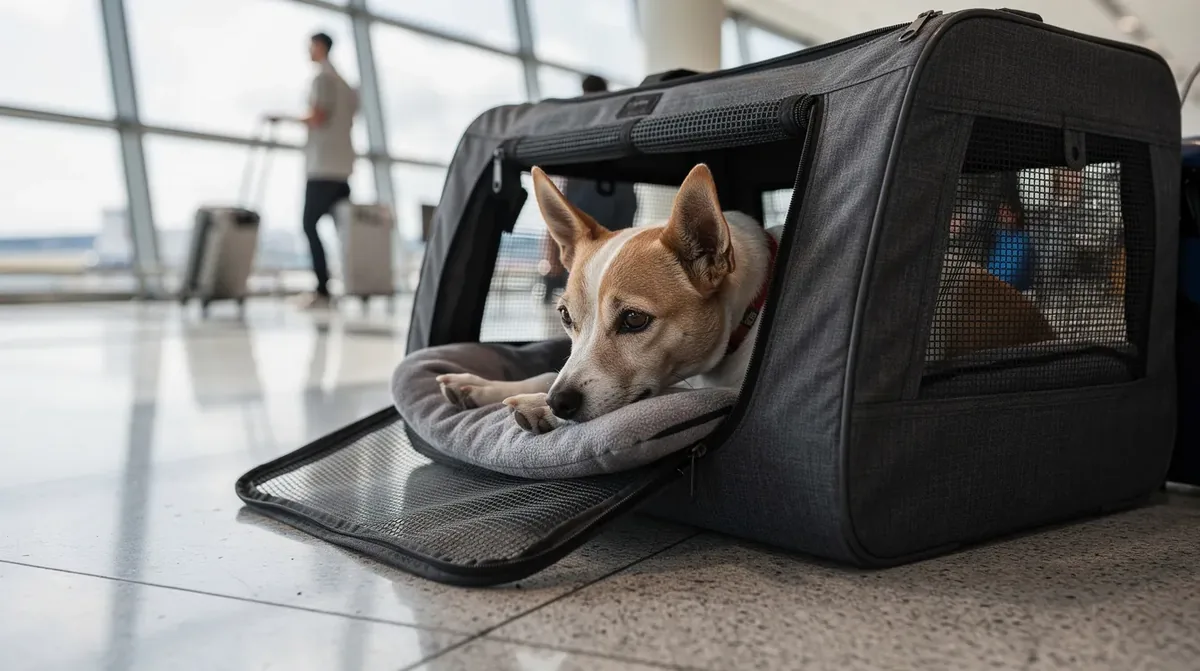
The pet carrier is critical. Southwest will deny boarding to a pet dog if the carrier does not meet their size or construction rules, regardless of your ticket status.
Southwest’s official maximum dimensions for pet carriers (as checked October 2026):
|
Carrier Type |
Length |
Width |
Height |
|---|---|---|---|
|
Southwest-branded carrier |
15 in. |
10 in. |
10 in. |
|
Other approved carriers |
Up to 18 in. |
Up to 10.5 in. |
Up to 10 in. |
These dimensions come from Southwest’s acceptable pet carriers page. Southwest recommends a soft-sided carrier because under-seat space varies by seat type and location, and space may be more limited in aisle seats.
Southwest sells its own branded pet carrier at the ticket counter ($58 on its fees page), but passengers may use any carrier that meets the size and structure rules. Soft-sided carriers tend to be more flexible and fit more easily under different seat configurations.
Functional requirements:
-
The carrier must be specifically designed as a pet carrier
-
The pet carrier must be leak-proof and well ventilated
-
No sharp hardware that could damage seats or injure the dog
-
The dog must be able to stand up and move around the carrier with ease
Practical tips:
-
Gradually crate-train your dog at home in the same carrier you plan to fly with.
-
Label the carrier with your name and phone number.
-
Place an absorbent pad and a familiar blanket inside for comfort.
-
Measure the carrier with your dog inside at home to see whether the fit is realistic.
Service dogs on Southwest Airlines: rights and documentation
Under DOT rules, Southwest recognizes only individually trained service dogs as service animals. This includes psychiatric service dogs that perform specific tasks for mental health disabilities.
The ADA definition is clear: a service animal is a dog individually trained to do work or perform tasks for a person with a disability. Comfort or emotional support alone does not qualify a dog as a service animal. The ADA has a separate, limited provision for miniature horses, but under the DOT air travel rule only dogs can be service animals.
DOT form and documentation:
-
Southwest requires a completed digital or printed DOT Service Animal Air Transportation Form, presented at the ticket counter or gate on the day of travel. The form must be dated on or after the date the ticket was purchased.
-
For flights scheduled for 8 hours or more, federal rules also let airlines require the DOT Service Animal Relief Attestation Form. Southwest’s service dog page lists only the Air Transportation Form.
-
Staff may ask fact-finding questions, including what work or task your dog has been trained to perform. Under the DOT rule, airline staff may not ask about the nature or extent of your disability.
-
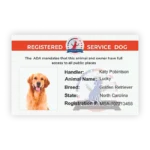
No certification, registration, ID card, or vest replaces the DOT form, and none is legally required. A vest or ID is an optional identification tool only.
“A service animal vest, harness, ID card, or registration certificate will not be accepted in place of the form.”
Southwest Airlines, I am traveling with a trained service dog
If you want help preparing the paperwork, our DOT form service is an optional convenience; it does not replace your own signed form or guarantee acceptance, and Southwest makes the final decision at the airport.
Limits and behavior standards:
-
Federal rules do not require airlines to accept more than two service animals for a single passenger.
-
The dog must be harnessed, leashed, or otherwise tethered to you at all times at the airport and onboard, and must not show aggressive or disruptive behavior.
-
Carriers must assess any safety concern individually, independent of the dog’s breed or type.
-
Southwest will refuse transportation to a dog that poses a direct threat to the health or safety of others, disrupts cabin service, or engages in disruptive behavior.
Service dogs fly free. No pet fare applies.

 Prevents airport boarding delays and access issues
Service Dog Air Travel Form
 Accepted by Airlines
 Meets Federal DOT Rules


Where can service dogs and pet dogs sit on Southwest flights?
Seating rules affect both comfort and compliance with FAA safety regulations, so handlers should plan in advance, especially with larger service dogs.
Pet dogs in carriers:
-
The carrier must stay under the seat in front of the passenger for the entire flight, and a pet may never occupy a passenger seat.
-
Pets are not permitted in an exit row or the first row (bulkhead).
Service dogs:
-
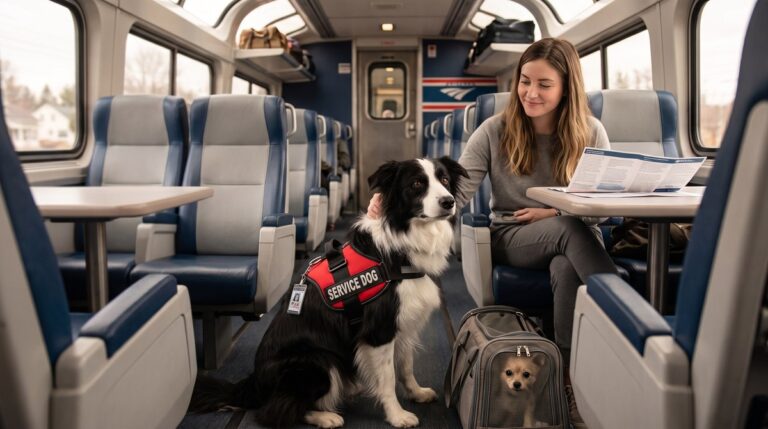
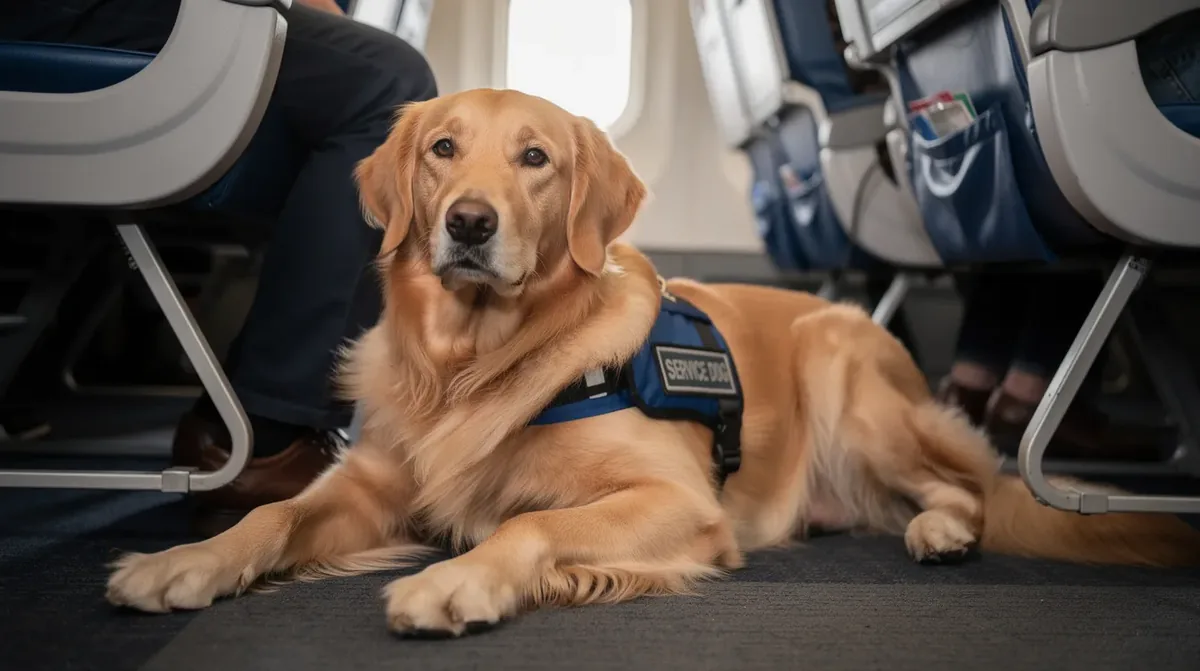
A service dog may sit on the floor at the handler’s feet or on the handler’s lap if it is no larger than a child under the age of two. The dog cannot occupy a seat or tray table, encroach on a neighboring seat, or extend into the aisle.
-
Southwest now assigns seats. Depending on your fare, you may be able to choose a seat that suits you and your dog at booking. You may sit anywhere except an emergency exit seat, and if you need a bulkhead or other specific seat because of your service dog, call Southwest after booking and no later than 24 hours before departure.
-
If a service dog cannot be safely accommodated at the original seat, the DOT rule says the airline must offer another seat in the same class of service if one is available.
Does Southwest allow dogs in the cargo hold?
No. Southwest states that no pets are transported in the cargo compartment. All accepted dogs must travel in-cabin, either as pets in a carrier or as service animals on the floor.
This means medium and large pet dogs that cannot fit comfortably in an under-seat pet carrier cannot fly on Southwest at all. Only larger dogs that are trained service animals and can safely remain at the handler’s feet may be permitted.
Some other U.S. airlines do offer cargo pet transport for larger animals. If you have already booked with Southwest but discover your dog cannot qualify as a cabin pet or trained service animal, contact the airline early, consider ground travel, or look into another carrier that can accommodate your dog’s size. Discuss any cargo travel option with your veterinarian before booking.
Emotional support animals on Southwest: ESAs are now pets
Emotional support animals previously had special access on many airlines, but since the January 2021 DOT rule change, carriers like Southwest may treat ESAs as ordinary pets. The federal rule spells it out:
“Animal species other than dogs, emotional support animals, comfort animals, companionship animals, and service animals in training are not service animals for the purposes of this part.”
14 CFR 382.3, What do the terms in this rule mean?
Southwest says service animals in training, emotional support animals, and therapy animals may qualify to travel as pets under its pet policy. That means an ESA must be a small cat or dog, ride in an approved carrier under the seat, and pay the same pet fare as any other pet. An ESA letter from a licensed mental health professional may matter for housing, but it does not grant special flying rights on Southwest.
There is no official U.S. government ESA registry. Registrations, ID cards, and vests are optional tools that provide no legal right to fly a dog as anything more than a pet. Be cautious of anyone claiming to sell “guaranteed” airline approval; our guide to spotting fake registration and letter scams explains the warning signs.
If you have a psychiatric disability and your dog is task-trained to perform work related to that disability, the dog may qualify as a psychiatric service dog. That is a different category entirely and would be accepted as a service animal based on training and behavior, not a letter alone.
How to prepare your dog for a Southwest flight
Good preparation makes the difference between a comfortable flight and a stressful one. Here are steps for both pet dogs and service dogs.
Pre-flight vet visit:
-
Schedule a health check a few weeks before departure.
-
Update all vaccinations as required by law. Carry proof of vaccination and health records.
-
Discuss anxiety management with your vet. Strong sedatives are generally discouraged at altitude.
Training and acclimation:
-
For pet dogs, practice carrier training at home so the dog can rest calmly for a long period.
-
For service dogs, practice staying under a table or at the handler’s feet in noisy, busy environments.
Packing checklist:
-
A copy of vet records and any required documentation (completed DOT forms for service dogs)
-
Extra leash and harness
-
Waste bags and cleaning wipes
-
Collapsible water bowl and a small supply of familiar food and treats
-
Absorbent pads for the carrier
Airport logistics:
-
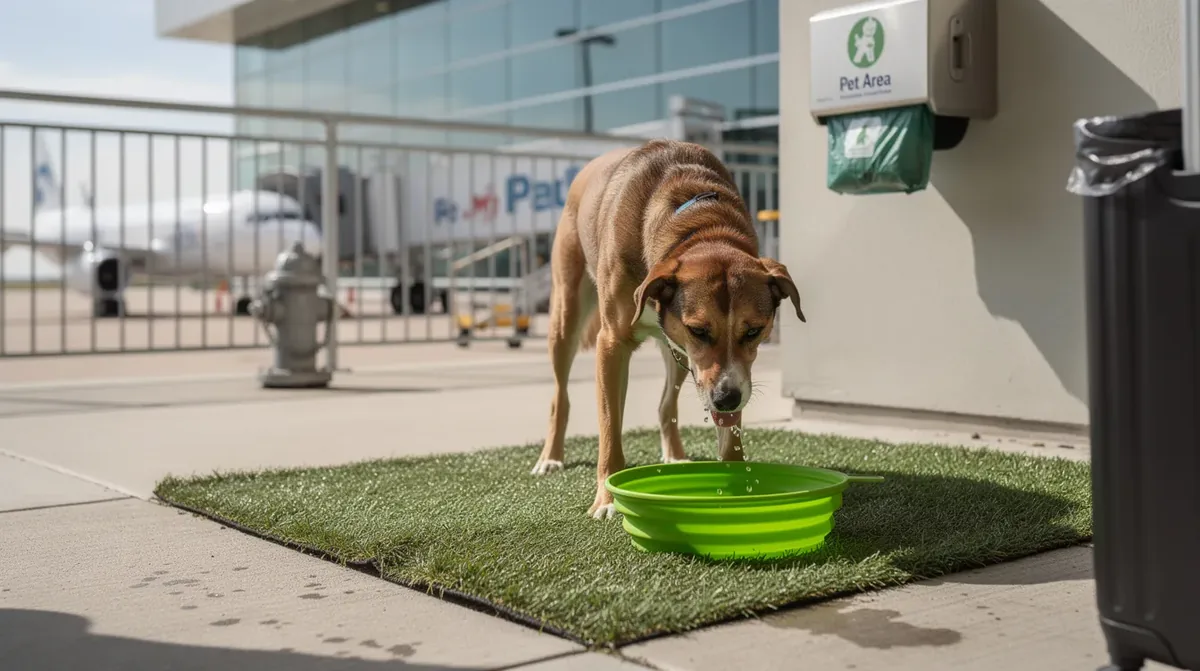
Arrive earlier than usual. Southwest has pet relief areas at each location it serves, but it will not hold a flight while you take your pet to one.
-
Pay the pet fee at the ticket counter if traveling with a pet.
-
Do not feed a full meal right before the flight to reduce nausea risk. Offer water in small amounts and check for signs of distress.
Holiday and peak-season travel tips with dogs on Southwest
Southwest flights around Thanksgiving, Christmas, New Year, and spring break sell out fast, and the limited pet travel spots go even faster. Handlers need extra lead time.
-
Book flights and pet reservations as early as you can for November, December, and other peak periods. Monitor email and the Southwest app for schedule changes, and reconfirm pet notes on the booking a few days before departure.
-
Airports are noisier and more crowded during holidays, which can stress both pet and service dogs. Bring high-value chews or puzzle toys (within TSA rules) to help your dog stay comfortable while waiting at the gate area.
-
Schedule flights earlier in the day to reduce the risk of delays, especially when traveling with a service dog that needs predictable relief breaks.
-
Winter weather can change travel plans suddenly. Carry extra dog supplies in your personal item or carry-on instead of checked bags, so you can care for your dog during unexpected overnight airport stays.
Legal framework for flying with service animals vs. pets
Southwest’s dog policy sits within a larger web of federal disability laws, primarily the Americans with Disabilities Act (ADA) and the U.S. Department of Transportation’s rules on service animals in air travel (14 CFR part 382).
ADA definition: A service animal is a dog individually trained to do work or perform tasks for a person with a disability. Psychiatric service dogs are covered if they perform trained tasks such as interrupting self-harm behaviors, grounding during episodes, or retrieving medication.
The two questions: When the need is not obvious, staff may ask only (1) whether the dog is required because of a disability and (2) what work or task the dog has been trained to perform. The ADA requires no certification, registration, or special ID; in air travel, airlines may require the DOT forms but generally no other documentation beyond what animal-import rules demand.
ESAs and comfort dogs:
“Dogs whose sole function is to provide comfort or emotional support do not qualify as service animals under the ADA.”
U.S. Department of Justice, ADA Requirements: Service Animals
That is why Southwest classifies ESAs as pets, consistent with DOT rules that took effect in January 2021.
Housing is a separate system: The Fair Housing Act has its own reasonable accommodation rules for assistance animals (42 U.S.C. 3604(f)(3)(B)), and they do not carry over to flights. For a full overview of flying with a task-trained dog, see our guide on how to fly with a service dog.
If you have questions about your rights as a handler, consider speaking with a disability rights attorney or advocacy group familiar with air travel law.
References
-
Southwest Airlines. I want to book travel with my pet (Pet Policy). Southwest Help Center, 2026. support.southwest.com
-
Southwest Airlines. What type of pet carrier can I bring? Southwest Help Center, 2026. support.southwest.com
-
Southwest Airlines. I am traveling with a trained service dog. Southwest Help Center, 2026. support.southwest.com
-
Southwest Airlines. Optional Travel Charges. Southwest Airlines, 2026. southwest.com
-
U.S. Department of Transportation. 14 CFR 382.3, What do the terms in this rule mean? Legal Information Institute, Cornell Law School. law.cornell.edu
-
U.S. Department of Transportation. 14 CFR 382.74, How many service animals must a carrier transport in the cabin of aircraft? Legal Information Institute, Cornell Law School. law.cornell.edu
-
U.S. Department of Justice. ADA Requirements: Service Animals. ADA.gov. ada.gov
This article is informational and not legal advice. Policies were checked in October 2026; confirm current rules and fees with Southwest before you fly.
The content on this website is for informational purposes only and does not constitute professional medical advice, diagnosis, treatment, or legal counsel.
Still Unsure If You Qualify?
Skip the confusion. Take a 3-minute assessment to see what your animal legally needs.
U.S handlers trust MyServiceAnimal

FAQ
No. Southwest only accepts small dogs that fit comfortably in an under-seat pet carrier and does not offer cargo hold pet travel. Most medium and large non-service dogs cannot travel on Southwest. Contact the airline to confirm, and consider other carriers or ground transport if your dog exceeds Southwest’s in-cabin limits.
Southwest’s pet pages set carrier dimensions rather than a separate pet weight limit. The dog must be able to stand up and move around inside the carrier with ease, and the carrier must fit entirely under the seat. Check the current policy on Southwest’s website before booking.
Service dogs must stay within the handler’s foot space or lap and cannot block the aisle or exit paths. If a dog cannot fit safely without blocking the aisle, Southwest may try to reseat the handler or, in rare cases, may not be able to transport the team on that flight.
Southwest welcomes “vaccinated” pets but does not list a specific vaccination document for domestic pet check-in. Carry rabies and core vaccine records in case airport authorities or the airline request proof, especially for flights to Hawaii or Puerto Rico, where extra rules apply.
Handlers are responsible for their animal’s behavior. If a dog bites or shows threatening behavior, Southwest can refuse transport or remove the team from the flight consistent with the DOT’s “direct threat” standard, and a pet showing disruptive behavior may be denied boarding.