How To Make Your Dog A Service Dog (U.S. Guide)
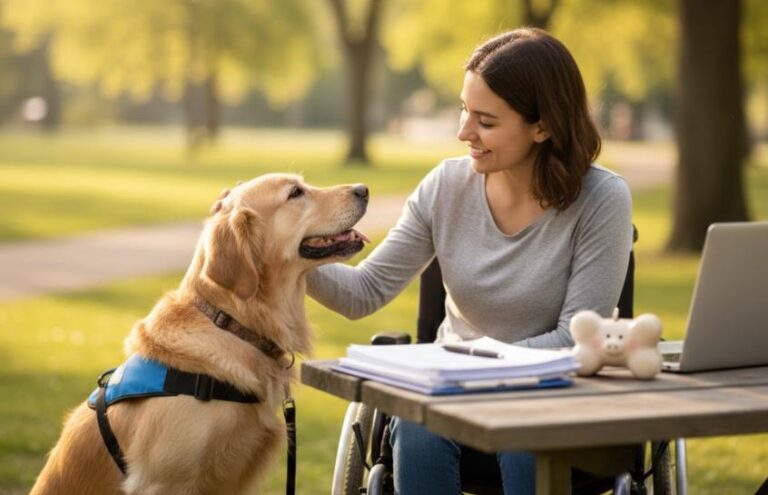
Under U.S. federal law, you can train your own service dog if you have a qualifying disability and the dog is individually trained to perform specific tasks related to that disability. There is no requirement for certification, registration, or a professional training program. The process often takes a year or more and involves screening your dog’s temperament, building solid obedience, teaching disability-related tasks, and polishing public access manners.
Key Takeaways
-
Under the Americans with Disabilities Act (ADA), a service animal is a dog individually trained to do work or perform tasks for a person with a disability. You are legally allowed to train your own service dog.
-
Comfort or companionship alone does not make a dog a service animal under the ADA, and no federal registration or certification is required.
-
The process often takes a year or more and includes temperament screening, basic obedience, task-specific training, and public access readiness.
-
Working with professional trainers experienced in service dog training can greatly improve your chances of success, even if you primarily do owner training.
What Is a Service Dog Under U.S. Federal Law?
Under the ADA, a service animal is a dog individually trained to do work or perform tasks for a person with a disability. The ADA covers physical, sensory, psychiatric, intellectual, and other mental impairments that substantially limit one or more major life activities. The Department of Justice describes service dogs as working animals, not pets.
The key word is “tasks.” A service dog must be trained to perform specific tasks that directly assist the handler. Examples include alerting to a panic attack, retrieving medication, guiding a visually impaired person, or interrupting self-harm behavior. These must be active, observable behaviors tied to the handler’s disability.
Dogs whose sole function is emotional support or comfort do not qualify as service animals under the ADA, even if an ESA letter has been issued by a licensed professional.
“Dogs whose sole function is to provide comfort or emotional support do not qualify as service animals under the ADA.”
U.S. Department of Justice, ADA Requirements: Service Animals
Service dogs are highly trained working dogs that assist individuals with disabilities in leading more independent lives.
Miniature horses may sometimes qualify under the ADA as well, but this guide focuses on dogs since the question is how to make your dog a service dog.
Is My Disability Eligible for a Service Dog?
You do not need to “register” your disability with any government body. However, the handler must have a physical or mental disability that limits major life activities to qualify under the ADA.
Eligible conditions include, but are not limited to:
-
Mobility impairments
-
Diabetes
-
Epilepsy
-
Autism spectrum disorder
-
Post traumatic stress disorder (PTSD)
-
Panic disorder
-
Severe depression or OCD
-
Traumatic brain injury
-
Hearing or vision loss
Individuals with disabilities can apply for a service dog through organizations or choose to owner-train. Age rules differ by program, and some organizations place dogs with children when a parent or guardian acts as the handler, so check each program’s eligibility page.
Talk with a licensed health care professional about whether a service dog could help your specific condition. Write down daily challenges you face, such as falls, dissociation, sensory overload, or missed alarms, so you can later identify concrete ways a dog could directly assist you. Claiming a disability is serious since service dogs receive broad public access rights based on that status.
Does My Current Dog Have the Right Temperament to Become a Service Dog?
Not every dog is suited for service work. Even a well-loved family pet may lack the traits needed to work reliably in public spaces. It is important to assess a dog’s temperament before training it as a service dog.
Desired traits:
-
Non-aggressive toward people and other animals
-
Confident but not pushy or overly social
-
Stable under loud noises, crowds, and unexpected stimuli
-
Eager to work and focused on the handler
-
Quick recovery from startle or surprise
Disqualifiers:
-
Any history of aggression or bite incidents
-
Severe fear or shutdown in public places
-
Intense, uncontrollable prey drive
-
Chronic reactivity toward other dogs or people
-
Serious health issues (joint problems, vision or hearing loss, chronic illness)
Research using the Canine Behavioral Assessment and Research Questionnaire (C-BARQ) supports early temperament screening. In a 2012 study by Deborah Duffy and James Serpell (University of Pennsylvania), puppy raisers at five U.S. guide and service dog organizations completed 11,997 C-BARQ evaluations for 7,696 dogs:
“…dogs that successfully completed training scored more favorably on 27 out of 36 C-BARQ traits at both 6 and 12 months of age…”
Duffy and Serpell, Applied Animal Behaviour Science, Predictive validity of a method for evaluating temperament in young guide and service dogs
The single most predictive trait in that study was pulling excessively hard on the leash.

To test your dog in practice, try “dog meets” at busy sidewalks, hardware stores, outdoor cafes, and pet-friendly shops. Watch how the dog reacts to carts, children, dropped items, and loud sounds. If you see consistent fear, aggression, or inability to remain calm, the dog may not be a good candidate.
A formal temperament evaluation with professional trainers experienced in working dogs is strongly recommended before committing to the full training timeline.
Should I Use Professional Training or Do Owner Training?
This is one of the biggest decisions you will make. The three main paths are fully owner-trained, fully program-trained, and a hybrid approach combining owner training with professional training support.
Under the ADA, you can train your own service dog without involving a professional training program.
“People with disabilities have the right to train the dog themselves and are not required to use a professional service dog training program.”
U.S. Department of Justice, Frequently Asked Questions about Service Animals and the ADA
But the dog must ultimately perform tasks reliably and show proper behavior in public. Basic obedience training is essential for both professional and owner training paths.
Before choosing, honestly assess your:
-
Available time (daily training, often for a year or more)
-
Budget
-
Dog training experience
-
Physical ability to handle and train the dog
-
Access to qualified professional trainers in your area
Many successful teams combine owner training for daily practice with targeted sessions from trainers who specialize in service dog training.
Pros and Cons of Professional Training
Professional training offers structured curricula, experienced eyes for behavior issues, and proven training techniques for task and public access work. Common models include board-and-train programs, weekly private lessons, and group classes for obedience and public access.
The intensive professional phase usually lasts several months, and follow-up work continues after.
Downsides:
-
High cost. Board-and-train programs and private lessons are expensive, and prices vary widely by region and trainer, so get a written quote.
-
Waitlists at nonprofit programs can be long.
-
Less day-to-day involvement during early bond-building.
-
Possible limited tailoring to unusual disabilities.
Vet any trainer carefully. Look for humane, science-based methods, explicit service dog experience, and a clear written training plan.
Pros and Cons of Owner Training
Owner training allows full customization to your handler’s disability, deeper bonding, and often lower direct costs than buying a program-trained dog.
The tradeoff is significant time and consistency. Owner training requires commitment and consistency over months or years. You will need to learn modern dog training skills, understand canine body language, and practice daily.
Owner trainers can still hire professional trainers for troubleshooting, task design, and polishing public access readiness. This hybrid approach is common and effective.
A critical warning: inconsistent or harsh punishment-based methods can create fear or aggression that may permanently disqualify a dog from service work. Stick to reward-based training techniques.
Planning Your Dog’s Service Role and Tasks
Before serious training begins, map out exactly how the dog will help you function day to day. The primary focus should be on tasks that mitigate your specific disability symptoms.
Create a written task list linking each symptom or limitation to at least one concrete dog behavior:
|
Symptom / Limitation |
Example Task |
|---|---|
|
Panic attacks |
Deep pressure therapy (dog lies across handler’s lap or chest) |
|
Dissociation |
Nudging or pawing to ground and reorient |
|
Mobility difficulty |
Service dogs can retrieve and deliver dropped items; retrieve objects like phones or remotes |
|
Difficulty with doors |
Service dogs can open doors using their nose or body weight |
|
Nightmares (PTSD) |
They can help interrupt anxiety and nightmares for PTSD handlers |
|
Low blood sugar episodes |
Alert to blood sugar changes through scent detection |
|
Hearing loss |
Alert to alarms, doorbells, or a handler’s name being called |
|
Limited reach |
They can turn lights on and off for their handlers |
|
Wheelchair use |
Service dogs assist with mobility by pulling lightweight wheelchairs |
Hearing dogs, medical alert dogs, guide dogs for the visually impaired, mobility assistance dogs, and psychiatric service dogs all perform specific tasks tailored to their handler’s condition.
Prioritize 2 to 5 core tasks at first. Trying to teach too many complex behaviors at once leads to sloppy performance. Tasks must also be safe for your dog’s size and structure. A 25-pound dog should not do heavy bracing. A dog with joint issues should not pull weight.
Building Foundation Skills: Basic Obedience and Manners
Basic obedience is the backbone of all later service work and public access. Without reliable foundation skills, task training and public behavior will fall apart.
Core behaviors to train to high reliability:
-
Sit, down, stay (including duration and distance)
-
Come when called
-
Heel and loose-leash walking
-
Leave it and drop it
-
Go to mat or place
-
Basic obedience training includes commands like sit and stay, but each must hold up under real-world distractions
Use reward-based methods with food, toys, and praise. Keep daily sessions short (10 to 20 minutes, multiple times a day) with clear criteria for success before raising difficulty.
Essential home manners for your own service dog:
-
No door bolting
-
No counter-surfing
-
Quiet in a crate or tethered area
-
Polite around visitors
-
Calm during grooming and vet exams
Structured programs like the AKC Canine Good Citizen (CGC) test, a 10-skill test of good manners, provide useful benchmarks for basic obedience skills. The CGC is not a legal requirement, but passing it is a strong indicator that your dog has the good behavior foundation needed for advanced training.
Task Training: Teaching Disability-Specific Skills
Once basic obedience is solid, you begin task-specific training, which is where your dog starts learning the actual work that defines it as a service animal. Advanced task-specific training follows basic obedience training.
The general process:
-
Break each task into small steps (shaping)
-
Teach each step using rewards
-
Chain the steps together into a full behavior
-
Add a verbal or physical cue
-
Practice in different environments until reliable
For example, teaching item retrieval might start with rewarding the dog for touching an object, then picking it up, then holding it, then bringing it to your hand. Trick training foundations (like “touch,” “hold,” and “carry”) often become the building blocks for real service tasks.

Psychiatric service dogs are recognized as service animals under federal law when they are trained to perform tasks that mitigate psychiatric disabilities, not just to offer emotional support. Examples include deep pressure therapy, grounding during dissociation, or alerting to rising anxiety before a full episode.
Some tasks, like medical alert work (blood sugar detection, heart rate changes, or seizure alert), may require help from professional trainers or programs that specialize in that specific training, because advanced scent or alert work takes expert guidance.
Public Access Skills and Real-World Training
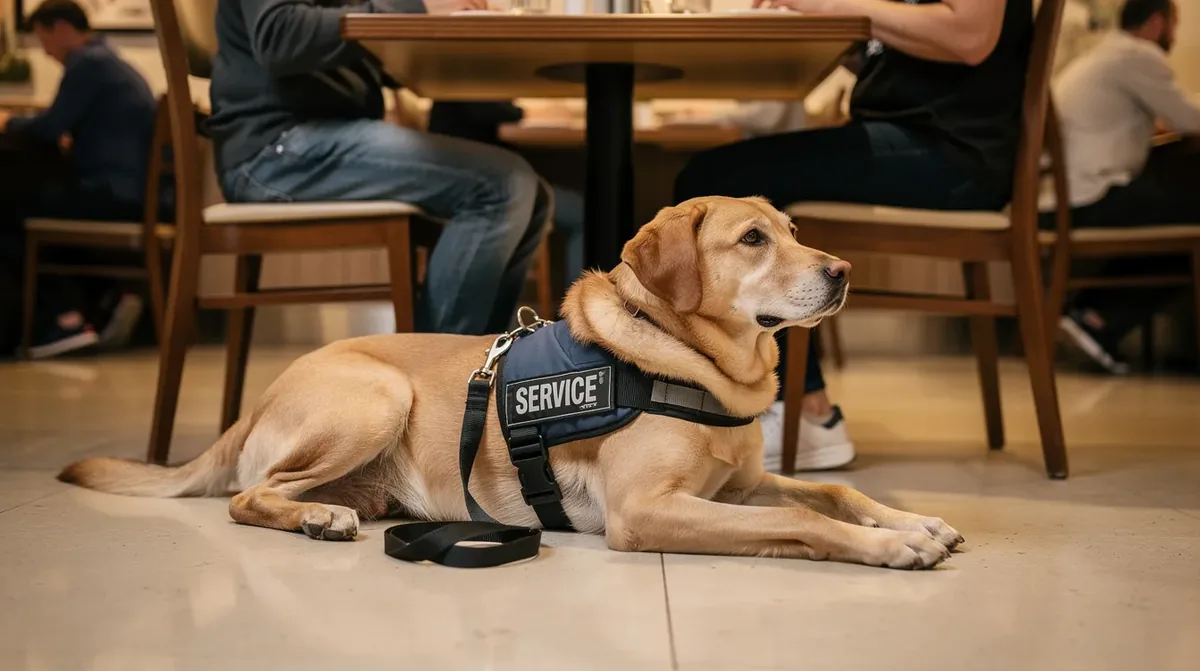
Public access training teaches dogs to behave calmly and safely in public spaces where the general public is present, like grocery stores, restaurants, buses, and medical offices. Public behaviors of service dogs must include remaining calm and controlled in various environments.
Key public access standards:
-
Staying under control on a leash at all times
-
Ignoring food, dropped items, and distractions
-
Remaining calm near children, other animals, and crowds
-
Settling quietly under tables or beside chairs
-
No potty accidents indoors
-
No excessive barking or lunging
Many teams use public access test checklists from nonprofit service dog organizations as training goals. These are not required by federal law but serve as solid benchmarks for whether your dog meets public access readiness.
Socialization helps dogs adapt to various environments and situations. Build difficulty gradually through socialization: expose your dog to quiet parking lots and outdoor seating first, then move to busier indoor spaces and public transportation. Exposing a service dog to diverse environments is essential for training.
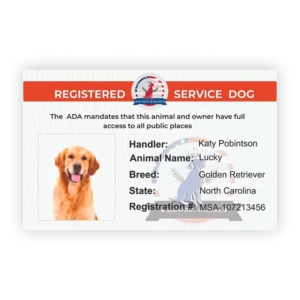
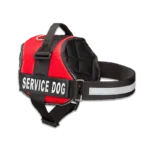
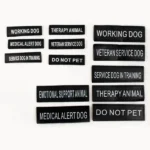
A vest or ID is optional and not required for ADA public access. Some handlers choose to use them to signal that the dog is working, but they add no legal rights and do not replace training.
Legal Requirements and Public Access Rights for Your Service Dog
Understanding your legal requirements and rights matters just as much as the training itself. Here is what you need to know across the three major federal laws.
ADA (Public Access)
The ADA is a federal law, so its public access rules apply nationwide. Under the ADA, covered businesses and government entities must allow a well trained service dog to accompany a disabled handler in areas open to the public. Businesses may only ask two questions to determine if a dog is a service animal:
-
“Is the dog required because of a disability?”
-
“What work or task has the dog been trained to perform?”
Staff may not ask about the nature of the disability, demand a demonstration, or require documentation. The Americans with Disabilities Act does not require certification for service animals, and no official U.S. government registry for service dogs exists. Service dogs are not considered pets under the ADA.
Fair Housing Act (Housing)
Under the Fair Housing Act (42 U.S.C. 3604(f)(3)(B)), housing providers must consider reasonable accommodations for assistance animals, which may include both service dogs and emotional support animals. HUD withdrew its prior assistance animal guidance (FHEO-2020-01 and FHEO-2013-01) effective September 17, 2025, so breed, weight, and pet fee questions now depend on the statute, courts, and state law.
Air Travel
Since January 11, 2021, airlines may treat emotional support animals as pets. Airlines must accept task-trained service dogs, including trained psychiatric service dogs, and may require the DOT Service Animal Air Transportation Form.
Misrepresentation
Misrepresenting a pet as a service dog may violate state law in many states and harms access for legitimate teams who depend on their dogs for essential assistance. Our guide to spotting fake service dog registration scams explains the red flags.
 Resolves 80% of housing & airline access issues instantly
Service Animal Registration
 Instant Digital ID
 Free Shipping
 5-Min Process


How Long Does It Take To Train Your Own Service Dog?
There is no federally mandated duration for training a service dog. How long it takes depends on the dog’s age, previous experience, and the complexity of tasks. For comparison, professional programs that start with puppies spend well over a year on raising alone: Guiding Eyes for the Blind volunteer puppy raisers return the dogs at 16 to 18 months, before formal guide training begins.
Sample timeline (illustrative, not a legal standard):
|
Phase |
Timeframe |
Focus |
|---|---|---|
|
Foundation |
Months 1 to 6 |
Socialization, exposure to common stimuli, basic obedience |
|
Intermediate |
Months 6 to 12 |
Proper training of early task work, public access basics, busier environments |
|
Advanced |
Months 12 to 24 |
Full task reliability, advanced training in stressful situations, proofing across various environments |
Young puppies should not be pushed too hard physically. Focus on gentle exposure and simple cues in the first year, protecting growing joints and avoiding overwhelming stimulation.
Schedule periodic checkpoints with professional trainers to objectively assess progress. If a dog shows persistent fear, aggression, or health issues, it may be kinder and smarter to career-change the dog to a pet role and start with a new candidate. Even purpose-bred program dogs often do not make it: the five organizations in the Duffy and Serpell study reported that training failure rates of 50 to 70% are typical, mostly for behavioral reasons.
Working With Professional Trainers and Programs
When searching for qualified professional trainers, look for:
-
Credentials such as CCPDT certification or IAABC membership
-
A clear positive reinforcement focus
-
Explicit experience with service dog task training and public access training
-
Willingness to let you attend and participate in sessions
Questions to ask a prospective trainer:
-
Do you have experience with psychiatric vs. mobility vs. medical alert dogs?
-
What training methods do you use? How do you handle fearful behavior?
-
Can I observe or attend all sessions?
-
Will you provide a written training program?
Use group classes for basic obedience and manners. Private lessons work best for fine-tuning specific tasks and solving individual issues. Avoid trainers who guarantee that any dog can become a service dog or who rely on harsh tools as the primary method.
Some organizations, like Canine Companions, place fully trained service dogs free of charge, but the application involves several steps, eligibility criteria, and often a wait.
Living and Working With Your Fully Trained Service Dog
Training does not end when the dog is “finished.” Service dogs require ongoing training and reinforcement throughout their lives. Both you and your dog will need regular refresher sessions to keep tasks sharp and public behavior reliable.
Daily care expectations:
-
High-quality diet appropriate for the dog’s size and activity level
-
Regular exercise and mental enrichment
-
Routine veterinary care
-
Scheduled downtime so the dog does not burn out
Set clear rules for when the dog is on duty (in harness or vest) versus off duty at home. Teach family and friends to respect those cues. A working dog should not be petted, distracted, or played with while performing tasks.

In most public places, advocate politely when questioned. Answer allowed questions and report serious access issues when necessary. Plan for the dog’s retirement, including savings for veterinary care and a potential successor, since every service dog eventually retires to pet life.
Emotional Support Animals vs. Service Dogs: What’s the Difference?
Emotional support animals (ESAs) are pets that a licensed health care professional has determined provide comfort by their presence. They are not required to be trained to perform specific tasks.
|
Service Dog |
ESA |
|
|---|---|---|
|
Task training required? |
Yes |
No |
|
ADA public access rights? |
Yes, nationwide |
No |
|
Housing accommodations? |
Yes (FHA) |
May qualify (FHA) |
|
Airline access? |
Yes, with DOT form |
Treated as pets since 2021 |
|
Certification required? |
No |
No (letter from licensed professional) |
ESAs may receive housing accommodations under the Fair Housing Act as assistance animals, but they do not have public access rights to enter most businesses. ESA letters must come from licensed professionals, and some states impose extra rules: California (Health and Safety Code 122318) requires a 30-day client-provider relationship before a provider issues ESA documentation.
If you only need comfort at home rather than public task assistance, an ESA might better match your needs and your dog’s well being than the demands of full service dog work.
References
-
U.S. Department of Justice, Civil Rights Division. ADA Requirements: Service Animals. ADA.gov, 2011 (updated). ada.gov
-
U.S. Department of Justice, Civil Rights Division. Frequently Asked Questions about Service Animals and the ADA. ADA.gov, 2015 (updated). ada.gov
-
Duffy DL, Serpell JA. Predictive validity of a method for evaluating temperament in young guide and service dogs. Applied Animal Behaviour Science 138:99-109, 2012. doi.org
-
42 U.S.C. 3604, Discrimination in the sale or rental of housing. Legal Information Institute, Cornell Law School. law.cornell.edu
-
U.S. Department of Housing and Urban Development. Notification of Withdrawal of Fair Housing and Equal Opportunity Guidance Documents. Federal Register, 2026. federalregister.gov
-
14 CFR 382.75, Service animal documentation (DOT Service Animal Air Transportation Form). Legal Information Institute, Cornell Law School. law.cornell.edu
-
American Kennel Club. Canine Good Citizen (CGC). AKC.org, 2026. akc.org
-
Guiding Eyes for the Blind. Fact Sheet. Guiding Eyes, April 2026. guidingeyes.org
This article is for informational purposes only and is not legal advice.
The content on this website is for informational purposes only and does not constitute professional medical advice, diagnosis, treatment, or legal counsel.
Still Unsure If You Qualify?
Skip the confusion. Take a 3-minute assessment to see what your animal legally needs.
U.S handlers trust MyServiceAnimal

FAQ
Yes. Under the Fair Housing Act, housing providers generally must consider reasonable accommodations for assistance animals, including service dogs, even in “no pets” housing. Your landlord may ask limited questions about your disability and how the dog helps, but they cannot demand ADA certification or federal registration because none exists. Put your accommodation request in writing and check any additional state-level housing laws where you live.
No federal public access test is required by the ADA. Your dog’s legal status depends on your disability and the dog being individually trained to perform tasks. Many handlers use standardized tests from reputable organizations as personal benchmarks to confirm their dog is safe and well behaved in different environments. Treat these tests as best-practice goals rather than legal checkboxes.
Some handlers legitimately work with two dogs when their disabilities require very different task sets, such as mobility assistance plus medical alert. Businesses may ask that both dogs remain under control and could limit numbers if space or safety is a genuine concern. Training and handling two service dogs at once is demanding, and most people are best served by one well trained, multipurpose dog.
A single mistake during training does not automatically disqualify a dog. However, ongoing disruptive behavior, including excessive barking, aggression, or repeated accidents, can lead a business to ask the team to leave under the ADA. Treat incidents as training feedback. Step back to easier environments, work with a trainer, and avoid pushing the dog into situations it is not ready for. Handlers are responsible for keeping their service dog under control and cleaning up any messes.
No U.S. federal or state government maintains an official registry that grants public access rights. Your legal status comes from your disability and your dog’s training, not from a database or certificate. Some handlers choose an optional service dog registration and ID card as a communication tool, but it does not create legal requirements or rights. Avoid sites that promise “legally registered” or “guaranteed approval,” as these claims are misleading. Our guide on how to register a service dog explains what such documents can and cannot do.