Service Dog Requirements: Training, Behavior & Legal Rules Explained
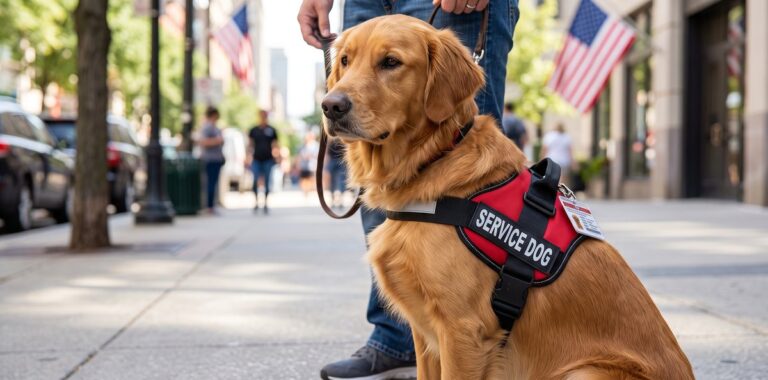
Under the ADA, a service dog is a dog individually trained to do work or perform tasks for a person with a disability. There is no federal requirement for certification, registration, an ID card, or a vest. What matters is the dog’s training and behavior, not paperwork or gear.
Key Takeaways
-
Under federal law, a service dog must be individually trained to perform specific tasks that directly relate to its handler’s disability. No official certification, registration, or service dog vest is required.
-
Dogs whose sole function is comfort or emotional support are not ADA service animals, but they may still qualify as assistance animals under housing rules like the Fair Housing Act.
-
Fully trained service dogs must perform at least one disability-related task, remain under control, and be housebroken to keep their public access rights.
-
A psychiatric service dog is treated the same as any other service dog under federal law, as long as it is task trained for a mental health disability.
-
This article is for general information only and is not legal advice. Consult a qualified attorney or official government sources for guidance on your specific situation.
What Is Legally Required For a Service Dog Under the ADA?
The Americans with Disabilities Act defines a service animal as a dog that is individually trained to do work or perform tasks for a person with a disability. In limited circumstances, covered entities must also permit miniature horses where reasonable.
Three core elements must be present for a dog to qualify as a service animal under the ADA:
-
A qualifying disability. The handler must have a physical, sensory, psychiatric, intellectual, or other mental impairment that substantially limits one or more major life activities.
-
Individual task training. The dog must be trained to perform specific tasks directly related to that disability.
-
Direct benefit to the handler. The tasks must help with the disability itself, beyond general companionship or a calming presence.
Tasks must be directly related to the handler’s disability. A dog that simply “is there” or provides emotional support without trained behaviors does not meet the standard.
“Dogs whose sole function is to provide comfort or emotional support do not qualify as service animals under the ADA.”
U.S. Department of Justice, ADA Requirements: Service Animals
Any breed or size of dog can qualify as a service dog if it meets the training requirements. The ADA does not restrict the breeds that can be service animals.
It helps to understand the broader terms. “Service dogs” are ADA-protected working animals. “Assistance animal” is a wider housing-law term that can also cover emotional support animals. Unlike service animals, emotional support animals provide comfort without specific task training and do not qualify under the ADA.
What Disabilities Qualify You For a Service Dog?
Under the ADA (42 U.S.C. 12102), a disability is a physical or mental impairment that substantially limits one or more major life activities, such as seeing, hearing, walking, concentrating, or caring for oneself. Handlers must have a disability that limits major life activities to qualify for a service dog.
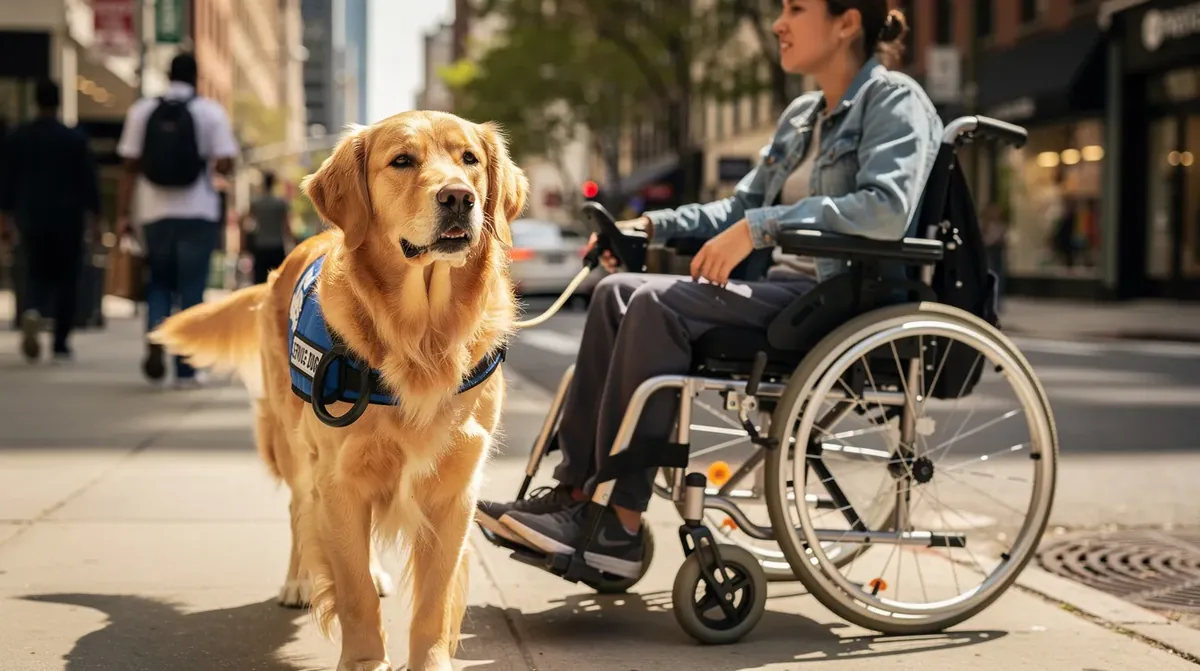
Examples of physical disabilities that may qualify include spinal cord injuries, multiple sclerosis, cerebral palsy, amputations, and significant mobility impairments. Service dogs can provide balance support for individuals with mobility issues or help with retrieving dropped items.
Sensory disabilities also qualify. These include legal blindness or low vision (where guide dogs are most commonly used), deafness, and other hearing impairments. Service dogs can alert individuals who are deaf to sounds like doorbells, alarms, and approaching vehicles.
Psychiatric and cognitive disabilities qualify too. These can include PTSD, major depressive disorder, bipolar disorder, schizophrenia, autism spectrum disorder, and traumatic brain injury. A person with a mental illness or mental health condition can absolutely have a service dog, provided the dog is specially trained for related tasks.
There is no official “approved list” of diagnoses. What disabilities qualify depends on functional limitations, not labels. If an impairment substantially limits daily life and trained tasks can help, a service dog may be appropriate.
Task Training Requirements: What Must a Service Dog Actually Do?
The central requirement under the ADA is task training. A service dog is trained to perform tasks for individuals with disabilities, and those tasks must be specific, trained behaviors that the dog performs on cue or in response to a recognized trigger.
Here are concrete examples organized by disability type:
|
Disability Type |
Example Tasks |
|---|---|
|
Mobility impairments |
Retrieving dropped items, opening doors, bracing for balance, pulling a wheelchair |
|
Visual impairments |
Guiding around obstacles, stopping at curbs, finding exits |
|
Hearing impairments |
Alerting to doorbells, alarms, or a specific person calling the handler’s name |
|
Medical conditions |
Alerting to dangerous blood sugar changes, responding to seizures |
|
Psychiatric disabilities |
Deep pressure therapy for anxiety, interrupting an anxiety attack, grounding during dissociation |
For psychiatric service dogs, tasks might include waking a handler from nightmares, interrupting self-harm behaviors, providing deep pressure therapy during PTSD episodes, or guiding a disoriented handler to an exit. Service dogs perform grounding and deep pressure therapy for anxiety as specifically trained responses, not just by sitting nearby.
Emotional support, comfort, or companionship alone are not considered tasks under the ADA, even if genuinely helpful. A dog performs qualifying work only when it has been trained to perform specific tasks related to a person’s disability.
Fully trained service dogs typically develop both public access skills (good manners, calm behavior) and multiple disability-related tasks. This rigorous training often unfolds over many months of consistent work.

Behavior, Control & Public Access Standards
Public access rights depend on the dog’s behavior. A business can ask a handler to remove a service dog that is out of control when the handler does not take effective action to control it, or if the dog is not housebroken.
Expected behaviors for public access include:
-
Remaining calm and focused in crowds, stores, and restaurants
-
Ignoring food, other patrons, and other animals
-
Minimal or no barking
-
Staying close to the handler
-
Following commands reliably
The dog must be under the handler’s control at all times, typically using a leash, harness, or tether. If those tools interfere with the dog’s task performance or the handler’s disability, voice or hand signals are acceptable alternatives.
Removal can be justified when a dog shows aggression, repeatedly lunges, barks uncontrollably, or toilets indoors. However, other people’s fears or allergies do not justify excluding a service dog.
“Allergies and fear of dogs are not valid reasons for denying access or refusing service to people using service animals.”
U.S. Department of Justice, ADA Requirements: Service Animals
Service dogs must be well-behaved to maintain public access rights. A working animal that cannot behave safely in public spaces loses the protections it would otherwise have.
“Public access tests” are common tools used in professional training programs to evaluate readiness, but the ADA does not require passing any specific test.
Psychiatric Service Dog Requirements vs Emotional Support Animals
A psychiatric service dog is a service dog trained to perform tasks for a person with a mental health disability. Under federal law, psychiatric service dogs have the same rights as any other service dog, as long as they are task trained.
Specific psychiatric tasks include waking a handler from night terrors, interrupting self-harm behaviors, leading the handler out of a triggering environment, reminding the handler to take medication, and performing deep pressure therapy during panic episodes.
Emotional support animals are different. ESAs provide comfort without specific task training. They are not classified as service animals under the ADA and do not have public access rights. The distinction is straightforward: if the dog is not trained to perform tasks, it is not a service animal, regardless of how helpful its presence may be.
Since January 11, 2021, airlines may treat ESAs as pets under updated Air Carrier Access Act rules (14 CFR part 382). Trained psychiatric service dogs, however, still count as service animals for air travel.
“Animal species other than dogs, emotional support animals, comfort animals, companionship animals, and service animals in training are not service animals for the purposes of this part.”
U.S. Department of Transportation regulation, 14 CFR 382.3
Under housing law, both service dogs and other assistance animals (including ESAs) may be requested as a reasonable accommodation. ESA requests are usually supported by a letter from a licensed health care professional, and some states add specific requirements for that provider relationship. Housing accommodations for assistance animals follow different rules than public access.
Paperwork & ID Myths: Do You Need Certification, Registration, or an ID Card?
No official certification is required for service dogs under the ADA. There is no federal or state certification, registration, vest, or ID card requirement. No official U.S. government registry exists.
Many websites sell “registration,” “certificates,” or “licenses” for service dogs or support animals. These products do not create any legal status and do not confer any rights. Service dog status depends entirely on disability and task training, not on purchased documents or gear.
Documentation is used in some specific contexts outside of general public access:
-
Housing: When a disability or the need for the animal is not obvious, a landlord may ask for reliable disability-related information, such as a letter from a licensed health care professional. Some states add rules for ESA documentation: California (Health and Safety Code 122318) requires a 30-day client-provider relationship before a provider issues it.
-
Air travel: Airlines may require the DOT Service Animal Air Transportation Form for trained service dogs.
-
Workplace: Employers may request medical documentation to process a reasonable accommodation request.
ID cards and vests are optional convenience tools. Staff cannot legally require them under the ADA.
 Resolves 80% of housing & airline access issues instantly
Service Animal Registration
 Instant Digital ID
 Free Shipping
 5-Min Process


Public Access Rights in Businesses, Transit & Other Places
Service dogs have broad public access rights under the ADA. A service dog can generally accompany its handler in places open to the public, including restaurants, hotels, retail stores, and public transportation. “No pets” policies do not apply to service animals.
Public access rights cover state and local government services, public transit, and private businesses that serve the public. These protections exist regardless of local rules that prohibit animals generally.
Staff in public accommodations can only ask two questions when the dog’s role is not obvious:
-
Is the service animal required because of a disability?
-
What work or task has the dog been trained to perform?
Staff may not demand medical records, an ID card, or a task demonstration. If a business charges pet deposits or fees, it must waive them for service animals. A service dog also may not be excluded based on assumptions about its breed. Golden retrievers, Labrador retrievers, German shepherds, and smaller breeds all qualify equally if properly trained.
Limited exceptions exist. In hospitals, it may be appropriate to exclude a service animal from operating rooms or burn units, where its presence may compromise a sterile environment. These exceptions must be narrow and justified.

Housing, Travel & Workplace Requirements
Different federal laws apply in housing, air travel, and employment, and their requirements differ from the ADA’s public access rules.
Fair Housing Act: Landlords must consider reasonable accommodations for assistance animals, including service dogs and sometimes ESAs, even where “no pets” policies exist. The relevant statute is 42 U.S.C. 3604(f)(3)(B), with the regulation at 24 CFR 100.204. A landlord does not have to accept an animal whose tenancy would be a direct threat to others or cause substantial physical damage (3604(f)(9)). For more detail, see our guide to service animal housing rights.
HUD withdrew its 2020 and 2013 assistance animal guidance documents (FHEO-2020-01 and FHEO-2013-01) effective September 17, 2025, as announced in the Federal Register on April 6, 2026.
“These documents have been removed from active use and should not be relied upon as authoritative.”
Federal Register, Notification of Withdrawal of Fair Housing and Equal Opportunity Guidance Documents
Breed, weight, and pet fee questions now depend on the statute, court decisions, and state law rather than those withdrawn documents.
Air travel: Since January 11, 2021, airlines may require the DOT Service Animal Air Transportation Form for service dogs. Our guide on how to fly with a service dog covers the details. Trained psychiatric service dogs are recognized as service animals. ESAs can be treated as pets, meaning airlines may charge fees and apply pet policies to them. Handlers should plan ahead to travel safely with proper documentation.
Workplace: Under ADA Title I, which covers employers with 15 or more employees, employers may need to consider allowing a service dog as a reasonable accommodation. Similar behavior, safety, and task requirements apply in the workplace.
Vests, Tags & ID Cards as Optional Tools
A service dog vest, tags, and ID cards are optional and not required by any federal law. No piece of gear “makes” a dog a service dog or guarantees public access.
That said, many handlers find these tools practically helpful:
-
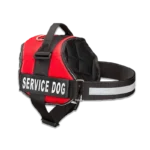
A service animal vest signals to the public that the dog is a working animal, which can reduce unwanted petting and questions from staff
-
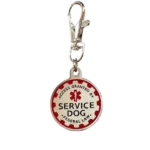
Tags can communicate “do not distract” messages
-
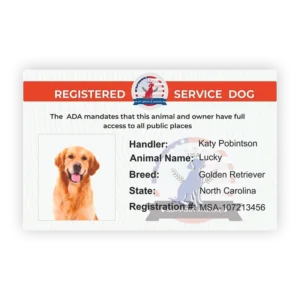
A voluntary ID card, such as the one in an optional service dog registration kit, might include the dog’s name, handler’s name, and a brief task description
These items have no legal force. Any provider that claims its vest, tag, or card guarantees approval or creates legal rights is misleading consumers. Our comparison of real vs fake service dog vests explains what gear can and cannot do.
Because some states regulate misrepresentation of pets as service animals, gear should only be used with legitimately task-trained service dogs. Putting a vest on an untrained pet can carry legal consequences.
How Do You Get or Train a Service Dog?
The ADA permits owner training. There is no requirement to use a professional trainer or a formal training program. Service dog training can be done by professionals or owners.
The typical path to a fully trained service dog looks like this:
-
Selecting a suitable dog. Temperament, health, and willingness to work matter more than breed. Sources include reputable breeders, rescue organizations, and established assistance dog programs.
-
Basic obedience and socialization. The dog learns foundational commands and gets exposure to a wide variety of environments and stimuli.
-
Task training. The dog learns disability-specific tasks through professional training or owner training, often with ongoing support from a professional trainer.
-
Proofing in real-world environments. The dog practices tasks and behavior in increasingly complex public spaces.
Training a service dog usually takes many months of consistent work, often more than a year. Program-trained dogs are expensive to produce: NEADS reports that breeding, raising, training, and matching one of its dogs costs over $55,000 on average. Many nonprofits, including NEADS and Canine Companions, do not charge clients for the dog and cover costs through donations, though wait lists can be long.
Ongoing costs include food, vet visits, and equipment like harnesses and leashes. Owner training can reduce the initial price but requires significant time and skill.
Service dogs in training do not have public access rights under the ADA, which says the dog must already be trained before it can be taken into public places. State laws differ on whether teams in training can enter public places, so check your state’s rules.
State Misrepresentation Laws & Consequences
According to Michigan State University’s Animal Legal and Historical Center, more than half the states have laws that make it a crime to fraudulently claim the right to be accompanied by a service animal. Penalties range from fines to community service and, in some states, possible jail time.
Examples of misrepresentation include:
-
Purchasing an ID card online for an untrained pet and insisting on public access
-
Falsely telling staff that an emotional support animal is a service dog
-
Using a service dog vest on a therapy dog or pet that has not been specifically trained to perform specific tasks related to a person’s disability
Some state penalty examples:
|
State |
Penalty |
|---|---|
|
California (Penal Code 365.7) |
Misdemeanor: up to $1,000 fine, up to six months in county jail, or both |
|
Texas (Human Resources Code 121.006) |
Fine of not more than $300 and 30 hours of community service |
|
Florida (Statutes 413.08) |
Second-degree misdemeanor and 30 hours of community service |
Misuse of service dog labels harms people with disabilities by creating backlash and making businesses more suspicious of legitimate handlers who may then be denied access unfairly.
Use accurate terms for your animal. If your dog is an emotional support animal, call it that. If it is a therapy dog used in therapy animals programs, use that term. If it is a trained service dog, say so. Checking your own state’s statutes or consulting an attorney is the best way to understand local penalties and definitions related to assistance dogs and misrepresentation.
References
-
U.S. Department of Justice, Civil Rights Division. ADA Requirements: Service Animals. ADA.gov, 2011 (updated). ada.gov
-
U.S. Department of Justice, Civil Rights Division. Frequently Asked Questions about Service Animals and the ADA. ADA.gov, 2015 (updated). ada.gov
-
U.S. Department of Housing and Urban Development. Notification of Withdrawal of Fair Housing and Equal Opportunity Guidance Documents. Federal Register, 2026. federalregister.gov
-
42 U.S.C. 3604, Discrimination in the sale or rental of housing. Legal Information Institute, Cornell Law School. law.cornell.edu
-
14 CFR 382.3 and 382.75, Nondiscrimination on the basis of disability in air travel. Legal Information Institute, Cornell Law School. law.cornell.edu
-
U.S. Equal Employment Opportunity Commission. Titles I and V of the Americans with Disabilities Act of 1990. EEOC. eeoc.gov
-
Wisch RF. Table of State Service Animal Laws. Animal Legal and Historical Center, Michigan State University College of Law, 2025. animallaw.info
-
NEADS World Class Service Dogs. Client Fundraising FAQ. NEADS, 2026. neads.org
This article is for informational purposes only and is not legal advice.
The content on this website is for informational purposes only and does not constitute professional medical advice, diagnosis, treatment, or legal counsel.
Still Unsure If You Qualify?
Skip the confusion. Take a 3-minute assessment to see what your animal legally needs.
U.S handlers trust MyServiceAnimal

FAQ
No. The ADA does not require an ID card, certification, or registration for a service dog. Staff may not legally demand documents. Your rights depend on your disability and the dog’s task training, not on paperwork or gear.
No. Emotional support alone does not meet ADA requirements. The dog must be trained to perform at least one specific task related to a disability to qualify as a service dog. A dog that provides only a calming presence is an emotional support animal, not a service animal.
Under federal law, trained psychiatric service dogs have the same public access rights as other trained service dogs. They must perform disability-related tasks and meet behavior standards, just like any other service dog.
Staff can only ask the two ADA questions: whether the dog is required because of a disability, and what tasks it is trained to perform. They cannot request medical records, a diagnosis, or detailed personal information.
No. This article is for general information only. Readers should consult a qualified attorney or official government sources for legal advice about their specific situation.
Training usually takes many months, often more than a year. Producing a program dog is costly (NEADS puts its average at over $55,000 per dog), though many nonprofits place dogs without charging the client. Owner training is permitted under the ADA and can reduce upfront expenses, but ongoing costs for food, veterinary care, and equipment still apply.