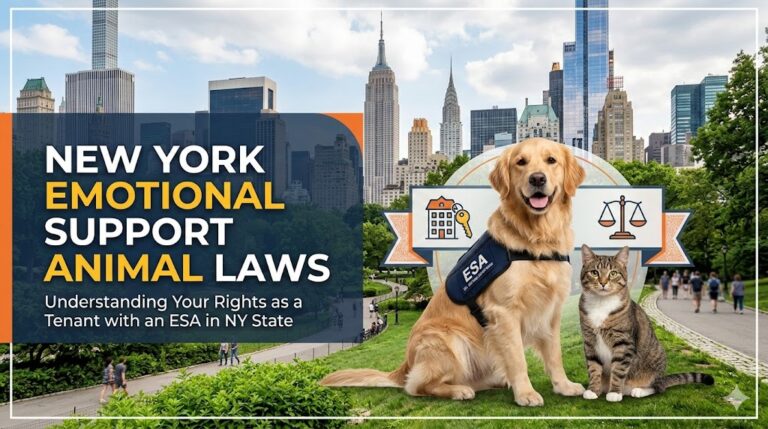
Emotional Support Animal Maryland Laws
Maryland residents with emotional support animals face a shifting legal framework in 2026. A major federal enforcement change, combined with Maryland’s own housing laws, has reshaped how tenants, landlords, and university students handle ESA accommodations across the state. This guide — reviewed by Daniel Butler, JD — breaks down every statute, deadline, and enforcement mechanism that applies to ESAs in Maryland right now.
Whether you rent an apartment in Baltimore, own property in Silver Spring, or attend college in College Park, understanding your rights and obligations under both federal and Maryland state law is essential.
Critical Update: May 2026 HUD Enforcement Memorandum
On May 22, 2026, the HUD Office of Fair Housing and Equal Opportunity (FHEO) issued an enforcement memorandum that fundamentally changed how the federal government handles ESA complaints. This is the single biggest shift in ESA policy since the 2020 guidance — and it directly affects every Maryland ESA holder and housing provider.
What Changed in the May 2026 HUD Guidance
The memorandum rescinded both the 2013 and 2020 HUD guidance documents that previously instructed housing providers to accommodate emotional support animals under the Fair Housing Act. Under the new enforcement posture:
- FHEO will only find reasonable cause for assistance animal complaints involving individually trained service animals — not untrained ESAs.
- All open ESA complaints have been sent to the Acting Deputy Assistant Secretary for case-by-case review.
- HUD intends to harmonize its FHA enforcement with the ADA’s service animal standard, which requires task-specific training.
How This Affects Maryland ESA Holders
Here’s what the memo does not do: it does not amend or repeal the Fair Housing Act itself. The FHA’s text has not changed. Private lawsuits under the FHA remain fully available to Maryland tenants whose ESA requests are wrongfully denied.
Here’s what it does do: if you file a federal HUD complaint about an ESA denial in Maryland, FHEO is unlikely to investigate or find reasonable cause in your favor. The federal administrative path has effectively narrowed to trained service animals only.
For Maryland residents specifically, this makes the state-level enforcement route through the Maryland Commission on Civil Rights (MCCR) more relevant than ever. Maryland’s own housing discrimination statute — State Government Article §20-706 — still requires reasonable accommodations for individuals with disabilities, and the MCCR enforces it independently of HUD’s posture.
Maryland Housing Laws for Emotional Support Animals
Maryland’s ESA housing protections come from two overlapping sources: the federal Fair Housing Act and the state’s own anti-discrimination statute. Both apply to most rental housing in the state.
Federal Fair Housing Act (FHA) Protections
The Fair Housing Act classifies emotional support animals as “assistance animals” and requires housing providers to make reasonable accommodations for tenants with disabilities. Under the FHA, a landlord must:
- Waive no-pet policies for a qualified ESA
- Exempt the tenant from pet deposits and pet rent
- Allow the ESA in breed- or weight-restricted housing
The FHA applies to nearly all housing in Maryland, with limited exceptions for owner-occupied buildings with four or fewer units and single-family homes rented without a broker.
Even with the 2026 HUD enforcement memo, the FHA’s statutory protections remain intact. A Maryland tenant can still bring a private lawsuit or pursue a state-level complaint for an unlawful ESA denial.
Maryland State Government Article §20-706
Maryland’s own housing discrimination law is found in State Government Article §20-706. This statute makes it unlawful to refuse to make reasonable accommodations in rules, policies, practices, or services when such accommodations are necessary for a person with a disability to have equal opportunity to use and enjoy a dwelling.
This is Maryland’s state-level analog to the FHA’s reasonable accommodation requirement. It is enforced by the Maryland Commission on Civil Rights (MCCR), not by HUD. Because it’s a state statute, HUD’s 2026 enforcement memo has zero impact on MCCR’s ability to investigate and penalize ESA housing discrimination.
Penalties under MCCR enforcement can reach up to $10,000 for a first offense, with higher penalties for repeat violations.

 Resolves 80% of housing disputes instantly
Emotional Support Animal Registration
 Instant Digital ID
 Free Shipping
 5-Min Process


What Maryland Landlords Can and Cannot Ask
Maryland landlords who receive an ESA accommodation request have specific rights — and strict limits. Here’s a clear breakdown:
| Landlords CAN | Landlords CANNOT |
|---|---|
| Request documentation from a licensed healthcare provider | Ask about the nature or severity of the tenant’s disability |
| Verify that the provider is licensed in the tenant’s state | Require specific diagnoses or medical records |
| Confirm a disability-related need for the animal | Demand certification, registration, or training documentation |
| Deny a request if the animal poses a direct threat to safety | Charge pet deposits, pet rent, or pet fees for a verified ESA |
| Deny a request if the animal would cause substantial property damage | Impose breed, weight, or species restrictions on a verified ESA |
A Maryland landlord can deny an ESA only if the animal would pose a direct threat that cannot be reduced through other accommodations, or if the accommodation would impose an undue financial or administrative burden.
Pet Fees, Deposits, and No-Pet Policies
Under both federal and Maryland law, an emotional support animal is not a pet. This means:
- No pet deposit can be charged for an ESA.
- No monthly pet rent can be charged for an ESA.
- No-pet policies must be waived for an approved ESA.
- The tenant remains liable for any actual damage the ESA causes beyond normal wear and tear.
If a Maryland landlord charges you a pet deposit after receiving a valid ESA letter, that charge violates both the FHA and Maryland State Government Article §20-706. You can file a complaint with the MCCR or pursue a private lawsuit.
ESA Letter Requirements in Maryland
An ESA letter from a licensed healthcare provider is the only document that legally substantiates your right to an emotional support animal in housing. There is no registry, certification, or ID card that provides any legal standing.
What Makes a Valid ESA Letter
A legitimate ESA letter in Maryland must include:
- The provider’s professional letterhead with license number
- The provider’s license type, state, and expiration date
- A statement that the patient has a disability as defined by the FHA
- A statement that the ESA provides disability-related therapeutic benefit
- The date of issuance (letters are typically valid for one year)
- The provider’s signature
The letter does not need to disclose your specific diagnosis, list your medications, or include your therapy notes.
Who Can Write an ESA Letter in Maryland
In Maryland, the following licensed professionals can write a valid ESA letter:
- Licensed Clinical Professional Counselors (LCPCs)
- Licensed Clinical Social Workers (LCSWs)
- Psychiatrists (MDs or DOs)
- Licensed Psychologists (PhDs or PsyDs)
- Psychiatric Nurse Practitioners (PMHNPs)
- Licensed Marriage and Family Therapists (LMFTs)
- Primary Care Physicians (MDs or DOs)
The provider should be licensed in Maryland or, for telehealth evaluations, licensed in the state where the patient is located at the time of the session.
Beware of Fake ESA Registrations and Certificates
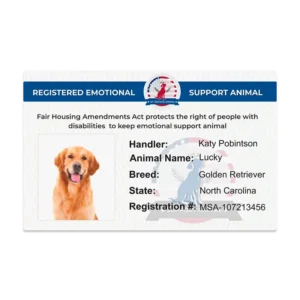
There is no official ESA registry — not at the federal level, not in Maryland. Websites selling ESA registration certificates, ID cards, or vest-and-badge packages are selling decorative items with zero legal authority.
A landlord who sees a “registration” document instead of a proper ESA letter from a licensed provider has grounds to request legitimate documentation. Tenants who rely on fraudulent paperwork risk having their accommodation request denied.
Service Animals vs. Emotional Support Animals in Maryland
The legal distinction between service animals and ESAs matters enormously in Maryland — especially with the HB 384 legislation that drew a hard line between the two categories.
Legal Definitions and Key Differences
| Category | Service Animal | Emotional Support Animal |
|---|---|---|
| Federal law | ADA (Americans with Disabilities Act) | FHA (Fair Housing Act) |
| Training required | Yes — task-specific training | No training required |
| Species | Dogs only (miniature horses in some cases) | Any species with a reasonable accommodation |
| Public access | Yes — restaurants, stores, hotels, transit | No — housing only |
| Housing rights | Yes | Yes (with valid ESA letter) |
| Air travel | Yes (DOT ACAA) | No (since January 2021) |
| Maryland criminal protection | Yes (Criminal Law §10-626) | No specific statute |
Learn more about how these categories compare in our full service animal vs. emotional support animal breakdown.
Maryland Disability Service Animal Program (HB 384)
Maryland House Bill 384 established the Maryland Disability Service Animal Program to help individuals with disabilities obtain trained service animals. The legislation explicitly excludes animals that provide only emotional support, well-being, comfort, or companionship.
This distinction matters because HB 384 codifies in Maryland law the idea that emotional support animals and trained service animals occupy different legal categories. While ESAs retain housing protections under the FHA and §20-706, they do not qualify for the state-funded service animal assistance program.
ESAs in Maryland Workplaces and Universities
Employment and Workplace Rights
Maryland law does not require employers to allow emotional support animals in the workplace. The ADA governs workplace accommodations, and under the ADA, only trained service animals qualify for access to places of public accommodation and employment.
That said, an employee with a disability may request an ESA as a reasonable accommodation under the ADA’s interactive process. The employer is not obligated to grant it, but they are required to engage in a good-faith discussion about possible accommodations. Some Maryland employers voluntarily permit ESAs as part of workplace wellness programs.
College and University Housing Accommodations
The FHA applies to university-owned housing. Maryland students living in campus residence halls at schools like the University of Maryland (UMD), Johns Hopkins University, Towson University, UMBC, Loyola University Maryland, and MICA can request ESA accommodations through their school’s disability services office.
Most Maryland universities require:
- An ESA accommodation request submitted through the Office of Accessibility and Disability Services (or equivalent)
- A valid ESA letter from a licensed mental health provider
- Completion of the school’s animal-in-housing agreement
- Current vaccination records for the animal
The 2026 HUD enforcement memo creates uncertainty for campus housing offices. Some universities may tighten their ESA policies in response to the changed federal stance, while others may maintain existing accommodation practices. If your Maryland university denies your ESA request, contact the school’s Office of Civil Rights or file a complaint with the MCCR.
ESA Fraud and Misrepresentation in Maryland
No Specific Criminal Statute in Maryland
Unlike more than 30 other states, Maryland does not have a specific criminal law penalizing the misrepresentation of a pet as an emotional support animal or service animal. There is no Maryland statute that criminalizes purchasing a fake ESA letter, wearing a fraudulent service animal vest, or falsely claiming a disability to obtain an animal accommodation.
This gap in Maryland law means that enforcement against ESA fraud relies on general fraud statutes, lease violation provisions, and civil liability rather than a targeted criminal penalty.
Civil Consequences and Lease Violations
Even without a dedicated fraud statute, misrepresenting a pet as an ESA in Maryland can lead to:
- Lease termination — landlords can evict tenants who submitted fraudulent ESA documentation
- Civil liability for damages — the tenant may owe back-rent for waived pet fees and any property damage
- Loss of credibility — future accommodation requests may be scrutinized more heavily
- Federal wire fraud exposure — if a fraudulent ESA letter was obtained through an interstate online scheme
Maryland Criminal Law §10-626 (Service Animal Protections)
While Maryland lacks an ESA fraud law, it does have Criminal Law §10-626, which protects service animals specifically. Under this statute:
- Killing or injuring a service animal: up to 2 years imprisonment and/or a $2,500 fine, plus full restitution
- Interfering with a service animal: up to 1 year imprisonment and/or a $1,000 fine
These protections apply only to trained service animals — not ESAs. However, if someone interferes with or harms any animal, general Maryland animal cruelty statutes (Criminal Law §10-604) may still apply.

ESA Air Travel Rules for Maryland Residents
Since January 2021, U.S. airlines are no longer required to accommodate emotional support animals in the cabin. The Department of Transportation revised its Air Carrier Access Act (ACAA) rules to recognize only trained psychiatric service dogs for in-cabin accommodations.
Maryland residents flying out of BWI Marshall, Reagan National, or Dulles should be aware that:
- ESAs may be treated as pets and subject to airline pet policies and fees
- Only trained psychiatric service dogs fly free in the cabin under ACAA
- Airlines may require DOT service animal forms completed 48 hours before departure
Guide for Maryland Landlords: Handling ESA Requests
The 2026 HUD memo has created confusion among Maryland landlords about their obligations. Here is a step-by-step process for handling ESA accommodation requests correctly under current law.
Step-by-Step Verification Process
- Receive the request in writing. The tenant should provide an ESA letter from a licensed healthcare provider.
- Verify the provider’s license. Check with the Maryland Department of Health or the relevant licensing board. Confirm the license is current and the provider’s scope of practice includes mental health treatment.
- Confirm the letter’s content. It should state the tenant has a disability and the ESA provides disability-related benefit. You may not ask for the specific diagnosis.
- Respond within 10 business days. While Maryland law does not specify an exact deadline, HUD guidance has historically recommended prompt responses. Unreasonable delays can constitute a denial.
- Approve or deny with documented reasoning. If denying, cite a specific legal basis — direct threat, undue burden, or inadequate documentation. Generic denials invite complaints.
What Landlords Should NOT Do
- Do not refuse to engage with the request because of the HUD memo — Maryland state law still applies
- Do not charge pet deposits or pet rent after approving an ESA
- Do not impose breed restrictions on approved ESAs
- Do not require the tenant to use a specific ESA letter provider
- Do not retaliate against a tenant who requests an ESA accommodation
Maryland landlords who violate these rules face MCCR complaints carrying penalties of up to $10,000 for a first offense. Consult a Maryland attorney if you’re unsure about a specific request.
How to File an ESA Housing Discrimination Complaint in Maryland
If your ESA accommodation request is wrongfully denied, you have two filing options: state and federal.
Maryland Commission on Civil Rights (MCCR)
The MCCR is the primary enforcement body for housing discrimination claims in Maryland. Given the 2026 HUD enforcement shift, filing with the MCCR may now be the stronger path for ESA-related complaints.
How to file:
- Visit the MCCR intake page or call the office directly
- Complete the intake questionnaire describing the discrimination
- Submit supporting documentation (your ESA letter, correspondence with the landlord, lease terms)
- MCCR assigns an investigator and contacts the housing provider
- Investigation typically includes interviews, document review, and mediation attempts
- If a violation is found, the MCCR can impose civil penalties and order corrective action
MCCR Contact Information:
| Phone | 410-767-8600 |
| Toll-Free | 1-800-637-6247 |
| [email protected] | |
| Maryland Relay | 7-1-1 |
| Fax | 410-333-1841 |
| Address | 6 Saint Paul Street, Suite 900, Baltimore, MD 21202-1631 |
| Hours | Monday – Friday, 9:00 AM – 5:00 PM |
| Filing Deadline | Within 300 days of the discriminatory act |
You can also contact the Maryland Attorney General’s Office Civil Rights Division at 410-576-6300 (or toll-free 888-743-0023) for guidance, or reach Disability Rights Maryland for legal assistance.
HUD Federal Complaint Process
You can still file a federal complaint with HUD at 1-800-669-9777 or through the HUD online portal. However, based on the May 2026 enforcement memo, FHEO is unlikely to find reasonable cause for complaints involving untrained emotional support animals. Federal complaints involving trained service animals remain fully viable.
Filing with both the MCCR and HUD simultaneously is possible. The agencies have a work-sharing agreement and will coordinate to avoid duplicate investigations.
References and Sources
- MD State Government Article §20-706 — Housing Discrimination
- MD Criminal Law §10-626 — Service Animal Interference Penalties
- HB 384 — Maryland Disability Service Animal Program
- HUD FHEO-2020-01 — Assistance Animals (Rescinded May 2026)
- Maryland Commission on Civil Rights (MCCR)
- HUD — File a Fair Housing Complaint Online
- 42 U.S.C. §§ 3601–3619 — Fair Housing Act
References
- 1.
- 2.
- 3.
- 4.
The content on this website is for informational purposes only and does not constitute professional medical advice, diagnosis, treatment, or legal counsel.
Still Unsure If You Qualify?
Skip the confusion. Take a 3-minute assessment to see what your animal legally needs.
U.S handlers trust MyServiceAnimal

FAQ
No. Under the Fair Housing Act, landlords cannot mandate that emotional support animals wear specific vests, ID badges, or collars. The only documentation they can legally require is your valid ESA letter from a licensed healthcare provider.
While the FHA does not strictly limit ESAs to dogs and cats, landlords can legally deny reasonable accommodation requests for unique or exotic animals if they pose a safety or public health risk. Standard domesticated animals (dogs, cats, small birds, rabbits, rodents) are generally protected.
Yes. For housing purposes, most property managers and landlords require an ESA letter to be dated within the last 12 months. It is highly recommended to renew your consultation with your licensed mental health professional annually to maintain your housing protections.
Absolutely. While landlords cannot charge upfront pet fees, pet deposits, or monthly pet rent, you are entirely responsible for any damages your ESA causes to the property. Landlords can deduct repair costs from your standard security deposit or bill you directly.
Yes, you can have more than one ESA, provided your licensed mental health professional explicitly states in your ESA letter that each specific animal is necessary to alleviate different symptoms of your mental health condition. However, landlords may push back if the number of animals creates an unreasonable burden for the specific dwelling size.